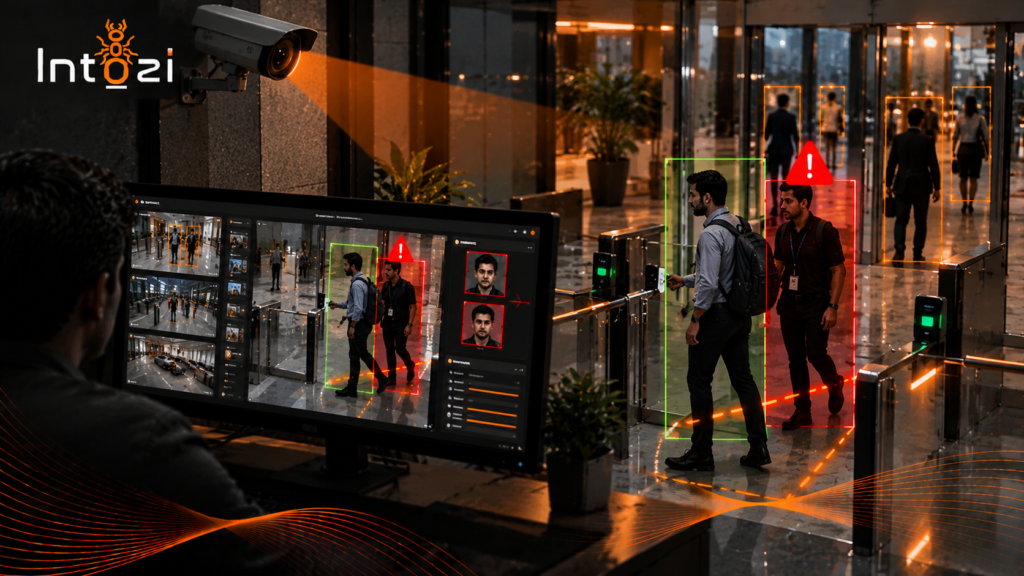
Existing CCTV cameras already provide visibility across entrances, restricted areas, offices, and other controlled locations, but conventional monitoring often depends on people noticing suspicious activity. Can AI Tailgating Detection Work With Existing CCTV Systems? In many environments, AI video analytics can process feeds from existing cameras to identify situations where an unauthorized person follows an authorized individual through a secured entry point.
How AI Tailgating Detection Works With Existing CCTV
AI-based detection uses computer vision to analyze live video feeds and identify movement patterns around controlled entry points. Instead of requiring security teams to continuously watch screens, an AI system can recognize when multiple people pass through an entrance in a way that may indicate tailgating or piggybacking.
A typical setup can involve:
- Existing IP cameras covering doors, gates, or access points
- AI video analytics processing the camera feed
- Detection of multiple people entering during a single authorized access event
- Real-time alerts for potentially unauthorized entry
- Event records that can support later investigation
This approach can make existing surveillance infrastructure more useful without requiring every camera to be replaced.
Can Existing CCTV Detect Tailgating and Piggybacking
Traditional CCTV records what happens, but identifying tailgating manually requires continuous observation and depends heavily on the attention of security personnel. AI changes this workflow by analyzing video automatically and identifying patterns associated with multiple people passing through a controlled access point.
With suitable camera positioning and image quality, AI tailgating detection software can analyze entrances and provide alerts when a possible violation is detected. The exact performance depends on factors such as camera angle, lighting, crowd density, entrance design, and the visibility of people within the camera frame.
What Is Needed to Add AI Tailgating Detection
Adding tailgating detection software to an existing CCTV environment generally starts with evaluating the available camera feeds and the areas that require monitoring. Not every existing camera will be equally suitable, so placement and coverage should be reviewed before deployment.
Important considerations include:
- Clear visibility of the entrance or access point
- Appropriate camera positioning
- Sufficient video resolution
- Stable camera streams
- Defined areas where access events need to be analysed
- Integration requirements with access control systems
These factors help determine whether existing infrastructure can support reliable AI-based detection.
AI Access Control Analytics for Unauthorized Entry
Tailgating is only one type of access-related event that can be analyzed through video. AI access control analytics can provide additional visibility into activity around restricted entrances, helping organizations identify potentially unauthorized movement and unusual access patterns.
When combined with access credentials or entry events, video analytics can provide additional context around who appears to enter an area and how many people pass through an access point. This can complement conventional access control rather than replacing it.
How Intozi Ikshana Supports AI-Based Tailgating Detection
Intozi’s Ikshana platform can process video feeds and apply AI-powered analytics to security and operational scenarios. For tailgating use cases, the platform can analyze relevant camera feeds to identify movement around monitored entry points and generate event-based intelligence.
The approach can support organizations looking at AI piggybacking detection software, tailgating detection system capabilities, and broader video-based security analytics while continuing to work with existing surveillance infrastructure where the camera feeds meet the required conditions.
Why AI Can Reduce Manual CCTV Monitoring
Continuous CCTV monitoring can become difficult when security teams have to observe numerous screens simultaneously. Important events may be missed, particularly during busy periods or when multiple entrances need attention. AI can shift this process from constant observation toward event-based monitoring by identifying potentially relevant incidents and bringing them to the attention of security teams. Intozi, through its Ikshana platform, supports this approach by applying AI video analytics to existing camera feeds, helping organizations add automated intelligence to security monitoring without relying entirely on manual observation.
Frequently Asked Questions
Can AI tailgating detection work with existing CCTV?
Yes, AI tailgating detection can work with existing CCTV when the cameras provide suitable coverage, image quality, positioning, and stable video feeds. The AI software analyses the camera stream rather than requiring the camera itself to contain the detection technology. However, an assessment of the existing CCTV setup is important because poor angles, blocked views, insufficient resolution, or difficult lighting conditions can affect detection performance.
Do I need to replace my existing CCTV cameras for tailgating detection?
Not necessarily. In many deployments, existing IP cameras can provide the video input required by an AI-based detection platform. Whether replacement is necessary depends on the camera specifications and the particular entrance being monitored. If the existing camera provides a clear and useful view of the access point, software-based analytics may be added without replacing the entire surveillance infrastructure.
How does AI detect tailgating through CCTV?
AI analyses video from the monitored entrance and identifies movement patterns involving people entering or passing through a controlled area. Depending on the deployment, the system can analyze the relationship between an access event and the number of people moving through the entrance. When the observed behavior matches configured detection conditions, an alert or event can be generated for security teams to review.
What is the difference between tailgating and piggybacking detection?
“Tailgating” and “piggybacking” both describe situations where an unauthorized person gains access by following an authorized person through a controlled entry point. The terms are sometimes used interchangeably, although organizations may define them differently based on their security procedures. AI-based unauthorized access detection software can analyze video activity around access points to identify potentially unauthorized entry patterns.
Can AI access control software work alongside existing access control systems?
Yes. AI access control software can complement existing access control infrastructure by adding video-based context to credential-based events. For example, an access system may record that a valid credential was used, while video analytics can analyze what happened immediately around that entry. Combining these sources can provide security teams with additional information when investigating potential access violations.