Anyone who works in a high-volume wash house will tell you the washing machines are never the real problem. The real bottleneck that messes up the daily schedule is always on the drying floor. If you want to keep large loads of wet linens moving fast out the door, you need heavy-duty Commercial Dryers that really know how to move air.
Most people think the best way to make a machine dry clothes faster is to make it hotter. But cranking up the gas burner is a bad idea for expensive textiles. The real trick to getting a huge load of thick terrycloth towels dry is air velocity, not just roasting them in a metal drum.
Industrial machines have huge blower fans that suck heat through the tumbling clothes at amazing speed. The air moves fast enough to pull the moisture out of the material and drive it right out the exhaust vent. The linens just sit in a puddle of their own steam and bake without that aggressive airflow.
The type of heat source is completely dependent on the building you are operating out of. Gas units are typically the go-to because they fire up instantly and gas is relatively cheap in most cities. But if you are in a high-rise, or a hospital where tapping a gas line is impossible, steam-heated coils or heavy electric elements is the way to go.
Internal moisture sensing is the biggest game changer for the modern machines. The older ones had simple egg-timer dials; you’d set it for forty minutes and it baked for forty minutes, even if the clothes were dry after twenty. That was a huge waste of utility money every single day.
Today, modern sensors continuously measure humidity inside the spinning cylinder. As soon as the load reaches the desired dryness, the burner is shut off and the machine tumbles the load for a cool-down period. This prevents workers from accidentally deep-frying thousands of dollars’ worth of expensive hotel sheets.
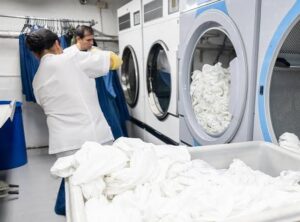
In modern machine design too, the physical health of the staff is a major concern. Pulling hundreds of pounds of wet cotton out of a drum will destroy the worker’s lower back in time. Newer machines have huge doors and even tilt forward on hydraulics so that gravity does most of the heavy lifting.
But you can’t ignore maintenance on these monsters. During a shift, you have to scrape the lint screens clean all the time. If that exhaust vent gets plugged with lint, the hot air backs up, the machine overheats and you have a very real fire hazard inside the building.
A good exhaust setup keeps the actual workroom from becoming a sauna as well. All that hot, humid air is pushed outside through rigid ductwork, keeping the floor temperature bearable for the crew. A comfortable staff moves much faster than a crew who are sweltering in a damp, miserable room.
Conclusion:
The key to industrial-scale drying is to move moisture as fast as possible, without destroying the fabric. Smart airflow engineering and auto-sensing technology help to keep utility bills low, and avoid costly textile damage. When the dry side of the floor is running well, the whole facility hits its daily numbers with no sweat.