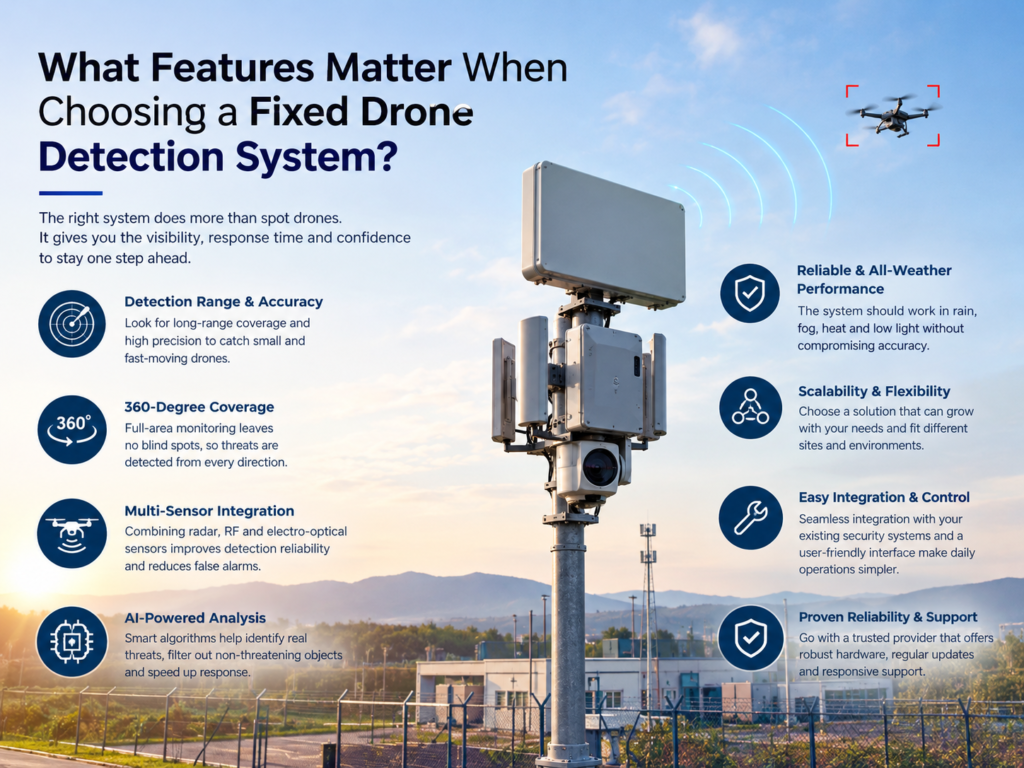
Choosing a fixed drone detection system requires evaluating detection range, sensor technology, coverage, alert accuracy, integration options, and environmental durability. The right system helps organizations monitor restricted airspace, identify potential drone activity, and respond to security concerns. Comparing these features before purchasing can help ensure the system meets the site’s operational requirements and long-term security needs.
1. Which Detection Technology Does the System Use?
Detection technology is one of the most important factors when evaluating a fixed drone detection system. Different sensors identify drones in different ways, and each approach has advantages and limitations.
Radio-frequency (RF) detection monitors signals associated with drone communications, such as control links or video transmissions. A fixed anti drone sensor using RF technology can help identify compatible drones without relying on visual confirmation.
However, RF detection may have limitations when a drone operates autonomously, uses unfamiliar protocols, or does not emit detectable radio signals. Radar and electro-optical or infrared cameras can provide complementary detection capabilities in these situations.
Before selecting a system, determine which drone types and operating conditions it is designed to detect.
2. How Important Is Detection Range and Coverage?
Detection range determines how far away a system may identify a potential drone, while coverage describes the area it can monitor. Both factors influence how effectively the system protects a facility.
When assessing coverage, consider the site’s size, surrounding terrain, nearby buildings, vegetation, and potential sources of interference. Physical obstructions can affect RF signals, while camera-based systems may require a clear line of sight.
Ask manufacturers for documented performance figures and clarify the conditions under which those figures were measured. A stated maximum range should not be treated as a guarantee of detection in every environment.
3. Can the Fixed Anti Drone Sensor Identify Different Drone Types?
Not all detection systems recognize the same drones. Some RF sensors can identify known communication protocols or match detected signals against supported device profiles. Others may report signal characteristics without identifying the exact drone model.
When comparing a fixed anti drone sensor, ask whether it supports the drone models, frequencies, and communication protocols relevant to your security requirements.
Also distinguish between detection and identification. Detecting a suspicious signal does not necessarily confirm that a drone is present, and identifying a drone model may not establish the operator’s identity or intent.
4. How Does the System Manage False Alarms?
False alarms can distract security teams and delay responses to genuine threats. A reliable detection system should provide useful information to help operators assess alerts and distinguish potential drone activity from unrelated signals.
Important features to evaluate include:
- Signal classification and filtering
- Configurable alert thresholds
- Event logging and historical records
- Clear information about detected signals
- Options to correlate alerts with other sensors
Ask for performance data from environments similar to the intended installation. Real-world testing can help determine whether the system delivers an acceptable balance between detection sensitivity and false-alarm rates.
5. Does the System Integrate With Existing Security Infrastructure?
A fixed drone detection system is often more useful when it works with an organization’s existing security operations. Integration may allow alerts to appear in a central monitoring platform alongside camera feeds, access control events, and other sensor information.
Before purchasing, check compatibility with the site’s security management software, network infrastructure, alerting systems, and any planned radar or camera integrations.
Also confirm whether the system supports the required communication interfaces, user permissions, remote monitoring, and reporting functions. Integration requirements should be documented before installation to reduce compatibility problems.
6. Can the System Operate Reliably Outdoors?
Fixed systems installed at airports, industrial facilities, utilities, and other outdoor sites may face changing temperatures, rain, dust, humidity, and vibration.
Review the equipment’s ingress protection rating, operating temperature range, mounting requirements, and environmental certifications. For installations in exposed locations, verify that the enclosure, connectors, power supply, and network equipment are suitable for local conditions.
Long-term reliability also depends on maintenance access, software updates, equipment diagnostics, and the availability of technical support.
7. What Cybersecurity and Data Protection Features Are Available?
Because a fixed drone detection system may connect to a facility’s network, cybersecurity should be part of the purchasing decision.
Look for features such as:
- Role-based access controls
- Secure administrator authentication
- Encrypted communications where supported
- Security logging and audit records
- Regular firmware and software updates
- Clear procedures for vulnerability reporting
Organizations should also understand what data the system collects, how long records are retained, and whether information is shared with external services. These details are especially important for sensitive facilities and regulated environments.
8. What Should You Consider Before Installation?
Installation planning helps ensure the sensor provides useful coverage and can be maintained throughout its service life.
Evaluate mounting locations, power and network availability, physical obstructions, and access for maintenance. For RF-based systems, local radio-frequency conditions may also affect performance.
A site survey can help identify coverage gaps and establish suitable installation positions. After installation, conduct acceptance testing under realistic conditions and document the results. Establish a maintenance schedule to check equipment health, review software updates, and verify that alerts reach the appropriate personnel.
Frequently Asked Questions
What is a fixed drone detection system?
A fixed drone detection system is equipment installed at a designated location to monitor potential unmanned aerial vehicle activity. Depending on its technology, it may use RF sensing, radar, cameras, or a combination of sensors.
What is the purpose of a fixed RF drone detector?
A fixed RF drone detector monitors radio-frequency signals associated with supported drone communications. It can help security teams identify potential drone activity, although performance depends on the drone’s communications, supported protocols, and local RF conditions.
Is RF detection enough to protect a facility?
Not in every situation. RF detection may not identify drones that do not emit detectable signals. Depending on the risk assessment, organizations may benefit from combining RF sensors with radar or camera-based systems.
How can organizations compare fixed anti-drone sensors?
Compare documented detection performance, supported protocols, coverage, false-alarm rates, integration capabilities, environmental ratings, cybersecurity controls, maintenance requirements, and total ownership costs.
Conclusion
The best fixed drone detection system is one that matches the site’s security risks, coverage requirements, and operating environment. Organizations should assess detection technology, range, identification capabilities, alert accuracy, integration, durability, and cybersecurity before making a decision. A well-planned installation and ongoing performance testing can help a fixed RF drone detector deliver dependable monitoring and support a more coordinated security response.