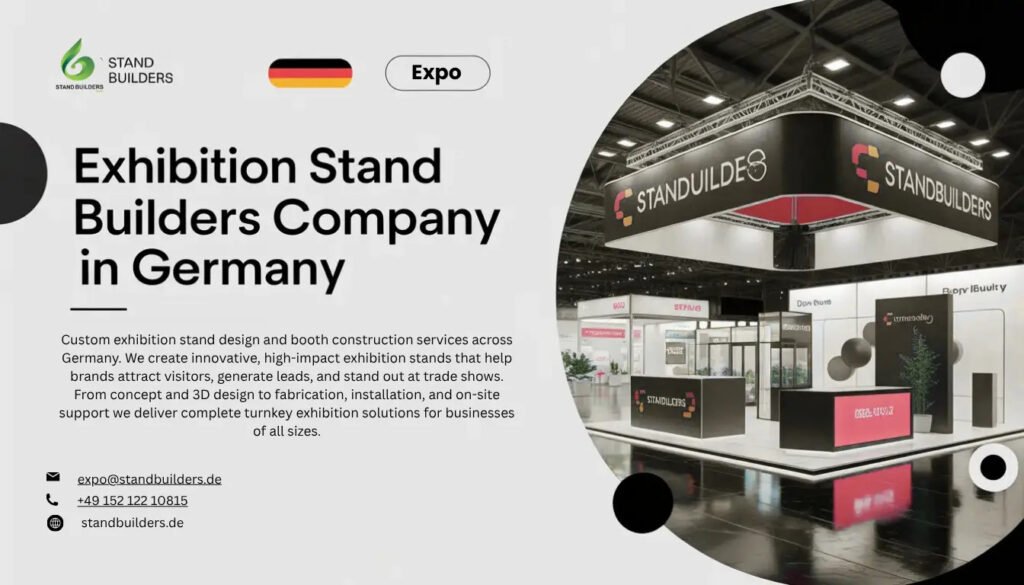
The exhibition industry in Germany serves as an important meeting place for companies that wish to show their products, investigate new markets, and establish professional relationships. Trade fairs in Germany covering fields such as technology and engineering, healthcare, the automotive sector, manufacturing and the consumer sector draw in exhibitors and visitors from many different international markets.
Successful participation involves more than just reserving space for an exhibition. A business must think about the way its stand will operate, the manner in which visitors will interact with it, and the effectiveness with which it will communicate the company’s identity in a crowded exhibition hall.
That is why businesses usually start looking into a company that builds exhibition stands in Germany well in advance of the event. If companies understand the basic principles of exhibition planning, they will be able to form clearer expectations and make more practical decisions.
Why German Trade Fairs Require Careful Preparation
German exhibitions are usually on a big scale, with large halls housing a great number of competing brands. Since visitors usually have only a limited amount of time to look at the various stands, the first impressions they form are especially important.
A stand should therefore be able to quickly communicate its purpose; effective visual branding, a well-organized display of products, easy access to information, and an attractive arrangement can help visitors to understand what a company has to offer.
The way in which you prepare also matters since exhibition sites have specific technical and operational needs; regulations concerning construction, electrical installations, fire safety, access, hanging parts, and the timing of installations can affect the eventual stand design.
A design which appears effective on paper might need to be altered if it doesn’t match the technical conditions of the venue.
Defining the Purpose of an Exhibition Stand
Before choosing a design, businesses must decide what they would like visitors to do.
A software company may wish for visitors to have the opportunity to see a live demonstration of its product, while a manufacturing company might require space for its machinery or technical samples and a consulting business might prefer private conversations over large product displays.
The fact that there are differences has a direct effect on the way the layout is arranged.
For instance, a company which specialises in product demonstrations might find it advantageous to have an open presentation area that is easy for visitors to approach. On the other hand, a business anticipating confidential negotiations would instead need enclosed meeting rooms.
The stand should therefore be designed with the aim of the exhibition in mind rather than merely considering its appearance.
Current Approaches to Exhibition Stand Design
Open and Accessible Layouts
Open plan arrangements can make a stand seem more welcoming, especially in crowded exhibition halls; rather than enclosing the whole area with high walls, companies can make use of partial constructions, counters, displays, and other architectural elements to divide up the various sections.
This method has the advantage of increasing visibility from the adjacent aisles and providing more convenient entry points.
Integrated Digital Experiences
Digital displays are now frequently used in modern exhibition settings, since large screens, interactive presentations, touch interfaces, and product demonstrations can be of help in explaining products which are hard to communicate using static graphics.
Technology should have a definite purpose; a screen which merely displays repetitive promotional material is unlikely to make a significant contribution to visitor engagement. Interactive features are generally more useful when they offer information, show how something works, or prompt substantial conversation.
Sustainable Materials
Sustainability is becoming more important when planning exhibitions. The use of reusable structures, recyclable materials, energy-efficient lighting, and adaptable graphics can lessen the requirement to rebuild each item for every event.
Modular construction can also help companies taking part in more than one exhibition to adapt their stand to different floor spaces.
The Role of Exhibition Stand Builders in Germany
When businesses are looking for companies that build exhibition stands in Germany they may come across firms which offer completely different ranges of services; some of them specialise in fabrication, while others give a more comprehensive range of support including design, production, graphics, transportation, installation and dismantling.
A Exhibition Stand Contractor in Germany can be of use in the case where a project involves the coordination of creative design and technical execution.
For example, a company might have a concept created by its own marketing team but would need technical experts to work out how the structure can be produced, transported, assembled and safely installed at the venue.
It is important to make this distinction since the construction of exhibition stands entails more than just visual creativity. Factors such as structural feasibility, the choice of materials, electrical requirements, access for installation, and the venue’s regulations all have to be taken into account.
Understanding Exhibition Stand Costs
Budgeting is one of the most important aspects of planning an exhibition, the total cost comprising exhibition space, stand construction, design, graphics, furniture, lighting, electrical services, transportation, installation, dismantling, storage, internet, and other venue services.
The stand’s size is obviously important, but so can the complexity of its design.
A smaller stand, with special architectural features, several screens, dedicated lighting, and complicated furniture, might need more production work than a larger one which is simpler and made from modular components.
They should therefore take into account the total cost of the project rather than concentrating only on the price of the construction.
Companies which take part in a number of events might also want to look at using reusable systems. A modular design can be adjusted to suit different spaces, and the graphics together with some of the furniture components can be replaced or reconfigured when necessary.
Common Design Mistakes to Avoid
A very common issue is overcrowding. It is usual for businesses to put into a small space too many products, messages, graphics, and promotional materials.
A clearer visual hierarchy will make the stand easier to understand, with the company name and the main message generally being visible at a glance, while the detailed information can be given through demonstrations, brochures, screens, or conversations.
Another problem is poor visitor traffic. If the meeting tables obstruct the entrance or if the product displays cause the pathways to become narrow, visitors might hesitate to go in.
Not having enough storage can also be a problem since boxes, marketing materials, personal items, and equipment must be kept out of sight in order that the areas facing visitors may remain organized.
Choosing Between Different Stand Approaches
Before choosing a stand provider in Germany, businesses can consider a number of factors. These factors are the exhibition frequency, the amount of floor space available, the desired degree of customization, the expected number of visitor interactions, the budget and the logistical requirements.
When companies are taking part in exhibitions in a number of countries, European exhibition stand builders should also be considered in order to ensure that a consistent branding is maintained in different venues.
Businesses that are looking in Germany for people to build exhibition stands should consider whether the supplier understands the technical requirements of the specific exhibition venue.
We should choose an approach that supports the event strategy not because it looks impressive.
Creating a Strong Visitor Experience
An exhibition that is to be successful must seem intuitive, so that visitors will know where to go in order to enter, what the company does, where the products are on show, and where they can have conversations.
Lighting can be used to establish a visual focus, and comfortable seating can lead to more extended discussions. Product demonstrations help make the technical features easier to understand, and graphics in a suitable position are able to convey the important information without needing long explanations.
It is precisely in this area that the design of exhibition stands in Germany calls for both creative and practical considerations, with the best ideas usually linking brand identity with functionality.
When Professional Support Becomes Useful
Portable or modular systems can occasionally be used to handle smaller exhibitions, but bigger events might require several contractors, involve detailed technical specifications, and have complicated logistics together with strict installation deadlines.
Under these conditions, a company in Germany which provides exhibition stand building services could potentially carry out a number of the stages of the process, ranging from the technical development and fabrication to transportation and the on-site installation.
For international exhibitors who are not familiar with German exhibition procedures, local project coordination can likewise make it easier to communicate with the venues and suppliers.
Conclusion
To exhibit in Germany you need a mix of strategy, creativity, technical planning and operational coordination. The most successful stand is not always the biggest or most elaborate one; its value lies in the way it communicates the brand, promotes visitor interaction and achieves the objectives set before the event.
Firms can enhance their preparations by carrying out research into the audience, understanding the requirements of the venue, setting a budget that is realistic, and choosing a stand format which matches their exhibition plans.
If a project turns out to be technically or logistically complicated, it makes sense to work with a Exhibition Stand Builders Company in Germany as part of the general planning. By setting clear aims and giving careful consideration to the preparations, taking part in an exhibition can turn into a well-organized chance for substantial professional involvement.
Frequently Asked Questions
Why is exhibition stand design important in Germany?
German trade fairs are able to draw in large numbers of professional visitors and exhibitors. A well-designed exhibition helps a company to clearly communicate its identity and at the same time provides a practical setting for demonstrations, discussions, and interaction with visitors.
What is the difference between modular and custom exhibition stands?
Custom stands are designed in particular for a brand and an exhibition space, whereas modular systems make use of flexible components which can be reused and reconfigured for different events.
Which expenses should form part of the exhibition budget?
Companies ought to take into account the costs of renting space, having it designed, constructing it, obtaining graphics, acquiring furniture, arranging lighting, paying for electricity, organizing transportation, carrying out the installation, handling the dismantling, providing storage, securing internet access, and dealing with venue-related services.
What are the ways in which an exhibition stand can prevent it from appearing overcrowded?
A clear communication hierarchy, a limited amount of primary messaging, well-organized product displays, enough open space, and suitable storage all contribute to keeping the environment clean and accessible.