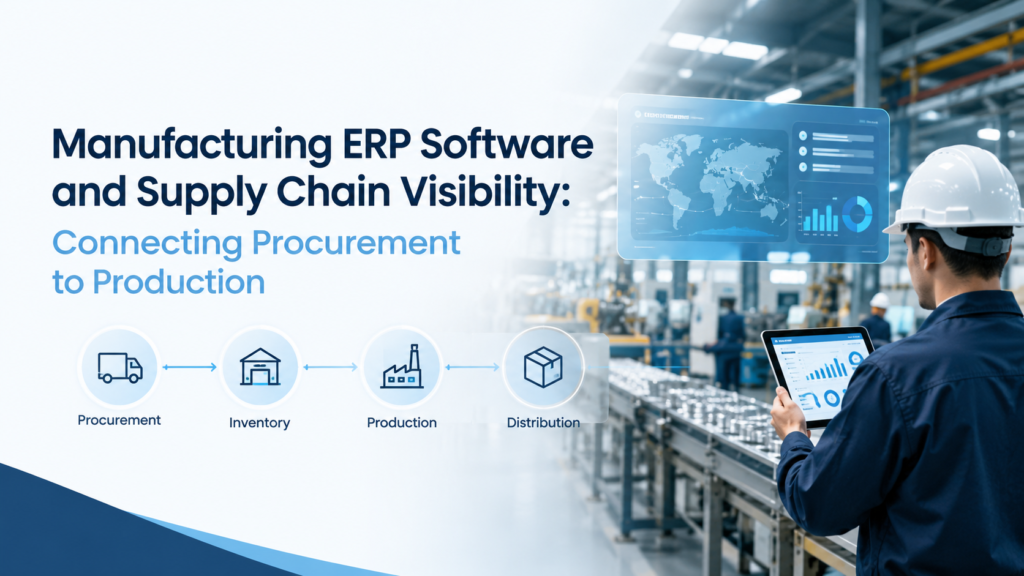
There’s a moment every operations manager knows well. You’re three days from a production deadline. Somewhere between your supplier’s warehouse and your shop floor, a critical component has gone quiet. No tracking update. No ETA. No answer. The line slows, schedules shift, and customers receive calls they didn’t want.
This isn’t a failure of effort. It’s a failure of visibility. And it’s more common than most manufacturers publicly admit.
Modern manufacturing runs on timing. Raw materials must arrive when machines are ready. Purchase orders need to reflect actual production schedules, not assumptions from last quarter. Yet in many facilities, procurement and production still operate from separate systems — sometimes separate spreadsheets — with data exchanged through email threads and manual updates. The gap between what procurement ordered and what production actually needs often surfaces too late to fix gracefully.
Companies like Arobit work with manufacturers on integrated technology solutions and consistently find the same first complaint: “Our buyers don’t know what the factory floor needs, and our planners don’t know what’s actually been ordered.”
Why the Disconnect Persists
It’s tempting to frame this as a technology problem. The roots go deeper.
Manufacturing organizations grow in layers. A purchasing team adopts one system. Production scheduling uses another. Inventory runs through a third. Over time, these tools get customized and patched until the original logic barely holds. The real cost isn’t licensing fees. It’s the invisible tax on every decision made without complete information:
- A procurement manager orders safety stock based on a report that’s 48 hours old
- A production planner builds a schedule around a lead time that changed last month
- A warehouse team receives materials that the floor no longer needs right now
This fragmentation compounds as product complexity grows. A manufacturer building a single SKU can manage with simpler tools. Managing hundreds of components, multiple suppliers across geographies, and a weekly-shifting production schedule? The cracks show fast.
What Supply Chain Visibility Actually Means
“Visibility” gets used so often it loses meaning. In manufacturing, it’s not about dashboards with green and red lights. It’s about answering specific operational questions without chasing three people and pulling four reports.
Ask yourself:
- Can your production planner see, right now, what’s in transit from your Tier 2 supplier?
- Can procurement spot a production delay before it creates excess inventory of a perishable input?
- Can finance see the landed cost of a purchase order before the goods arrive?
These aren’t exotic capabilities. They’re the baseline for running a manufacturing operation without constant firefighting. They only become possible when procurement data and production data share the same environment. A purchase order update should ripple into the production schedule automatically. A shift in manufacturing demand should flag a procurement review without anyone sending an email.
Where ERP Becomes the Connective Tissue
This is where manufacturing ERP software earns its place. Not as a reporting tool. Not as a system of record for audits. As the connective tissue between what you’re buying and what you’re building.
The real value isn’t any single module. It’s the shared data layer. When procurement, inventory, production scheduling, and quality control all read from and write to the same system:
- Buyers raising a purchase order can see current stock levels, open production orders, and supplier lead time history in one view
- Production planners building a weekly schedule can flag inbound delivery conflicts before they become shortages
- Operations managers stop making decisions with yesterday’s data
A Practical Example
Consider a mid-size contract manufacturer running five production lines with roughly 200 active suppliers. Their procurement team placed orders based on weekly inventory snapshots emailed from the warehouse. By the time an order was raised, approved, and confirmed, production priorities had shifted. Expedite fees became routine. Buffer stock piled up, tying down significant working capital in materials the floor sometimes didn’t need for months.
After the company implemented an integrated ERP:
- Purchase orders generated directly from production orders
- Supplier confirmations updated the production schedule in real time
- Buffer stock targets dropped noticeably
- Expedite costs fell sharply within the first year
Same suppliers. Same products. Same team. The information flow changed everything.
The Case for Custom Implementation
Off-the-shelf ERP platforms offer broad functionality. But manufacturing environments vary too much for a one-size-fits-all setup to hold.
A food and beverage producer has traceability requirements that look nothing like those of an electronics assembler. A make-to-order shop floor runs differently from a make-to-stock facility. The configuration decisions made during implementation — how production orders link to purchase requisitions, how demand signals flow to suppliers — carry lasting operational consequences.
This is why custom manufacturing ERP software services matter more than the platform itself. The software must reflect how your operation actually works. When the system gets built around your procurement workflows, your approval hierarchies, and your supplier data structures, people use it. When it doesn’t fit, people work around it. Then you’re back to spreadsheets and email.
Key areas where customization drives adoption:
- Procurement workflows: Approval rules that match your actual authorization structure
- Supplier integration: Data exchange formats that sync with how your suppliers actually communicate
- Production linkage: Demand signals that reflect your scheduling logic, not a generic template
- Reporting layers: Outputs that answer the questions your team actually asks
Looking Forward
The next evolution isn’t more software. It’s deeper integration.
Manufacturers are connecting ERP data with supplier portals, IoT signals from production equipment, and logistics tracking APIs. The result: a supply chain that anticipates what’s about to happen, not just records what already did.
Predictive procurement — where the system flags a potential shortage before it reaches the production floor — is already in use at larger manufacturers. The technology itself isn’t exotic. What it requires is a clean, integrated data foundation. A well-implemented ERP builds exactly that.
For manufacturers still running on disconnected systems, the path forward starts with that foundation:
- Identify where procurement and production data currently diverge
- Map the decisions that suffer most from that gap
- Build or configure a system that closes it, shaped around real workflows
Not a full digital transformation. Not a platform overhaul. A deliberate, targeted effort to connect what’s already there.
Conclusion
Supply chain visibility isn’t a feature. It’s the outcome of connecting the right systems with the right logic, built around how your manufacturing operation actually runs.
The manufacturers who’ve done this well share one thing in common: they treated the ERP implementation as an operational project, not an IT project. They started with the business question — where does procurement lose sight of production? — and worked backward to the technology.
Arobit has worked with manufacturing businesses on exactly this challenge, helping translate operational complexity into integrated technology that teams actually use. The goal stays the same across every engagement: fewer surprises between the purchase order and the production line.
Frequently Asked Questions
- What’s the difference between supply chain visibility and supply chain management in an ERP context?
Supply chain management covers the processes: procurement, logistics, inventory, and fulfillment. Visibility refers to how much real-time, accurate information your team has across those processes at any given moment. An ERP supports both. But visibility specifically depends on how well the modules are integrated and how current the underlying data stays.
- How long does it typically take to see ROI from an ERP implementation in manufacturing?
It varies based on company size and implementation scope. Manufacturers with well-defined procurement and production workflows often see measurable improvements within 6 to 12 months post go-live. Reduced expedite costs, lower buffer stock, and fewer stockouts tend to show up first. The timeline shortens when the implementation aligns closely to actual operational workflows rather than default system configurations.
- Is ERP suitable for small or mid-size manufacturers, or only at enterprise scale?
ERP systems are increasingly viable for smaller manufacturers. Cloud-based and modular options have reduced both upfront cost and implementation complexity significantly. The right question isn’t about size. It’s about operational complexity. Multiple suppliers, multiple product lines, multi-step production — if disconnected systems are creating real inefficiency, the case for ERP holds regardless of company size.