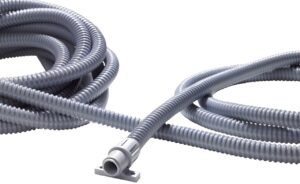
A well-planned cable route gives installers room to work and maintenance teams a clear path to follow. The connection between the conduit and its mounting point deserves the same attention as the cables inside it.
The Swivel Cable Conduit Fitting from HellermannTyton combines a straight fitting with a swivel bracket. Identified as FG36-UH-PP-GY, article number 167-00525, it belongs to the FlexiGuard system and suits its 36 mm nominal conduit size.
For a successful installation, start with three questions: does the conduit match, is there enough mounting space, and can the finished route be inspected easily?
What Does the Swivel Bracket Add to the Installation?
This design brings the conduit connection and its mounting bracket together in one component. The manufacturer also specifies an internal ferrule for cable protection and resistance to vibration and tension.
The practical benefit is worth considering during layout planning. Look at how the conduit approaches the mounting surface, where the next support will sit and whether surrounding equipment leaves room for the intended arrangement.
When comparing Cable Conduit Fittings for a project, assess the mounting method alongside the conduit connection. A fitting can match the tube size yet still be awkward to accommodate within the available space.
Which Conduit Should Be Paired With This Fitting?
Compatibility starts with the conduit family. FlexiGuard FG36 conduit uses PVC with steel spiral reinforcement and has a 36 mm outside diameter and a 30 mm inside diameter. Its published applications include machinery, plant construction and connections to switch cabinets.
Within the Conduit range, check the manufacturer’s system reference before choosing a replacement or completing a new assembly. Matching the nominal diameter alone does not establish compatibility between different conduit designs.
For maintenance purchases, record the markings on the existing conduit as well as the fitting. This makes the order easier to verify and helps avoid fitting a visually similar component with a different connection geometry.
Why Does the Minimum Bore Matter?
The fitting has a 27.9 mm minimum bore, which is smaller than its 36 mm nominal conduit size. These dimensions describe different features and should be checked separately.
Plan cable capacity around the narrowest part of the route. Consider the cable bundle’s actual dimensions, the space needed for installation, and any connectors already attached to the cables.
For example, a pre-terminated lead may pass through the conduit but encounter difficulty at a narrower fitting. Checking this before assembly can prevent unnecessary disconnection or changes to the planned route.
Allow for future servicing too. A route that is difficult to assemble initially is unlikely to become easier when one cable needs replacing.
How Much Mounting Space Should Be Reserved?
The manufacturer’s dimensional information gives 53 mm fixing-hole centres, 6.7 mm fixing holes and an overall height of 67 mm. Use these figures alongside the technical drawing when planning the bracket position.
Before marking the mounting surface, check access for the selected fasteners and installation tools. Look beyond the bracket footprint: nearby covers, machine guards and other cable routes may affect access after assembly.
A simple layout check can include:
- Space to fit and inspect the conduit connection.
- Clearance from sharp edges and nearby moving parts.
- Access to mounting fasteners during maintenance.
- A route that accommodates the cables’ required bend radius.
Choose mounting hardware to suit the supporting structure and application requirements.
What Protection Does IP54 Provide?
HellermannTyton specifies IP54 when this fitting is used with FlexiGuard FG conduit. The fitting is grey polypropylene, so material compatibility should also be considered where cleaning agents or process chemicals are present.
IP54 describes protection against dust and splashing water. It should not be interpreted as approval for immersion or high-pressure cleaning.
Review the environment at the actual installation point. A fitting mounted beneath equipment may face different contamination and cleaning conditions from one positioned inside a protected machine area. Select the complete conduit assembly for those conditions.
How Should the Rest of the Cable Route Be Supported?
Treat the fitting as one part of the routing plan. Decide where the conduit needs support and where access must remain available before finalising its length.
Suitable Cable Clips & Clamps can support the surrounding installation when their dimensions, mounting method and intended use match the cable or conduit being secured.
Check that supports hold the route without crushing the conduit or forcing abrupt changes in direction. Follow the applicable conduit and cable bend limits, and confirm the finished arrangement with the equipment in its expected operating positions.
How Can Identification Make Maintenance Easier?
A tidy installation becomes more useful when technicians can identify what each cable serves. Include identification in the assembly plan, particularly where several similar routes enter the same machine area.
Appropriately selected Cable Markers help connect physical wiring with drawings and maintenance records. Position labels where they remain readable after the conduit and covers are installed.
Record the fitting reference, conduit type and cable destinations together. A photograph of the completed route can also give future maintenance staff useful context when ordering parts or investigating a change.
Before ordering the Swivel Cable Conduit Fitting, compare article number 167-00525 with the required conduit system, mounting layout and environmental conditions. Keeping those details together makes the product easier to specify accurately and the completed installation easier to maintain.