Unauthorized drone activity can create security challenges for industrial facilities, airports, energy infrastructure, warehouses, and other sensitive sites. Drones may enter restricted areas, capture images of private operations, or disrupt routine activities. Organizations need reliable ways to identify potential drone threats and help security teams respond appropriately.
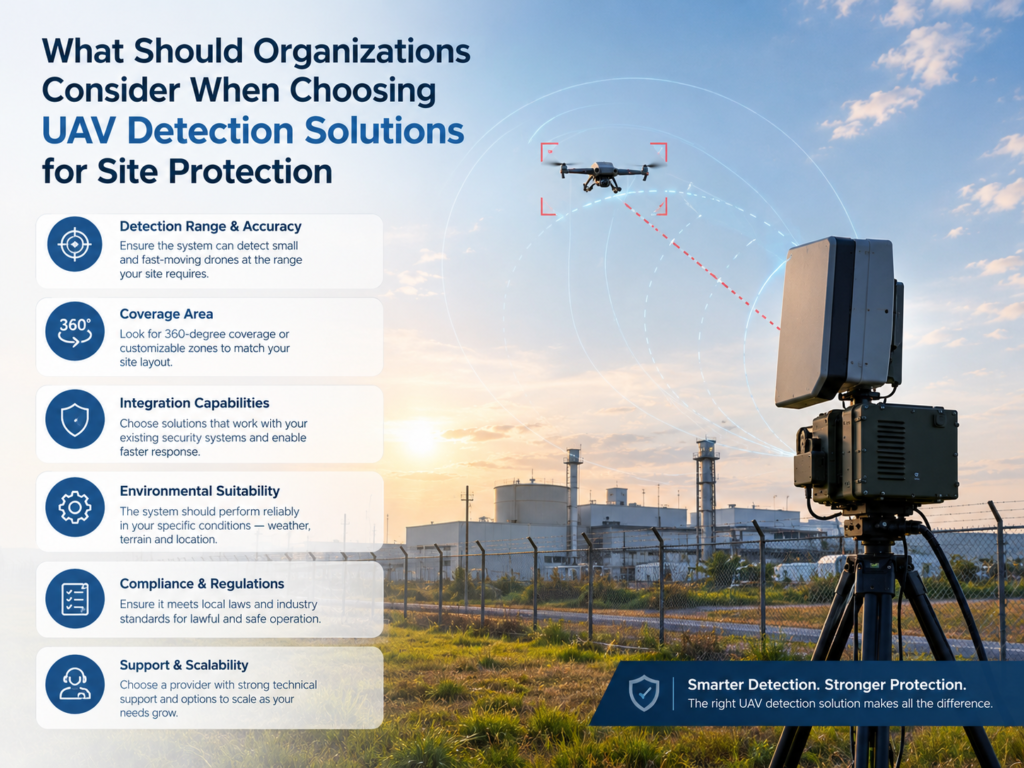
Choosing suitable UAV detection solutions requires more than comparing equipment specifications. Organizations should evaluate site conditions, detection coverage, tracking capabilities, false alarm rates, integration requirements, and operating costs. Technologies such as anti-drone detection radar, drone tracking sensors, and AI-based drone detection can serve different purposes depending on the environment and security objectives.
A structured evaluation helps organizations select a detection system that fits their site, supports security personnel, and provides useful information for incident response.
1. Assess the Site’s Security Requirements
Every facility has different security priorities. An industrial plant may need to monitor restricted operational zones, while a warehouse may focus on perimeter security and unauthorized surveillance. Airports and critical infrastructure sites may require broader coverage and coordination with established security procedures.
Before selecting equipment, organizations should assess:
- Site size, boundaries, and surrounding terrain
- Nearby buildings, trees, and other potential obstructions
- Likely drone activity and relevant threat scenarios
- Areas that require continuous monitoring
- Existing security personnel and response procedures
This assessment helps determine which UAV detection solutions can meet the site’s requirements. It also prevents organizations from purchasing equipment that offers unnecessary features or fails to address important coverage gaps.
2. Evaluate Anti-Drone Detection Radar
Radar systems detect objects by transmitting radio waves and analyzing their reflections. Specialized anti-drone detection radar can help identify and track airborne objects, including certain small drones, depending on the system’s design and operating conditions.
When evaluating radar, organizations should review the manufacturer’s documented detection range, target classification capabilities, tracking performance, and coverage limitations. Small drones can present detection challenges because their size, materials, movement, and operating altitude affect radar performance.
Environmental conditions also matter. Buildings, terrain, vegetation, and other objects can obstruct coverage or create unwanted radar returns. Organizations should assess radar performance in conditions that resemble their actual site rather than relying solely on maximum-range specifications.
An anti-drone detection radar may suit sites that need broad-area monitoring, but it should form part of a wider evaluation of detection technologies.
3. Consider the Role of Drone Tracking Sensors
Drone tracking sensors help security teams monitor detected objects and gather information about their movement. Depending on the technology, these systems may use radio-frequency analysis, electro-optical cameras, infrared imaging, or other sensing methods.
Each technology has different strengths and limitations.
- Radio-frequency sensors: May identify communication signals associated with certain drones and controllers.
- Electro-optical cameras: Provide visual information that can help operators inspect and identify a detected object.
- Infrared sensors: Can support observation in some low-light conditions, depending on the equipment and environment.
- Radar sensors: Can provide detection and tracking information even when visual identification proves difficult.
Organizations should assess whether drone tracking sensors can maintain useful tracks, work under expected environmental conditions, and provide information that security personnel can interpret. Sensor selection should reflect actual site needs rather than the number of technologies included in a product package.
4. Examine AI-Based Drone Detection Capabilities
AI-based drone detection uses algorithms to analyze sensor data and identify patterns associated with potential drone activity. Depending on the system, AI may help classify objects, correlate information from multiple sensors, and distinguish potential threats from ordinary activity.
These capabilities can help security teams manage large amounts of monitoring data. However, AI performance depends on the quality of the input data, the models used, and the conditions in which the system operates.
Organizations should ask vendors how their systems perform in environments with birds, aircraft, moving machinery, and other potential sources of false alarms. They should also review testing methods, system limitations, software updates, and human verification procedures.
A useful AI-based drone detection system should provide understandable alerts and support operator decisions. AI classifications should not replace appropriate verification and established incident response procedures.
5. Review Detection Range and Coverage
Detection range is an important consideration, but a single maximum-range figure rarely describes real-world performance adequately. Different sensors may detect different types of drones at different distances and under different conditions.
Organizations should examine the expected detection performance for the drone categories relevant to their site. They should also assess low-altitude coverage, terrain restrictions, blind spots, and the system’s ability to monitor areas around buildings and other structures.
For large or irregularly shaped properties, several sensors may be necessary to provide suitable coverage. Security teams should map the required monitoring areas and validate coverage through a professional site assessment.
When comparing UAV detection solutions, organizations should prioritize documented performance under realistic operating conditions instead of relying on headline specifications alone.
6. Check Integration With Existing Security Systems
Detection equipment becomes more useful when it works with the site’s wider security infrastructure. Integrating sensors with video surveillance, access control, alarm management, and security operations platforms can help teams investigate alerts more efficiently.
Before purchasing a system, organizations should establish whether it supports their existing software, data formats, communications interfaces, and reporting requirements.
They should also determine how the system presents alerts, records incidents, and shares information with authorized personnel. Integration can reduce the need to monitor multiple independent dashboards and help security teams maintain a consistent incident record.
Compatibility should be verified during procurement rather than assumed from general vendor statements.
7. Consider False Alarms and Operational Reliability
Frequent false alarms can overwhelm security personnel and distract them from genuine incidents. Environmental interference, birds, weather conditions, and other objects may affect detection performance.
Organizations should request information about false alarm rates, classification accuracy, system availability, and performance across different operating conditions. They should also ask how vendors test their equipment and update detection models or sensor software.
Reliability involves more than detection accuracy. Power requirements, network connectivity, environmental protection, maintenance needs, and backup procedures also affect long-term performance.
A well-planned evaluation should include operational testing and clear procedures for verifying alerts before security teams initiate a response.
8. Evaluate Cybersecurity, Privacy, and Regulatory Compliance
Connected detection systems may collect sensor data, video footage, location information, and operational records. Organizations should understand how vendors store, process, transmit, and protect this information.
Important questions include:
- Does the system support role-based access controls and secure authentication?
- How does the vendor manage software updates and security vulnerabilities?
- Where does the system store recorded data?
- What retention and deletion controls are available?
- Does deployment comply with applicable privacy, aviation, and telecommunications regulations?
Organizations should also clarify whether the system only detects and tracks drones or includes active counter-drone capabilities. Detection and mitigation have different legal and operational implications. Any proposed mitigation measures require a separate review of applicable authorizations and safety risks.
9. Compare Total Cost of Ownership and Vendor Support
The initial equipment price is only one part of the overall investment. Organizations should account for installation, integration, training, maintenance, software licenses, repairs, and future upgrades.
They should also evaluate vendor experience, technical support availability, warranty terms, replacement parts, and service response commitments. A system that meets initial requirements may become difficult to maintain if the supplier offers limited long-term support.
A detailed comparison should assess both purchase costs and expected operating expenses over the system’s useful life. Pilot testing can also help organizations verify whether the proposed solution performs adequately before committing to a larger deployment.
Frequently Asked Questions
What are UAV detection solutions?
UAV detection solutions are systems designed to identify and monitor unmanned aerial vehicles. They may use radar, radio-frequency sensors, cameras, infrared imaging, or AI-based analysis to help security teams recognize potential drone activity.
How does anti-drone detection radar work?
Anti-drone detection radar transmits radio waves and analyzes the returning signals to identify and track objects. Its performance depends on the radar design, target characteristics, terrain, and surrounding environment.
What role do drone tracking sensors play in site protection?
Drone tracking sensors provide information about detected objects, their movement, or their associated signals. This information can help security teams assess alerts and coordinate appropriate responses.
How can AI-based drone detection help security teams?
AI-based drone detection can analyze sensor information, classify potential targets, and help manage alerts. Its usefulness depends on model performance, data quality, environmental conditions, and appropriate human oversight.
How should an organization choose a drone detection system?
An organization should assess its site risks, coverage requirements, detection accuracy, integration needs, cybersecurity obligations, operating costs, and vendor support. Testing the proposed system under realistic conditions can help validate its suitability.
Conclusion
Choosing suitable UAV detection solutions requires organizations to balance detection performance, site coverage, system integration, reliability, and long-term costs. Anti-drone detection radar can support broad-area monitoring, while drone tracking sensors and AI-based drone detection can provide additional information for identifying and assessing potential threats. No single technology suits every environment, so organizations should evaluate their requirements before selecting equipment. A professional site assessment, realistic performance testing, and careful review of cybersecurity and regulatory obligations can help guide procurement. Contact a qualified detection-system provider to discuss site-specific risks, compare suitable technologies, and develop a practical monitoring strategy.