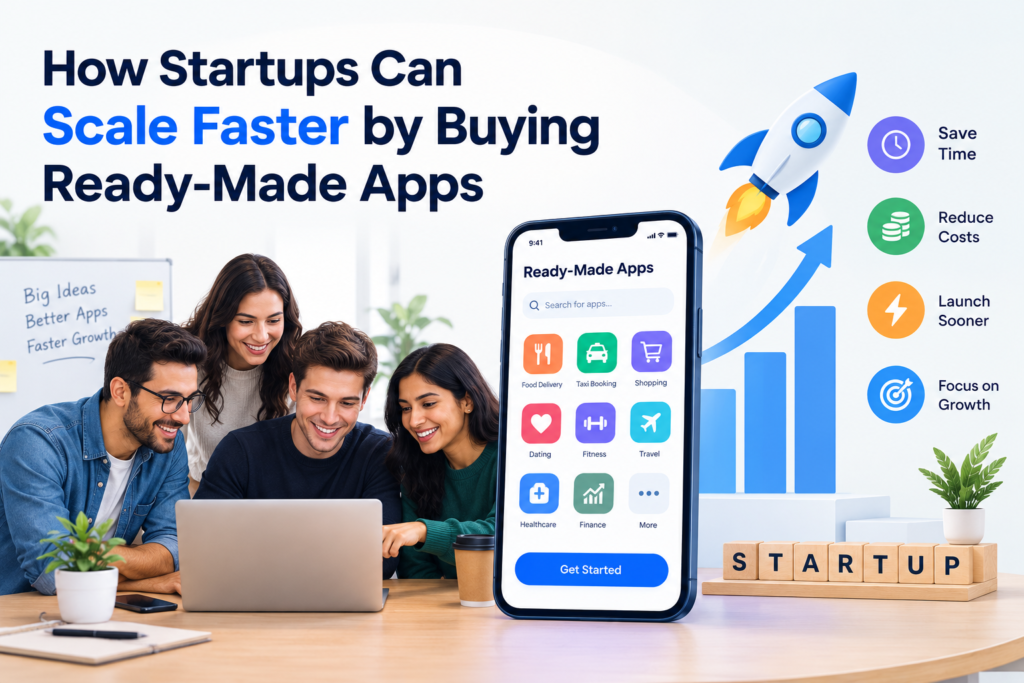
For startups, speed is often as important as funding. A great idea can lose its advantage if a company spends years building technology that competitors can launch in months. This is why more startups are exploring an alternative to traditional app development: buying ready-made apps and customizing them for their business goals.
A ready-made app can provide a functioning technological foundation without requiring a startup to begin every feature from scratch. Instead of spending months designing, coding, testing, and launching a product, founders can acquire an existing application and focus their resources on customization, branding, customer acquisition, and growth.
But buying an app is not simply about saving development time. Done strategically, it can become a way to enter a market faster, test an idea with less development risk, and create a scalable digital business.
What Does Buying a Ready-Made App Mean?
Buying a ready-made app generally means acquiring an existing software product, application, source code, or complete digital business that can be modified and operated by a new owner.
Depending on the product, a startup might acquire:
-
A mobile application
-
A web application
-
An SaaS product
-
An e-commerce platform
-
A marketplace application
-
A booking platform
-
A delivery application
-
A social networking app
-
A productivity tool
-
An industry-specific software solution
Some ready-made apps are sold as complete solutions, while others are designed specifically for customization.
For example, a startup planning to launch a local service marketplace doesn’t necessarily need to develop user registration, provider profiles, search functionality, bookings, payments, notifications, and dashboards from zero. An existing marketplace application may already contain these components.
The startup can then modify the application around its target audience and business model.
The Biggest Advantage: Faster Time to Market
One of the strongest reasons to consider a ready-made application is faster deployment.
Building an application from scratch means the startup must first create the technical foundation. With a ready-made solution, many core components may already be functional.
This can allow founders to concentrate on questions that have a more direct impact on growth:
Who is the target customer?
What problem does the product solve?
How will customers discover it?
What pricing model makes sense?
How can the company retain users?
Instead of spending the majority of the early stage solving technical problems, the team can spend more time validating the business.
This is particularly useful for startups entering markets where timing matters. Getting a functional product in front of customers can generate real-world feedback that may be more valuable than months of theoretical product planning.
Ready Made Food Delivery App Solution: Reducing the Initial Development Burden
Developing a food delivery platform from the ground up requires considerable planning, technical resources, and development time. A startup needs to create multiple components, including customer registration, restaurant management, menu handling, order processing, online payments, delivery management, notifications, and administrative controls. Building each of these elements independently can increase the initial development burden and delay the launch of the platform.
A Ready Made Food Delivery App Solution provides an existing technological foundation that can be adapted to the requirements of a food delivery business. Instead of developing the core functionality from the beginning, a startup can use pre-existing modules and modify them according to its operational model. This approach is based on the concept of software reuse, where established functionality is adapted rather than recreated.
The initial development burden can be reduced because many standard food delivery features may already be incorporated into the solution. Customer-facing applications, restaurant panels, delivery partner interfaces, and administrative dashboards can form part of the overall platform structure. The startup can then concentrate on configuring the application, integrating required services, and introducing features that are relevant to its target market.
From a theoretical perspective, this model allows development resources to be distributed more efficiently. Instead of allocating most of the initial budget and development time to basic application infrastructure, resources can also be directed toward areas such as customer acquisition, restaurant partnerships, delivery operations, marketing, customer support, and platform improvements.
A Ready Made Food Delivery App Solution can also provide a framework for testing a food delivery business model. Once the platform is customized and deployed, the startup can observe customer behavior, restaurant participation, order patterns, and delivery requirements. These observations can help determine which additional features or improvements should be developed as the platform grows.
However, the suitability of a ready-made solution depends on its customization capabilities and technical foundation. A startup should consider factors such as scalability, security, payment integration, third-party API compatibility, source-code accessibility, maintenance requirements, and future expansion before adopting a particular solution.
The main theoretical benefit of a Ready Made Food Delivery App Solution is therefore not simply reduced development time. It provides a structured starting point from which a startup can develop its food delivery platform while concentrating its technical resources on customization, differentiation, and long-term business requirements. This approach can create a balance between an existing technological foundation and the flexibility required to build a distinctive food delivery service.
Ready-Made Doesn’t Mean One-Size-Fits-All
A common misconception is that buying an existing application means accepting whatever features come with it.
That isn’t necessarily the case.
Many ready-made apps can be customized to match a startup’s requirements. Branding, colors, layouts, workflows, payment methods, user roles, integrations, and other functionality may be modified depending on the technology.
For example, a startup might purchase a ready-made delivery platform and customize it by adding:
-
Its own branding
-
Local payment gateways
-
Location-specific delivery rules
-
Customer loyalty features
-
Promotional campaigns
-
Vendor dashboards
-
Custom analytics
-
Additional notification options
This creates a hybrid approach: buy the foundation, then build the differentiation.
That distinction is important because startups rarely need to invent every technical component themselves. Their competitive advantage usually comes from how they package, position, distribute, and improve the product.
Faster MVP Development
A minimum viable product, or MVP, is designed to test whether customers actually want a product before a startup makes a major investment.
Building an MVP from scratch can still require significant development work.
A ready-made application can shorten subscription-based fitness platform. Rather than developing authentication, subscription management, user profiles, dashboards, notifications, and content management from scratch, the founder could start with an existing application that process by providing a functional starting point.
Suppose a founder wants to test a subscription-based fitness platform. Rather than developing authentication, subscription management, user profiles, dashboards, notifications, and content management from scratch, the founder could start with an existing application that already contains several of those capabilities.
The startup can then launch a focused version, measure customer behavior may look attractive technically while having little business value if application’s architecture, source code, dependencies, hosting setup, security practices focus on premium customers. Another could target small businesses. One might compete through expected. Startups should create a realistic implementation budget instead of assuming the purchased product will work an entire marketplace platform from zero, a company could acquire an existing marketplace foundation and entry, lower initial development workload, and quicker product validation. It allows founders to begin with an existing technological foundation and use customization to create a product aligned functionality, startups can focus on customers, branding, marketing, partnerships, product-market. Conduct technical and legal due diligence, evaluate scalability, understand the total cost of ownership, and determine a ready-made app isn’t about taking a shortcut. It can be a deliberate way to start with a proven foundation, learn from real customers sooner, and, and decide which features deserve further investment.
This approach supports a valuable principle:
Validate demand before expanding technology.
Acquisition Can Provide More Than Code
When startups buy an existing app or digital product, they may sometimes acquire assets beyond the software itself.
Depending on the transaction, an acquisition could potentially include:
-
Existing users
-
Domain names
-
Brand assets
-
Customer relationships
-
Documentation
-
Analytics data
-
Existing integrations
-
Search visibility
-
Revenue streams
-
Operational processes
This can turn an app acquisition into a broader business opportunity.
However, these assets should never be assumed. Buyers need to verify exactly what is included in the transaction and whether ownership can legally be transferred.
A piece of software may look attractive technically while having little business value if its users are inactive or its revenue is declining.
The Importance of Technical Due Diligence
Buying a ready-made application without examining its technical foundation can create serious problems later.
Before purchasing, startups should investigate the application’s architecture, source code, dependencies, hosting setup, security practices, and documentation.
Important questions include:
-
Is the source code included?
-
Who owns the intellectual property?
-
Are third-party licenses transferable?
-
What programming languages and frameworks are used?
-
Is the code documented?
-
How frequently has it been updated?
-
Does it integrate with modern APIs?
-
Is the database structure scalable?
-
Are there known security vulnerabilities?
-
Can developers easily modify the application?
A low purchase price doesn’t necessarily represent good value if the application requires a complete technical rebuild.
The goal should be to acquire a usable foundation, not simply a large amount of code.
Scalability Should Be Checked Before Purchase
An application that works for 1,000 users may not work efficiently for 100,000 users.
Startups should therefore evaluate scalability before making an acquisition.
Consider the application’s:
-
Database architecture
-
Cloud infrastructure
-
API performance
-
Caching strategy
-
Authentication system
-
File storage
-
Monitoring capabilities
-
Server configuration
-
Third-party dependencies
Scalability should also be considered from a business perspective.
Can new pricing plans be introduced?
Can additional user types be added?
Can the platform support new locations?
Can more payment methods be integrated?
Can the product expand into adjacent markets?
A scalable ready-made application should support growth without forcing the startup to repeatedly rebuild its foundation.
Customization Creates the Real Competitive Advantage
Buying an app provides speed, but customization is where startups can create differentiation.
Two companies could purchase similar technology and build completely different businesses.
One might focus on premium customers. Another could target small businesses. One might compete through pricing, while another could specialize in customer experience.
The underlying software may be similar, but the customer experience, brand, business model, and distribution strategy can be completely different.
Startups should therefore avoid trying to customize everything at once.
A better approach is to identify the features that directly influence customer value and competitive differentiation.
Technology should support the strategy rather than become the strategy.
Avoiding Common Mistakes
There are several mistakes startups should avoid when purchasing ready-made applications.
Choosing Based Only on Price
The cheapest application isn’t necessarily the most economical. Poor code quality, outdated dependencies, limited documentation, or weak security can create expensive problems later.
Buying Too Many Features
More features don’t automatically create more value. A startup may end up paying for functionality customers never use.
Ignoring Ownership Rights
Contracts should clearly define ownership, licensing, source-code access, trademarks, data rights, and third-party dependencies.
Skipping Security Reviews
Security should be evaluated before customers are brought onto the platform, especially if the application handles personal or financial information.
Underestimating Customization
A ready-made app may require more customization than initially expected. Startups should create a realistic implementation budget instead of assuming the purchased product will work perfectly out of the box.
A Smarter Scaling Strategy
The most effective approach is not necessarily “buy instead of build.”
It is buy what already exists and build what makes your business different.
A startup can use an existing application for standard functionality while investing its engineering resources in proprietary features.
For example, instead of developing an entire marketplace platform from zero, a company could acquire an existing marketplace foundation and dedicate its developers to recommendation algorithms, specialized workflows, analytics, or industry-specific features.
This creates a more efficient division of resources.
The startup isn’t wasting time reinventing common technology, but it is still investing in innovation where innovation matters.
Final Thoughts
Buying a ready-made app can give startups a practical route to faster market entry, lower initial development workload, and quicker product validation. It allows founders to begin with an existing technological foundation and use customization to create a product aligned with their market.
The real value, however, isn’t simply the ability to launch faster.
It is the opportunity to redirect time and capital toward growth.
Instead of spending months recreating standard functionality, startups can focus on customers, branding, marketing, partnerships, product-market fit, and differentiated features.
The key is to approach an app purchase strategically. Conduct technical and legal due diligence, evaluate scalability, understand the total cost of ownership, and determine which parts of the product genuinely need customization.