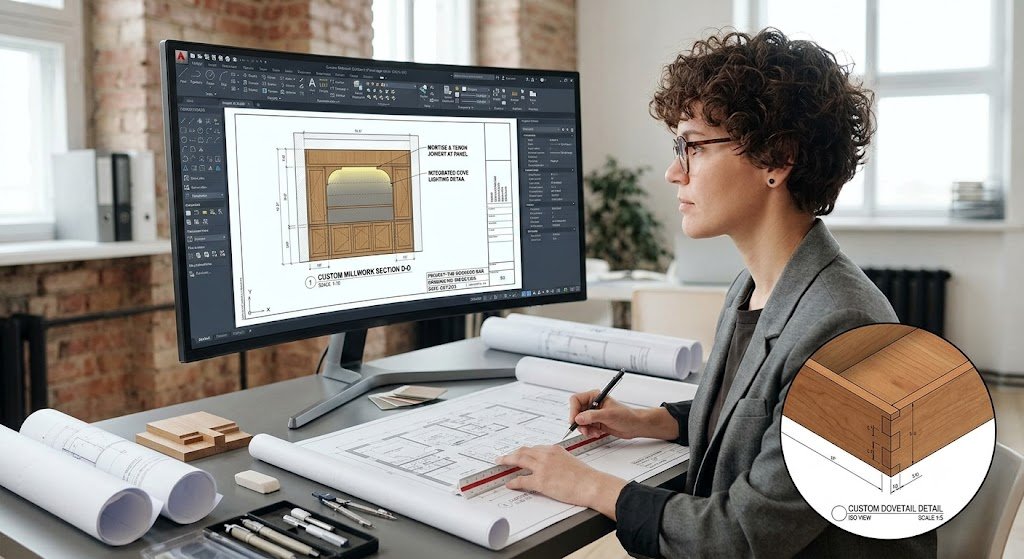
Millwork drafting plays an important role in turning architectural and interior design concepts into clear, buildable documentation. Whether you are working on a commercial office, retail store, restaurant, hotel, healthcare facility, or custom residential project, accurate drawings help millwork contractors and fabricators understand exactly what needs to be manufactured and installed.
However, choosing the right millwork drafting services is not simply about finding a drafting company that can produce CAD drawings. The right drafting partner should understand architectural millwork, interpret design intent, coordinate with project documentation, and produce detailed drawings that support fabrication, submittals, approvals, and installation.
For architects, interior designers, general contractors, and millwork contractors in the USA, selecting the right drafting service can directly affect coordination, revision cycles, project schedules, and fabrication accuracy.
This guide explains the key factors to consider when choosing a millwork drafting service for your project.
What Are Millwork Drafting Services?
Millwork drafting services involve creating detailed technical drawings for custom architectural woodwork, casework, cabinetry, reception desks, wall panels, retail fixtures, counters, doors, and other fabricated interior elements.
Depending on the project requirements, millwork drawings may include:
- Floor plans and enlarged plans
- Millwork elevations
- Detailed sections
- Plan and section details
- Cabinet and casework drawings
- Interior elevations
- Countertop details
- Wall panel details
- Reception desk drawings
- Retail fixture drawings
- Hardware information
- Material specifications
- Dimensions and clearances
- Installation details
- Coordination information
- Revision documentation
The objective is to translate design information into technical documentation that a millwork contractor or fabricator can use during the project.
Why Choosing the Right Millwork Drafting Partner Matters
Millwork is often highly customized. Small discrepancies in dimensions, materials, hardware, clearances, or interfaces with surrounding construction can create problems during fabrication or installation.
A suitable drafting partner can help organize complex information into coordinated documentation.
For example, a retail project may include dozens of individual fixtures, while a hospitality project may require custom bars, reception desks, wall panels, banquettes, casework, and decorative millwork.
If drawings are incomplete or inconsistent, the project may experience:
- Additional RFIs
- Revisions
- Fabrication delays
- Coordination conflicts
- Material discrepancies
- Installation issues
- Approval delays
- Increased project costs
This is why the selection process should focus on technical capability, project experience, communication, coordination, and quality control, rather than price alone.
1. Check Their Experience With Architectural Millwork
The first thing to evaluate is whether the drafting provider has experience specifically with architectural millwork.
General CAD drafting experience does not automatically mean a company understands millwork documentation.
Millwork drafting requires familiarity with construction assemblies, cabinetry, materials, hardware, dimensions, joinery, fabrication requirements, and installation conditions.
Ask whether the provider has worked on projects involving:
- Custom casework
- Commercial cabinetry
- Retail fixtures
- Hospitality millwork
- Office interiors
- Reception desks
- Bars and counters
- Wall panel systems
- Architectural woodwork
- Custom furniture
- Store fixtures
Reviewing previous project samples can help you determine whether the drafting team’s experience matches the complexity of your project.
2. Review Their Sample Drawings
Before hiring a drafting service, ask for sample millwork drawings.
Do not evaluate samples only based on how visually attractive they look. Examine the technical information.
Look for:
- Clear dimensions
- Logical drawing organization
- Consistent annotations
- Material information
- Detailed sections
- Elevations
- Construction details
- Hardware references
- Coordination information
- Revision tracking
- Appropriate drawing scales
- Clear title blocks
A professional millwork drawing should communicate information efficiently to the people who need to review, fabricate, or install the work.
If the sample drawings are visually clean but lack important technical information, ask how that information is handled during actual projects.
3. Confirm Their Understanding of Your Project Type
Different project types create different millwork requirements.
For example, a retail project may require extensive fixture documentation, while a restaurant may involve bars, service counters, banquettes, cabinetry, and back-of-house casework.
Hospitality projects can involve highly customized decorative elements, while corporate interiors may focus more heavily on standardized casework and workstations.
Ask whether the drafting company has experience with your specific project category.
Common project types include:
- Retail
- Restaurants
- Hotels
- Corporate offices
- Healthcare
- Education
- Residential
- Multifamily
- Commercial interiors
- Institutional projects
Relevant project experience can reduce the amount of explanation and interpretation required during the drafting process.
4. Ask About Their CAD and BIM Capabilities
The software used by a drafting service can affect project coordination and workflow.
Depending on your project requirements, you may need deliverables in:
- AutoCAD
- Revit
- SketchUp
- DWG
- Other project-specific formats
For projects involving BIM coordination, Revit-based millwork modeling may be required.
For primarily 2D documentation, AutoCAD may be sufficient.
The important point is not simply whether a company uses a particular software package. It is whether the team can produce the required deliverable in the correct format and level of detail.
Before starting the project, confirm:
- Which software will be used?
- What file formats will be delivered?
- Can source files be provided?
- Can the team work from your existing drawings?
- Can they follow your CAD or BIM standards?
- How will revisions be managed?
5. Evaluate Their Ability to Read Architectural and Interior Drawings
Millwork does not exist independently from the rest of the building.
A millwork drafter may need to interpret:
- Architectural floor plans
- Interior elevations
- Reflected ceiling plans
- Finish plans
- Enlarged plans
- Sections
- Details
- Specifications
- Furniture layouts
- MEP information
- Design drawings
The drafting team should be able to understand how millwork interacts with walls, ceilings, floors, doors, appliances, lighting, electrical components, and other building elements.
This is particularly important when developing shop drawings from architectural or interior design documents.
6. Ask About Shop Drawing Standards
If your project requires shop drawings for contractor or architect review, ask the drafting provider how they approach shop drawing documentation.
A typical millwork shop drawing package may contain:
- General notes
- Plans
- Elevations
- Sections
- Details
- Dimensions
- Materials
- Finishes
- Hardware
- Construction methods
- Installation information
- References to related drawings
The exact requirements depend on the project, specifications, contract documents, and approval process.
For projects in the United States, you may also want to ask whether the team has experience working with Architectural Woodwork Standards (AWS) and project-specific specifications.
7. Check Their Quality Control Process
Quality control is one of the most important factors when selecting a drafting partner.
Ask how drawings are reviewed before delivery.
A structured review process may check:
- Dimensions
- Drawing references
- Material information
- Hardware
- Detail references
- Sheet numbering
- Revision information
- Coordination with architectural drawings
- Consistency between plans and elevations
- Missing information
- Drawing standards
A second-person review can help identify errors before drawings reach the client or project team.
Ask a simple question:
“Who reviews the drawings before they are delivered to us?”
The answer can tell you a lot about the company’s internal quality-control process.
8. Understand Their Revision Process
Millwork drawings often go through multiple revisions.
Architects, designers, contractors, consultants, and owners may provide comments during the review process.
Before hiring a drafting service, understand:
- How revisions are submitted
- How comments are tracked
- How quickly revisions are returned
- Whether revisions are included in the pricing
- How major design changes are handled
- How revision clouds and notes are managed
A clearly defined revision process can prevent confusion later in the project.
9. Evaluate Communication and Project Management
Technical drafting quality is important, but communication is equally important.
A drafting team may be technically capable but difficult to coordinate with. That can become a problem when project deadlines are tight.
Ask how communication will work.
For example:
- Who is the project manager?
- Who will review your instructions?
- How frequently will updates be provided?
- How are questions handled?
- How are urgent changes communicated?
- What happens when project information is incomplete?
For US-based contractors and design teams working with offshore or remote drafting providers, a clearly defined communication process becomes especially important.
10. Compare Turnaround Times
Turnaround time should be evaluated alongside drawing complexity.
A simple casework package may require significantly less time than a large hospitality or retail millwork package.
Instead of asking only:
“How quickly can you finish?”
ask:
“What is your expected turnaround for a project of this size and complexity?”
Also ask whether they can accommodate phased submissions.
For example:
- Phase 1: General millwork
- Phase 2: Reception and feature elements
- Phase 3: Detailed casework
- Phase 4: Revisions
- Phase 5: Final approved drawings
Phased delivery can sometimes help the project team review information without waiting for the entire package.
11. Don’t Choose a Provider Based Only on Price
Cost is an important consideration, but the lowest quote is not necessarily the lowest project cost.
Suppose one drafting provider offers a very low price but produces incomplete drawings that require multiple corrections.
The project may then experience:
- Additional coordination time
- More revisions
- Delayed approvals
- Fabrication changes
- Additional communication
- Installation problems
Instead of comparing only the price, compare the overall service scope.
Look at:
| Factor | What to Check |
|---|---|
| Experience | Relevant millwork project experience |
| Drawing quality | Detail, accuracy, organization |
| Software | AutoCAD, Revit, or required platform |
| Standards | Ability to follow project standards |
| Coordination | Architectural and consultant coordination |
| Revisions | Revision process and turnaround |
| Communication | Project management and response time |
| Quality control | Internal drawing review |
| Delivery | File formats and submission process |
| Pricing | Scope, inclusions, and exclusions |
This provides a more useful comparison than simply choosing the cheapest proposal.
12. Check Whether They Can Work From Your Existing Documentation
Many contractors and designers do not start millwork documentation from scratch.
You may already have:
- Architectural drawings
- Interior design drawings
- PDFs
- CAD backgrounds
- Revit models
- Finish schedules
- Material specifications
- Hardware schedules
- Design concepts
- Sketches
- Markups
Ask whether the drafting team can use these documents as the basis for the millwork package.
A capable drafting service should be able to review available information and identify missing or conflicting details rather than simply drawing exactly what appears on one reference sheet.
13. Evaluate Their Ability to Handle Coordination
Millwork often interfaces with multiple building elements.
For example, a custom reception desk may need coordination with:
- Electrical outlets
- Data connections
- Lighting
- Flooring
- Wall finishes
- Countertops
- Equipment
- Accessibility requirements
Similarly, commercial cabinetry may need coordination with plumbing, appliances, electrical systems, and surrounding finishes.
Ask the drafting provider how coordination issues are identified and communicated.
Good coordination can reduce surprises later in the project.
14. Ask About Confidentiality and File Security
Architectural and construction drawings can contain sensitive project information.
Before sharing project files, understand how the drafting provider handles confidentiality.
Depending on the project, you may want:
- NDA agreements
- Controlled file access
- Secure file transfer
- Project-specific folders
- Restricted access to project documentation
This is particularly relevant for large commercial projects, branded retail environments, hospitality projects, and proprietary designs.
15. Look for a Scalable Drafting Partner
Your current project may be small, but your future requirements may not be.
If you regularly handle multiple projects, consider whether the drafting company can scale with your workload.
For example, you may need:
- One small casework package this month
- Multiple retail locations next quarter
- A large hospitality project later
- Ongoing drafting support throughout the year
A scalable drafting partner can potentially support different project sizes without requiring you to find a new provider every time.
What Information Should You Provide to a Millwork Drafting Service?
The quality of the final drawings depends partly on the quality of the information provided at the beginning.
Before starting, organize as much relevant information as possible.
Useful project inputs can include:
- Architectural plans
- Interior design drawings
- Elevations
- Sections
- Details
- Revit models
- CAD files
- PDFs
- Finish schedules
- Material specifications
- Hardware schedules
- Design sketches
- Product information
- Appliance specifications
- Site dimensions
- Project standards
- Client comments
Clearly identifying the scope can also prevent unnecessary revisions.
For example, specify whether you need only drafting or whether you also expect the service provider to assist with drawing coordination, detailing, revisions, or documentation organization.
Questions to Ask Before Hiring a Millwork Drafting Company
Before awarding the project, consider asking these questions:
Experience
- How many years have you worked on millwork drafting?
- Have you worked on projects similar to mine?
- Can you provide relevant drawing samples?
Technical Capability
- Which software do you use?
- Can you work with AutoCAD or Revit files?
- Can you follow our CAD/BIM standards?
- Can you prepare detailed elevations and sections?
Workflow
- How do you review incoming project information?
- How do you handle missing dimensions?
- How do you coordinate revisions?
- Who manages the project?
Quality Control
- Is every drawing reviewed before submission?
- How are errors identified?
- How are revisions documented?
Delivery
- What file formats will we receive?
- Can you provide editable source files?
- What is the expected turnaround time?
- Can you support phased submissions?
Commercial Terms
- How is pricing calculated?
- What is included in the quoted scope?
- How are additional revisions charged?
- What happens if the project scope changes?
Millwork Drafting Services vs. In-House Drafting
Some companies maintain an internal drafting team, while others outsource some or all millwork documentation.
In-House Drafting
Potential advantages include:
- Direct internal communication
- Immediate access to project information
- Greater internal control
- Existing company standards
Potential challenges can include:
- Additional staffing requirements
- Training costs
- Workload limitations
- Difficulty handling sudden increases in project volume
Outsourced Millwork Drafting
Potential advantages include:
- Flexible drafting capacity
- Access to specialized drafting resources
- Ability to handle overflow work
- Potentially lower fixed staffing requirements
However, outsourcing requires a clear process for communication, file sharing, quality control, and project management.
The appropriate approach depends on your workload, internal resources, project complexity, and documentation requirements.
Red Flags to Watch For
There are several warning signs worth considering before selecting a drafting provider.
1. No Relevant Portfolio
If a provider cannot demonstrate relevant millwork work, ask how their experience translates to your project.
2. Extremely Low Pricing With an Unclear Scope
A low quote may exclude important services or revisions.
3. No Defined QA Process
If nobody reviews drawings before delivery, ask how errors are identified.
4. Unclear Communication Structure
If you do not know who will manage the project, coordination can become difficult.
5. No Clear Revision Policy
Make sure everyone understands how comments and revisions will be handled.
6. Generic CAD Services Presented as Millwork Expertise
Creating CAD drawings is not the same as understanding architectural millwork documentation.
A Simple Checklist for Choosing the Right Millwork Drafting Service
Before making a decision, review the provider against this checklist:
- Relevant millwork drafting experience
- Similar project portfolio
- Clear sample drawings
- Required CAD/BIM software
- Understanding of architectural documentation
- Experience with shop drawings
- Knowledge of relevant project standards
- Defined quality-control process
- Clear revision workflow
- Reliable communication
- Suitable turnaround time
- Transparent pricing
- Secure file handling
- Ability to scale
- Clearly defined deliverables
The more of these requirements a provider can satisfy, the easier it becomes to establish a predictable drafting workflow.
Final Thoughts
Choosing the right millwork drafting services requires more than comparing prices. The drafting partner should have relevant millwork experience, understand architectural and interior documentation, produce organized technical drawings, coordinate with project information, and maintain a clear process for revisions and quality control.
For contractors, architects, interior designers, and developers, the right drafting workflow can make it easier to move from design information to coordinated millwork documentation.
Before starting a project, review the provider’s portfolio, technical capabilities, workflow, communication process, quality-control procedures, turnaround times, and pricing structure. Most importantly, make sure the scope and deliverables are clearly defined before work begins.
A well-defined drafting process gives your project team a clearer foundation for submittal, review, fabrication, and installation while reducing avoidable documentation issues.