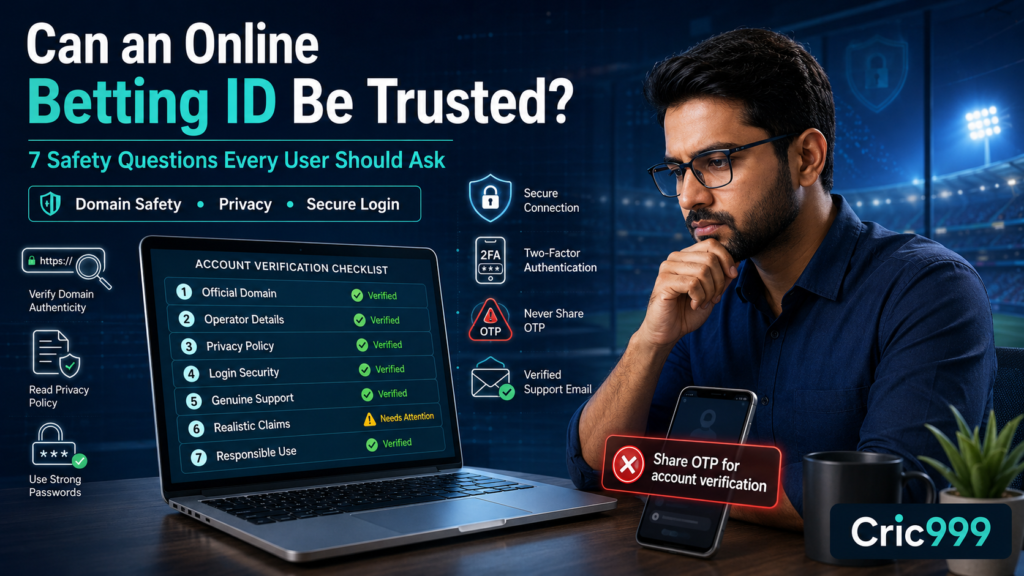
Words such as “trusted,” “verified,” “secure” and “official” appear frequently across online platforms and social-media profiles. However, these labels are marketing claims unless users can verify them independently. Before trusting an Online Betting ID, sharing identity documents or making any payment, users should examine who operates the service, how it protects personal data and whether its policies are transparent. A professional-looking website is not proof of legitimacy. The following seven questions provide a practical framework for identifying warning signs and making safer, more responsible decisions.
Can an Online Betting ID Be Trusted Without Verification?
No online account, platform or private agent should be trusted solely because it has positive testimonials, a large social-media following or an official-looking logo. Reviews can be manipulated, screenshots can be edited, and impersonators may copy the design of a genuine website.
Trust should be based on verifiable information, including an accurate domain, identifiable operator, readable policies and traceable support channels. These checks may reduce risk, but no verification method can guarantee complete safety.
1. Is the Website Address Official and Correct?
Start by examining the complete website address. Fraudulent websites often replace one letter, add a hyphen or use an unusual subdomain to imitate a known platform. Users should also watch for unexpected redirects, fake download buttons and login links received from unknown messaging accounts.
HTTPS means that information exchanged with a website is encrypted in transit. It does not prove that the website or its operator is legitimate. CERT-In warns that phishing campaigns can use convincing messages and counterfeit websites to capture login credentials and personal information.
Instead of opening a random link, type the known address manually or verify it through a reliable official source.
2. Does the Platform Clearly Identify Its Operator?
Platform transparency requires more than a logo and customer-support number. Users should look for the operator’s name, contact details, jurisdiction, terms and conditions, privacy policy and complaint procedure.
Missing information deserves caution. Copied legal pages, anonymous ownership or support available only through private messages may indicate that accountability is limited. However, the presence of legal pages does not automatically prove legitimacy. Users should check whether the information is specific, consistent and reasonably verifiable.
The regulatory position of online gaming in India may also depend on the activity involved and the applicable rules. The Ministry of Electronics and Information Technology currently publishes the Promotion and Regulation of Online Gaming Act, 2025, related rules and information about the Online Gaming Authority of India. Users should consult current official guidance rather than relying on an agent’s legal claims.
3. What Personal Information Does It Request?
Before submitting information, ask why the platform needs it, how long it will retain it and who may receive it. Requests for names, phone numbers, identity documents, location access, device permissions or bank-related details should have a clear purpose.
This reflects data minimisation: a service should collect only the information reasonably required for a stated function. Users should not provide unnecessary identity documents or allow unrelated device permissions.
Never share passwords, PINs, OTPs or card CVVs with an agent or support representative. The Reserve Bank of India states that banks and payment-system operators do not ask customers for passwords, PINs, OTPs or CVV numbers.
A profile requesting an OTP to “verify” or “recover” an account should therefore be treated as a serious warning sign.
4. How Secure Are the Login and Recovery Systems?
Secure login practices begin with a strong, unique password that is not reused for email, banking or social-media accounts. Where available, users should enable two-factor or multi-factor authentication, login alerts and device-management controls.
CERT-In recommends using unique passwords and enabling multi-factor authentication for online accounts. It also advises users to avoid downloading applications or files from unverified sources.
Account recovery deserves equal attention. A strong password offers limited protection if anyone can reset it through an easily guessed question or an unverified support profile. Genuine recovery procedures should use traceable, secure verification rather than asking users to surrender account control.
5. Are the Support Channels Genuine and Traceable?
Reliable support should be connected to the platform’s published website and provide written, traceable communication. Useful signs include an official-domain email address, ticket number, contact page and clear escalation process.
Be cautious when a person claiming to be an agent contacts you privately and requests payment, remote-screen access or an OTP. Compare the contact information with the details published on the official website. Inconsistencies between email addresses, phone numbers and support instructions may indicate impersonation.
6. Are the Offers and Payment Claims Realistic?
Promises of guaranteed returns, fixed results, risk-free earnings or instant profits should not be treated as evidence of trust. Neither should claims about secret strategies or guaranteed account recovery.
Scammers often create urgency by saying an offer will expire immediately or an account will be blocked unless payment is made. CERT-In identifies urgent messages and links leading to counterfeit websites as common phishing techniques.
Users should pause when asked to transfer money to a personal account or make an immediate payment without written terms. Pressure is not verification.
7. Does the Platform Encourage Responsible Use?
A responsible platform should communicate age restrictions, financial and behavioural risks, account-control options, complaint procedures and any available limits or cooling-off tools.
These protections may help users control activity, but they cannot eliminate financial loss or behavioural harm. Users should stop and seek suitable professional or personal support if online activity begins affecting their finances, work, relationships or wellbeing.
Legal availability should never be assumed. Users must check current national and locally applicable requirements through official sources before participating in any online activity involving money.
Red Flags Users Should Never Ignore
Warning signs include:
- A misspelled or frequently changing domain
- No meaningful privacy policy or operator details
- Requests for OTPs, PINs, passwords or CVVs
- Support available only through private profiles
- Guaranteed-win or risk-free-profit claims
- Pressure to pay immediately
- Payment requested through an unrelated personal account
- Unknown APK files or unofficial application downloads
- Requests for remote-screen access
- Repeated redirects to unfamiliar login pages
Users who encounter suspected cyber fraud can access India’s National Cyber Crime Reporting Portal. Financial cyber-fraud incidents should be reported as quickly as possible through the official reporting channels.
How Cric999 Supports Safer Online Awareness
The Cric999 digital-safety resources publish informational content covering cricket education, account-safety awareness, fake-link prevention, official-domain checking and responsible online behaviour. This educational role should not be interpreted as verification, approval or endorsement of any Online Betting ID service.
Frequently Asked Questions
Is HTTPS proof that an Online Betting ID website is genuine?
No. HTTPS encrypts information exchanged between a browser and a website, but a fraudulent website can also use HTTPS. Users must check the domain, operator details, policies and official contact information.
Should users share an OTP with customer support?
No. An OTP can authorise account access or a financial transaction. It should not be disclosed to agents, callers or private support profiles.
What should users do after opening a suspicious link?
They should avoid entering information, close the page, check the device for unwanted downloads and change affected passwords through the genuine website. Multi-factor authentication should also be enabled where available.
Are online gaming rules identical throughout India?
Users should not assume this. The applicable legal position may depend on the nature of the activity and current central or other applicable requirements. Current guidance should be verified through official government sources.
Conclusion
An Online Betting ID should not be considered trustworthy merely because an advertisement, testimonial or private agent describes it that way. Trust requires verifiable operator information, transparent policies, secure login systems, realistic communication and responsible-use protections. Check domains carefully, protect personal information, reject unrealistic promises and read the relevant policies before acting. Users in India should also review current official regulations and cybersecurity guidance because rules and risks can change. The final decision should be informed, cautious and based on evidence rather than urgency or promotional claims.