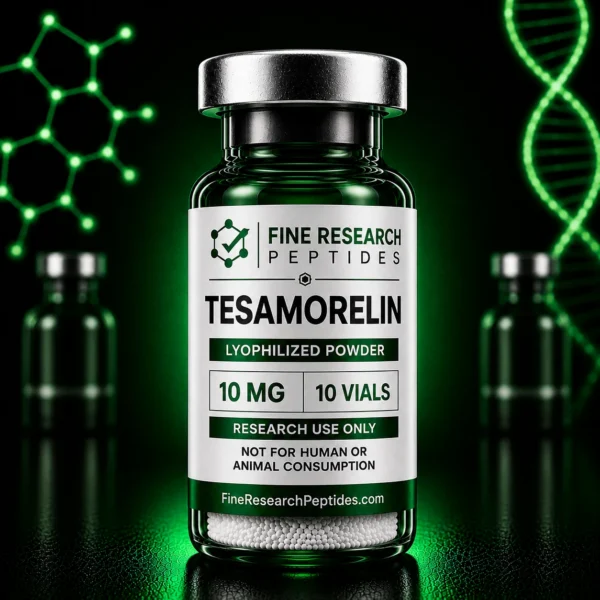
best place to buy tesamorelin online
In neuroendocrine research and metabolic signaling, the growth hormone secretagogue axis serves as a primary model for studying cellular regeneration, lipolysis, and protein synthesis. Central to this system is growth hormone-releasing hormone (GHRH), a hypothalamic peptide that binds directly to GHRH receptors on anterior pituitary somatotrophs, stimulating the pulsatile synthesis and secretion of endogenous growth hormone (GH).
Unlike exogenous growth hormone administration—which bypasses natural negative feedback loops and suppresses native pituitary function—GHRH analogues preserve somatotroph responsiveness and maintain physiological GH pulsatility.
Among these synthetic secretagogues, Tesamorelin stands out as a stabilized, 44-amino-acid GHRH analogue modified with a trans-3-hexenoic acid group at its N-terminus. This structural alteration dramatically extends its enzymatic half-life while retaining full receptor binding affinity.
For research institutions investigating visceral adiposity, hepatic lipid turnover, and neurotrophic signaling, obtaining analytical-grade compounds from the best place to buy tesamorelin online is essential for maintaining strict experimental control over endocrine assays.
1. Molecular Mechanism: N-Terminal Stabilization and Somatotroph Receptor Kinetics
To evaluate the scientific rationale behind Tesamorelin signaling, researchers must examine how its structural modification alters binding kinetics at the pituitary level.
The underlying signaling mechanisms activated by Tesamorelin include:
-
Enzymatic Resistance: Native GHRH ($1\text{–}44$) is rapidly cleaved by dipeptidyl peptidase-IV (DPP-IV) at its N-terminal $Ala^2\text{-Asp}^3$ peptide bond, yielding an inactive fragment with a half-life of less than 10 minutes. The trans-3-hexenoic acid modification on Tesamorelin blocks DPP-IV cleavage, extending its plasma half-life and biological activity.
-
G-Protein Coupled Receptor (GPCR) Activation: Tesamorelin binds with high specificity to the pituitary GHRH receptor, activating adenylate cyclase and increasing intracellular cyclic AMP ($cAMP$) and $Ca^{2+}$ influx. This cascade triggers exocytosis of stored GH granules without causing receptor desensitization or somatotroph exhaustion.
-
Downstream Hepatic IGF-1 Axis: Circulating growth hormone acts directly on hepatocytes to stimulate the transcription and release of Insulin-like Growth Factor 1 ($IGF\text{-}1$). This downstream mediator coordinates systemic protein translation, satellite cell activation, and nitrogen retention in peripheral tissues.
For laboratories establishing longitudinal Somatotroph Axis trials, sourcing sequence-verified compounds from a reputable vendor offering high-purity tesamorelin peptide for sale ensures consistent bioactivity across extended protocols.
2. Preclinical Application Across Visceral Fat and Metabolic Models
In preclinical models of metabolic syndrome, antiretroviral-associated lipodystrophy, and non-alcoholic fatty liver disease (NAFLD), Tesamorelin administration produces distinct metabolic improvements.
Key experimental milestones documented in metabolic literature include:
-
Visceral Adipose Tissue (VAT) Reduction: Exogenous GHRH agonism activates protein kinase A ($PKA$) and hormone-sensitive lipase ($HSL$) in deep visceral fat depots. This selectively reduces visceral adiposity while preserving subcutaneous fat and lean muscle mass.
-
Hepatic Steatosis Mitigation: In animal models of hepatic lipid accumulation, Tesamorelin lowers intrahepatic triglyceride content, suppresses pro-inflammatory cytokines ($TNF\text{-}\alpha$, $IL\text{-}6$), and improves liver enzyme profiles ($ALT/AST$).
-
Preservation of Glucose Homeostasis: Because Tesamorelin promotes natural, pulsatile GH release rather than constant elevation, it avoids the severe insulin resistance and hyperglycemia frequently observed with continuous exogenous human growth hormone (hGH) protocols.
3. Analytical Benchmarks for High-Purity GHRH Analogue Synthesis
Because Tesamorelin is a large 44-amino-acid peptide with an N-terminal lipophilic modification, precise Solid-Phase Peptide Synthesis (SPPS) and rigorous purification are required. Synthetic errors, truncated sequences, or residual reagents can alter binding affinity or induce cellular toxicity.
| Analytical Parameter | Low-Tier Global Imports | Certified USA Research Standard | Impact on Experimental Data |
| RP-HPLC Purity Profile | Variable (80–90%) | Guaranteed $\ge$98% per batch | Eliminates truncated fragments from interfering with $GHRH$ binding |
| ESI-MS Mass Identity | Unverified or generic | Confirmed mass ($5195.9\text{ Da}$) | Validates full 44-amino-acid sequence and trans-3-hexenoic adduct |
| Endotoxin Level (LAL) | High risk ($>0.5\text{ EU/mg}$) | Strict $\le0.25\text{ EU/mg}$ benchmark | Prevents $TLR4$-mediated systemic inflammation and cytokine interference |
| Counter-Ion Profile | High residual $TFA$ salts | Acetate/salt-exchanged options | Eliminates pH shifts and localized cell culture toxicity |
Sourcing materials through an authenticated domestic research peptide supplier usa guarantees that every lot is backed by lot-specific Reverse-Phase High-Performance Liquid Chromatography (RP-HPLC) and Electrospray Ionization Mass Spectrometry (ESI-MS) documentation.
4. Reconstitution Mechanics and Liquid Solution Preservation
Maintaining the structural stability of reconstituted long-chain peptides is critical during longitudinal research protocols. Large peptides like Tesamorelin are susceptible to hydrolytic cleavage, aggregation, and microbial degradation in aqueous environments.
When reconstituting a multi-dose tesamorelin peptide for sale vial intended for multi-week trial designs, using unpreserved sterile water introduces a risk of microbial infiltration upon repeated vial entries. Introduced bacteria produce peptidases that quickly degrade the 44-amino-acid chain.
To safeguard experimental integrity:
-
Preserved Reconstitution Vectors: Dissolve lyophilized peptide cakes using high-grade bacteriostatic water for peptides containing 0.9% USP-grade benzyl alcohol. Formulations supplied in bacteriostatic water 10ml or 10ml bacteriostatic water formats inhibit bacterial growth and preserve compound stability for up to 28 days under refrigeration ($2^\circ\text{C}$ to $8^\circ\text{C}$).
-
Handling Standards: Direct the stream of bacteriostatic water for reconstituting peptides slowly down the inner glass wall of the vial. Gently swirl until fully dissolved; avoid vigorous shaking or vortexing, which can introduce mechanical shear stress and cause peptide aggregation.
5. Endotoxin Control and Preclinical Precision
Bacterial endotoxins (lipopolysaccharides, or LPS) present a major confounding variable in neuroendocrine and metabolic research.
In primary pituitary cell cultures, hepatocyte assays, and in vivo metabolic models, trace endotoxin levels bind to Toll-like receptor 4 ($TLR4$). This binding triggers an upstream NF-$\kappa$B pro-inflammatory response ($TNF\text{-}\alpha$, $IL\text{-}6$), inducing inflammatory stress and altering $IGF\text{-}1$ transcription. This background noise masks the true metabolic signaling of GHRH secretagogues.
Selecting reagents verified via Limulus Amebocyte Lysate (LAL) testing guarantees endotoxin levels remain strictly below $0.25\text{ EU/mg}$. Combined with expedited domestic cold-chain shipping, this preserves compound bioactivity and ensures clean, publishable data.
Advancing Pituitary Secretagogue Science
The application of stabilized GHRH analogues like Tesamorelin represents a major advancement in understanding somatotroph axis dynamics, visceral lipolysis, and hepatic lipid management. By stimulating physiological, pulsatile growth hormone release through native pituitary receptors, Tesamorelin provides a precise model for metabolic and neuroendocrine studies.
For laboratories determining the best place to buy tesamorelin online and establishing protocols to buy peptides online for research use, adhering to strict analytical standards—including $\ge98\%$ HPLC purity, LAL endotoxin verification, and proper preserved reconstitution—is essential. Sourcing high-purity, analytical-grade compounds ensures that research institutions generate reliable, reproducible, and publication-ready scientific datasets.