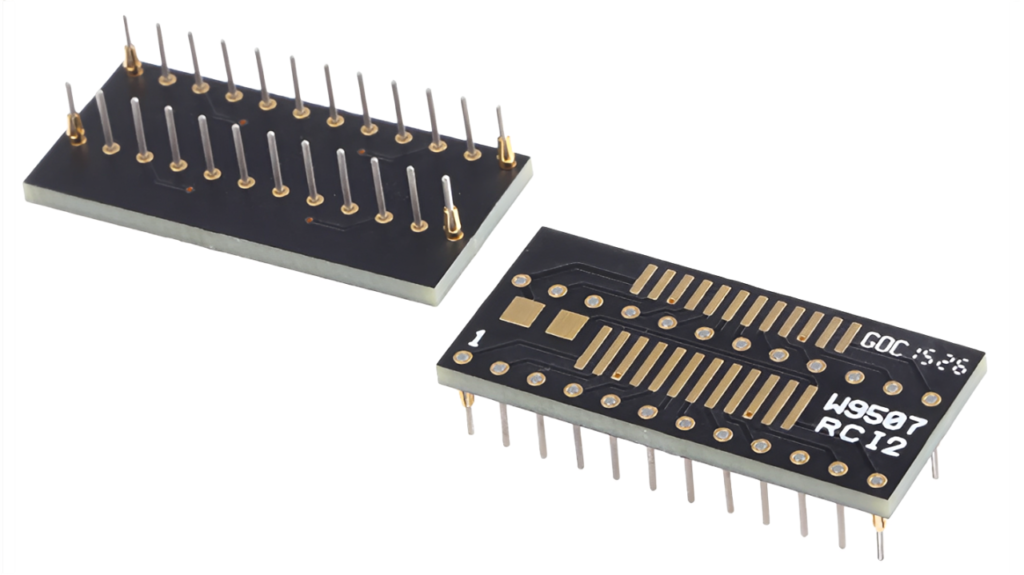
IC Socket Adapters
Introduction
Electronic systems are becoming smaller, faster, and more complex, yet engineers still need practical ways to test, replace, programme, and upgrade integrated circuits. IC Socket Adapters provide a flexible connection method that allows an IC to communicate with a circuit board, development platform, programmer, or test system without requiring a permanent direct installation.
Their value extends beyond simple package conversion. They can protect expensive components, preserve printed circuit boards, support design changes, and help maintenance teams keep equipment operational for longer. In applications where reliability, accessibility, and compatibility matter, IC Socket Adapters can become an important part of the overall engineering strategy.
What Role Do IC Socket Adapters Play in Modular Circuit Design?
Modular design allows individual parts of an electronic system to be changed without replacing the entire assembly. IC Socket Adapters support this approach by making integrated circuits removable and interchangeable.
A designer may use one circuit board to evaluate several compatible devices. Instead of soldering each IC directly to the board, an adapter provides a stable connection that can be reused during testing.
This approach supports:
- Rapid component substitution
- Easier circuit experimentation
- Simplified board revisions
- Reduced prototype waste
- Faster fault identification
- Convenient firmware updates
- Improved access to critical devices
Modular connections are especially useful when a product is still being developed and the final IC has not yet been selected.
How Do IC Socket Adapters Protect Printed Circuit Boards?
Repeated soldering and desoldering can weaken PCB pads, damage tracks, and affect nearby components. This risk increases when fine-pitch devices or multilayer circuit boards are involved.
IC Socket Adapters reduce the need to apply heat directly to the board whenever an integrated circuit must be replaced. The adapter is installed once, while the IC can be inserted or removed as required.
This can help protect the board from:
- Lifted copper pads
- Damaged plated holes
- Excessive thermal exposure
- Solder contamination
- Broken component leads
- Accidental bridging
- Repeated mechanical stress
Preserving the PCB is particularly important in costly prototypes, specialist instruments, and equipment that is difficult to replace.
How Are Package Differences Managed?
Integrated circuits are available in a wide range of package formats. These include dual in-line, small outline, quad flat, chip carrier, ball grid array, and other specialised arrangements.
A circuit board designed for one format cannot normally accept another without modification. IC Socket Adapters create a mechanical and electrical bridge between the device and the required connection footprint.
The adapter must correctly manage:
- Pin count
- Pin spacing
- Row width
- Device orientation
- Contact arrangement
- Package dimensions
- Signal routing
- Mounting style
Accurate mapping is essential. Every connection on the IC must reach the intended point on the circuit board or test system.
Why Does Contact Quality Matter?
The electrical connection inside an adapter must remain stable under normal operating conditions. Weak or contaminated contacts may introduce resistance, noise, or intermittent behaviour.
High-quality IC Socket Adapters are manufactured with carefully formed contacts that provide consistent pressure against the IC leads or terminals. Contact finishes may include tin, nickel, or gold, depending on the required durability and environment.
Reliable contacts help provide:
- Stable signal transmission
- Low connection resistance
- Improved corrosion protection
- Secure mechanical retention
- Consistent performance during repeated use
- Reduced risk of intermittent faults
Gold-plated contacts are often chosen for demanding applications because they resist oxidation and support dependable conductivity.
How Can IC Socket Adapters Affect Signal Performance?
An adapter adds extra conductive paths between the integrated circuit and the main circuit. In many low-frequency applications, this has little effect. However, high-speed or precision systems require greater attention.
Additional lead length may introduce small amounts of capacitance, inductance, resistance, or signal delay. These effects can influence timing, communication quality, or noise levels.
Engineers should consider:
- Operating frequency
- Signal rise time
- Data transfer speed
- Current demand
- Voltage level
- Ground connection quality
- Distance between contacts
- Adapter track layout
For sensitive applications, the adapter should be specifically designed for high-frequency or low-noise performance.
Where Are IC Socket Adapters Used During Product Development?
Development teams regularly test alternative components before approving a final design. IC Socket Adapters allow these evaluations to take place without permanent changes to the PCB.
They are commonly used when testing:
- Microcontrollers
- Memory devices
- Logic circuits
- Interface controllers
- Signal converters
- Timing devices
- Amplifiers
- Programmable components
An engineer can insert one device, record its performance, remove it, and install another. This creates a controlled and repeatable comparison process.
Adapters also make it easier to investigate failures. A suspected IC can be replaced quickly to determine whether the problem is caused by the component or another part of the circuit.
How Do IC Socket Adapters Support Production Programming?
Many electronic products require firmware, calibration data, security information, or configuration settings to be loaded into an IC before assembly.
Programming systems often use specialised IC Socket Adapters to hold devices securely while data is written and verified. These adapters may include hinged covers, locking frames, or zero-insertion-force mechanisms.
Production programming benefits include:
- Fast device loading
- Accurate positioning
- Reduced risk of bent pins
- Repeatable electrical contact
- Efficient batch processing
- Easier removal after verification
Adapters intended for manufacturing are usually designed to withstand frequent opening, closing, insertion, and removal.
Why Are They Useful for Equipment Maintenance?
Industrial machines, laboratory instruments, communication systems, and control units may remain in service for many years. During that time, an original IC may fail or become unavailable.
IC Socket Adapters can support repair by allowing a compatible replacement device to connect to the existing board. In some cases, the adapter may reroute pins or convert a newer package into the older footprint.
This approach can help maintenance teams:
- Restore obsolete equipment
- Avoid complete PCB replacement
- Reduce system downtime
- Use modern replacement components
- Simplify future repairs
- Extend equipment service life
This is particularly valuable when replacing the entire machine would be expensive or operationally disruptive.
What Mechanical Factors Should Be Evaluated?
An adapter must fit physically as well as electrically. Its additional height, width, and mounting arrangement can affect the surrounding assembly.
Before selection, check:
- Available vertical clearance
- Distance from nearby components
- Enclosure dimensions
- Heat sink positioning
- Cable routing
- Ventilation requirements
- Vibration exposure
- Device retention strength
In compact products, even a small increase in height may prevent the enclosure from closing correctly. Mechanical measurements should therefore be confirmed before installation.
How Should IC Socket Adapters Be Handled?
Careful handling helps prevent damage to the adapter and integrated circuit.
Recommended practices include:
- Confirm the correct orientation
- Inspect pins before insertion
- Use electrostatic discharge protection
- Keep contacts free from dust and oil
- Apply even insertion pressure
- Avoid forcing misaligned devices
- Use suitable removal tools
- Check continuity before power is applied
- Follow recommended soldering temperatures
Bent pins should be corrected carefully before installation. A device should never be forced into an adapter that does not match its package.
Conclusion
IC Socket Adapters help engineers create flexible, maintainable, and adaptable electronic systems. They support package conversion, component testing, production programming, circuit repair, and long-term equipment support.
Their effectiveness depends on accurate package matching, dependable contact materials, suitable electrical performance, sufficient mechanical clearance, and careful installation. When selected correctly, IC Socket Adapters can protect circuit boards, reduce development time, simplify component replacement, and support reliable operation throughout the life of an electronic system.