Manufacturers are under constant pressure to maintain product quality, minimise production delays, and improve workplace safety while managing complex operations. Artificial intelligence is helping address these challenges by analysing production data, identifying process irregularities, and supporting faster operational decisions. AI in manufacturing and operations is becoming increasingly valuable for organisations looking to improve production efficiency and maintain consistent quality. Are there benefits of using AI to improve production efficiency and quality control? Yes. AI can help identify visible defects, monitor production activities, detect potential safety risks, and highlight operational issues that may affect output. Intozi, through its Ikshana Vision AI platform, supports camera-based analytics that can provide additional visibility into manufacturing environments.
How AI Is Changing Modern Manufacturing Operations
The adoption of AI in manufacturing is extending beyond basic automation. Manufacturers are using AI to analyse information from machines, production lines, sensors, and cameras to understand operational performance.
Some important applications include:
- Production monitoring: Analysing selected activities to identify delays and process irregularities.
- Quality inspection: Identifying visible defects and missing components through configured computer vision models.
- Predictive maintenance: Analysing machine data to identify patterns that may indicate maintenance requirements.
- Resource optimisation: Supporting better planning of materials, labour, and production schedules.
- Safety monitoring: Identifying selected unsafe activities and generating alerts for review.
These applications help manufacturers improve visibility into daily operations and make decisions based on relevant information.
How Artificial Intelligence in Manufacturing Improves Quality Control
Product quality depends on consistent processes, accurate inspections, and timely identification of defects. Artificial intelligence in manufacturing can support quality control by analysing production data and visual information.
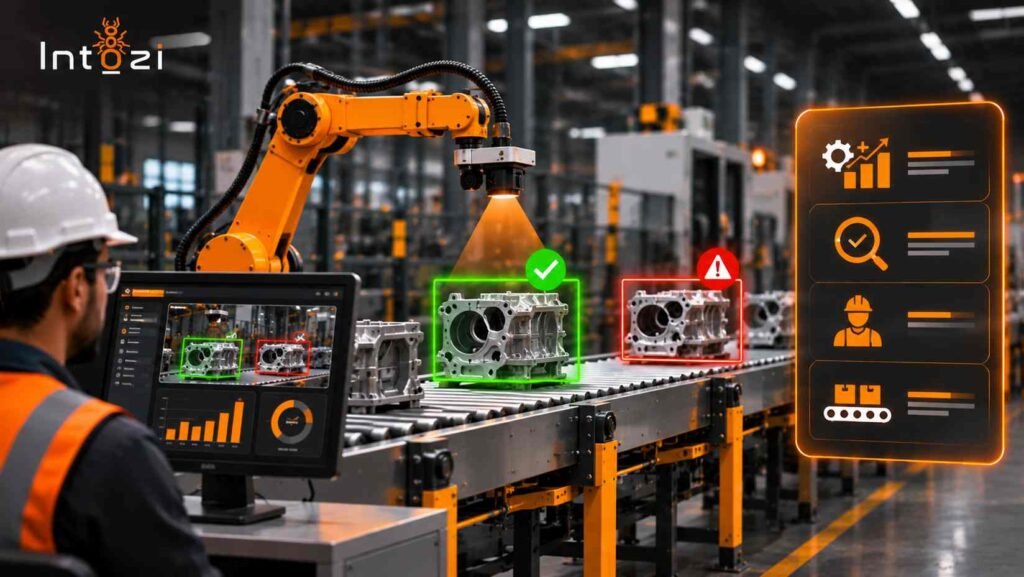
Computer vision systems can be configured to identify visible surface defects, missing components, incorrect positioning, or other predefined inspection conditions.
AI-based quality monitoring can help manufacturers:
- Identify visible product defects during selected inspection stages.
- Monitor component placement and assembly activities.
- Reduce dependence on repetitive manual visual checks.
- Maintain records of detected quality-related events.
- Identify recurring patterns that require further investigation.
AI inspection is most effective when models are trained for specific products and defect types. Human verification and established quality assurance procedures remain important, particularly for critical inspections.
Why Smart Manufacturing Solutions Matter for Production Efficiency
Modern factories need connected systems that provide a clearer picture of production activities. Smart manufacturing solutions combine AI, automation, sensors, industrial software, and connected equipment to improve coordination across production environments.
These solutions can support:
- Better production planning and scheduling.
- Improved visibility into machine and process performance.
- More coordinated material movement.
- Faster identification of operational bottlenecks.
- Data-supported decisions for resource allocation.
When production systems share reliable information, manufacturers can identify inefficiencies and take corrective action more effectively.
How Manufacturing Video Analytics Improves Factory Visibility
Manufacturing facilities have multiple activities taking place simultaneously, from assembly and material handling to packaging and dispatch. Manufacturing video analytics uses computer vision to analyse compatible CCTV footage and identify selected activities or events.
Depending on camera coverage and model configuration, it can help with:
- Monitoring movement around production lines.
- Identifying unauthorised entry into restricted areas.
- Observing material handling and equipment movement.
- Detecting selected safety-related events.
- Reviewing activity around designated production zones.
This adds an intelligent monitoring layer to existing camera infrastructure and helps supervisors focus on events that may require attention.
The Role of an Industrial AI Monitoring System in Daily Operations
An industrial AI monitoring system can combine information from cameras, sensors, and connected operational systems to support a more coordinated view of factory activities.
For example, camera-based analytics may identify a vehicle entering a restricted zone, while machine data may indicate an unusual operating condition. Reviewing these signals together can help teams understand potential operational issues.
Such systems can support:
- Centralised monitoring across factory areas.
- Alerts for predefined events and process conditions.
- Better visibility into selected production activities.
- Faster review of operational incidents.
- More structured reporting for supervisors.
The exact capabilities depend on available data sources, system compatibility, and deployment requirements.
How a Factory Safety Analysis System Helps Reduce Workplace Risks
Manufacturing environments may involve heavy machinery, forklifts, moving vehicles, and employees working in shared spaces. A factory safety analysis system can help identify selected unsafe conditions through configured monitoring rules.
Applications may include PPE detection, restricted-area monitoring, unsafe vehicle movement detection, and observation of activities around hazardous zones.
These insights can help safety teams:
- Identify potential safety violations for review.
- Monitor designated hazardous areas.
- Receive alerts for configured unsafe events.
- Review recorded footage during incident investigations.
- Identify recurring safety concerns across monitored locations.
AI-based alerts should complement safety training, inspections, and established workplace procedures rather than replace them.
Why Real-Time Manufacturing Analytics Supports Better Decisions
Production delays and quality issues can affect output when they are not identified promptly. Real-time manufacturing analytics helps organisations review incoming operational information and identify conditions that may need attention.
By analysing available production data and video-based events, manufacturers can gain insights into activity patterns, recurring interruptions, and selected process deviations.
For instance, prolonged inactivity in a monitored production zone may prompt a supervisor to investigate a possible delay. Similarly, repeated safety alerts in one area may indicate a need to review site procedures or equipment arrangements.
How Process-Oriented AI Detection Improves Manufacturing Monitoring
Different production processes have different monitoring requirements. Process-oriented AI detection in manufacturing focuses on identifying specific activities, conditions, or deviations within a defined workflow.
Rather than applying the same detection rules everywhere, manufacturers can configure analytics around particular operational needs, such as assembly monitoring, PPE compliance, material movement, or restricted-zone activity.
A suitable AI-powered industrial safety solution can also help identify predefined safety events and notify relevant personnel. This enables teams to review the situation and take action based on the event and its context.
How Intozi and Ikshana Support Intelligent Manufacturing
Intozi provides AI video analytics capabilities through Ikshana, its Vision AI platform. It can be configured to analyse compatible CCTV feeds and support selected manufacturing monitoring requirements.
Depending on deployment needs, applications can include PPE detection, restricted-area monitoring, vehicle movement monitoring, fire and smoke detection, and process-related activity monitoring. These capabilities help manufacturers turn selected camera feeds into useful alerts and operational information.
By combining video intelligence with existing factory systems and human supervision, Intozi and Ikshana can support better visibility into production activities, workplace safety, and operational performance.
Frequently Asked Questions (FAQs)
1. How does AI improve production efficiency in manufacturing?
AI analyses production information to identify delays, recurring issues, and opportunities for better resource utilisation. Intozi’s Ikshana platform can complement these applications through configured video analytics for monitoring selected factory activities.
2. Can AI detect product defects during manufacturing?
Yes, computer vision models can identify visible defects and predefined inspection issues when configured for specific products and inspection requirements. Intozi and Ikshana support camera-based analytics that can provide additional visual information for manufacturing teams.
3. How does AI video analytics improve factory safety?
AI video analytics can monitor selected areas for events such as PPE violations, restricted-zone entry, and unsafe vehicle movement. Intozi’s Ikshana platform can generate alerts for configured safety applications, helping teams review potential risks.
4. What is the role of AI in smart manufacturing?
AI supports production monitoring, quality inspection, predictive maintenance, and operational planning. Intozi and Ikshana can contribute through video-based monitoring applications that provide additional visibility into manufacturing environments.
5. Can AI monitoring systems work with existing factory cameras?
Yes, compatible CCTV cameras can often be used for configured video analytics applications, depending on their quality, connectivity, and placement. Intozi’s Ikshana platform can analyse supported camera feeds without necessarily requiring a complete CCTV replacement.