Electric vehicles have improved dramatically, but many drivers still hesitate before making the switch. They may like quiet acceleration, lower everyday energy costs, and the convenience of charging at home, yet worry about long trips, towing, cold weather, or finding a reliable public charger. Extended-range electric vehicles could offer an appealing answer.
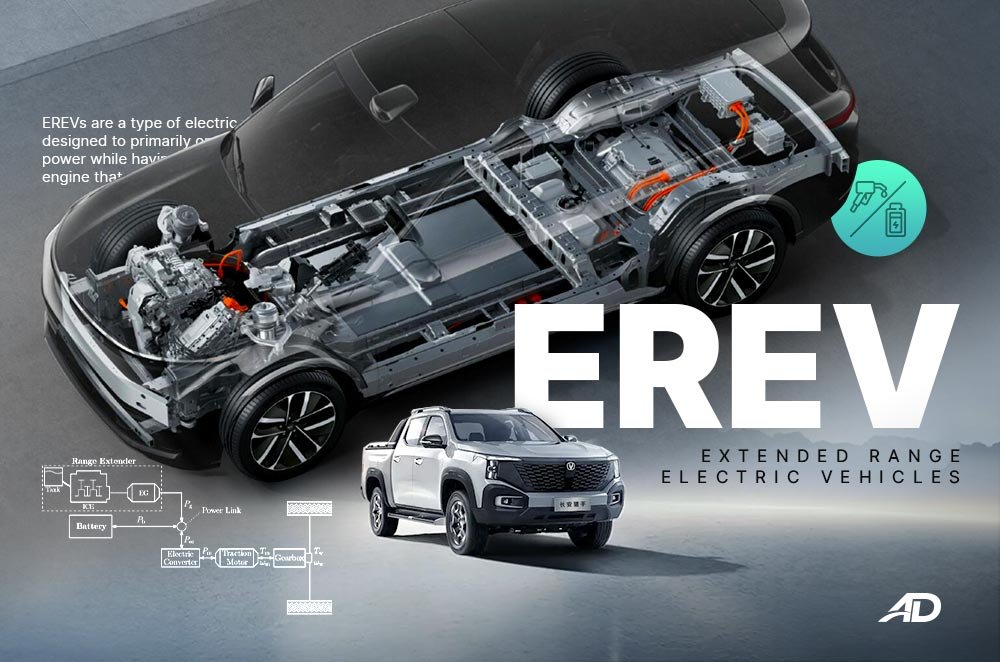
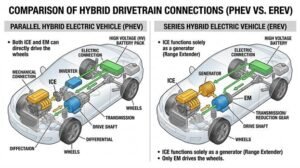
An extended-range electric vehicle, often shortened to EREV or REEV, is driven primarily by electric motors. It carries a battery that can be plugged in and charged, much like a battery-electric vehicle. The key difference is a small combustion engine that can generate electricity when the battery becomes depleted. In a typical EREV design, that engine is not the main source of mechanical power for the wheels.
This arrangement sounds like a compromise, and technically it is. But compromise is not always a weakness. For millions of drivers, the winning vehicle may not be the one with the purest powertrain. It may be the one that makes electric driving easy without turning an occasional long journey into a charging puzzle.
What Makes an Extended-Range EV Different?
The automotive market now contains several electrified powertrains. A battery-electric vehicle runs entirely on stored electricity. A conventional hybrid uses an electric motor to assist its engine but is not normally plugged in. A plug-in hybrid can travel some distance electrically, while its engine can usually help drive the wheels.
An EREV approaches the job differently. Electric motors provide the familiar EV driving experience, while the onboard engine works mainly as a generator. When the battery has sufficient energy, the vehicle can complete everyday journeys without burning gasoline. When more range is needed, the generator supplies electricity so the journey can continue.
The wheels still feel electric
Because the electric motors remain responsible for propulsion, an EREV can deliver smooth acceleration and immediate torque even after its gasoline generator starts. The engine can also operate within a narrower and potentially more efficient speed range than an engine that must directly respond to every movement of the accelerator.
The boundary between an EREV and a plug-in hybrid is not always neat. Some architectures can connect the engine mechanically under limited conditions. Buyers should look beyond the badge and ask how the vehicle operates, how far it travels on battery power, and whether its engine drives the wheels.
Why Drivers May Be Ready for EREVs
The strongest case for extended-range electric vehicles is not that people dislike EVs. It is that many people like electric driving but remain uncomfortable with the practical limits surrounding it.
Range anxiety becomes less important
Modern battery-electric cars can cover substantial distances, yet highway speeds, low temperatures, steep terrain, heavy cargo, and towing can increase energy use. Public chargers may also be busy, broken, or poorly located.
An EREV reduces the consequences of those uncertainties. Drivers can charge at home and use electricity for routine travel, then rely on the generator when a journey extends beyond the available battery range. Refueling takes place through the familiar fuel network, which can be valuable in rural regions and places where charging infrastructure is still developing.
That flexibility helps explain the attention surrounding models such as Scout Motors’ planned Traveler SUV and Terra pickup. Scout describes its Harvester option as a gas-powered range extender that generates energy for the electric drive system. Reuters reported in 2026 that the extended-range versions attracted the large majority of Scout’s early reservations, although reservations are not the same as completed sales.
Daily travel can remain mostly electric
The presence of an engine does not mean it must run every day. If the battery covers a driver’s normal commute, shopping trips, school runs, and local errands, most journeys can still be completed in electric mode. The generator becomes backup for infrequent long-distance travel rather than the default power source.
The result depends heavily on behavior. An owner who rarely charges may carry a large battery and electric hardware while regularly burning fuel. EREVs work best when plugging in is easy and becomes part of the owner’s routine.
Why Automakers Are Taking the Idea Seriously
Manufacturers are investing in batteries, software, factories, and charging partnerships, but regions are moving toward full EVs at different speeds. An EREV lets a company offer electric-focused driving to buyers who are not ready to depend completely on charging.
Smaller batteries can stretch limited resources
Compared with a long-range battery-electric truck or large SUV, an EREV may be able to use a smaller battery while maintaining impressive total driving range. This can reduce the quantity of expensive battery materials needed per vehicle and potentially allow a manufacturer to build more electrified models from a fixed supply of cells.
An EREV still needs an engine, fuel tank, exhaust equipment, cooling components, and emissions controls. These add cost, weight, and complexity, so the smaller battery does not guarantee a cheaper or lighter vehicle.
Trucks and SUVs are a natural testing ground
Large vehicles expose some of the hardest challenges for full electrification. A heavy battery can provide excellent unloaded range, yet towing a trailer may reduce that range significantly. Charging a truck and trailer can also be awkward if a station requires the trailer to be disconnected.
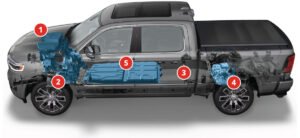
This makes pickups, family SUVs, and work vehicles logical candidates for range extenders. Stellantis originally presented the Ram 1500 Ramcharger as a battery-powered truck supported by an onboard generator, while Scout has built the Harvester concept into its future truck and SUV plans. These vehicles aim to deliver electric torque for work and recreation without asking every owner to depend on high-power charging on every route.
China Shows That the Concept Can Scale
EREVs are sometimes discussed as if they were a brand-new invention, but the basic idea has existed for years. What has changed is its commercial scale and sophistication, particularly in China.
Brands such as Li Auto helped popularize large, technology-rich EREVs for families. Other manufacturers have since entered or announced products in the category. Reuters reported in 2026 that Xiaomi unveiled extended-range SUVs, illustrating how the format has moved from a niche solution into a competitive product strategy.
Success in one market does not guarantee success everywhere
Driving patterns, fuel prices, charging access, and regulations vary by market. A powertrain receiving favorable treatment in one country may be regulated as a plug-in hybrid elsewhere.
Automakers must also prove that total-range claims translate into sensible real-world efficiency. A very large fuel tank and a headline-grabbing combined range may look impressive, but those figures reveal little about fuel consumption after the battery is depleted. Buyers need separate electric-range and charge-sustaining efficiency figures to compare vehicles honestly.
The Environmental Case Is More Complicated Than the Marketing
An EREV can reduce fuel consumption when owners charge frequently and complete most travel on electricity. It can also use a smaller battery than some comparable long-range EVs. Those qualities may reduce resource demand and operating emissions in the right circumstances.
However, an EREV is not a zero-emission vehicle. Its generator produces tailpipe emissions whenever it runs, and the vehicle still requires fuel production and distribution. It also contains both battery components and combustion hardware, each with its own manufacturing footprint.
The International Energy Agency’s Global EV Outlook provides broader context on electric-car adoption, battery demand, charging, and policy. Its analysis reinforces an important point: environmental performance depends on the vehicle, the electricity supply, how often it is charged, and how it is actually driven.
Charging behavior can make or break the benefit
Studies of plug-in hybrids have repeatedly found a gap between laboratory assumptions and real-world fuel use when drivers do not charge regularly. EREVs with generous battery range may encourage more electric operation, but the same behavioral risk remains.
A well-used EREV might complete the working week on electricity and use gasoline for a weekend trip. A poorly used one might carry a battery that is rarely charged. The owner determines how much of the technology’s potential benefit becomes real.
The Tradeoffs Buyers Should Understand
EREVs solve several problems, but they do not eliminate compromise. The added engine and fuel system create more components that may eventually require inspection or repair. Owners may still need oil changes and emissions-system maintenance, even if the engine operates infrequently. Service technicians must understand both high-voltage electric systems and combustion equipment.
Efficiency after the battery is depleted matters
An EREV may feel like an EV at the accelerator, but energy still passes through several stages when gasoline is being used. The engine converts fuel into mechanical energy, the generator turns it into electricity, and the electric motor converts that electricity back into motion. Engineers can optimize the engine for generation, yet conversion losses still exist.
Consumers should therefore examine more than total range. Useful questions include the usable battery capacity, real-world electric range, fuel economy in generator mode, charging speed, towing efficiency, maintenance schedule, and performance when the battery reaches its lower operating limit.
Could EREVs Slow the Move to Fully Electric Cars?
Critics argue that range extenders could prolong gasoline dependence or delay affordable battery-electric vehicles. If EREVs are advertised as electric cars but mostly operated on fuel, their environmental benefit could be overstated.
Supporters see them as a bridge rather than a detour. A household may begin charging at home, become comfortable with electric propulsion, and discover that most trips require no gasoline. Its next vehicle may then be fully electric, especially as chargers become more available and batteries improve.
Both outcomes are possible. Electric range, charging behavior, pricing, regulation, and honest communication about fuel use will influence the result.
Why Extended-Range Electric Vehicles Could Become a Major Trend
The modern car market is asking for flexibility. Drivers want lower running costs but dislike uncertainty. They want cleaner technology but may not have dependable charging at every destination. They want electric performance without sacrificing family trips, rural travel, towing, or work capability.
Extended-range electric vehicles address that tension in a way that is easy to understand: drive electrically when possible, generate electricity onboard when necessary. The format is especially attractive while charging networks remain uneven and large batteries remain costly.
EREVs will not suit everyone. City drivers with home charging may be better served by a battery-electric car. People who cannot plug in regularly may prefer an efficient conventional hybrid. Long-distance drivers and those carrying heavy loads may find an EREV especially useful.
The next big trend may be a transition technology
The automotive industry’s future rarely arrives in one clean step. Technologies overlap while infrastructure, prices, and habits catch up. EREVs fit that messy reality. They offer much of the experience people enjoy in electric cars while keeping a familiar safety net for the journeys that still make them nervous.
Conclusion
Extended-range electric vehicles could become the next big car trend because they meet consumers where they are today. They can provide quiet electric driving for everyday trips, reduce dependence on public chargers, and make long-distance travel or towing less stressful. For automakers, they offer another route to electrification without requiring the largest possible battery in every vehicle.
Their success should not be judged by combined range alone. The best EREVs will need meaningful electric range, efficient generator operation, competitive pricing, transparent emissions data, and owners who plug them in consistently. They remain fuel-burning vehicles when the generator is active, and their mechanical complexity may create maintenance and cost tradeoffs.
Even so, the appeal is clear. An EREV can behave like an electric car most of the week and adapt when life demands more distance. Until fast, reliable charging becomes ordinary everywhere, that combination of electric character and long-range flexibility may be exactly what brings the next wave of drivers into electrified vehicles.