From Sample Concentration to Solvent Recovery in Modern Chemical Workflows
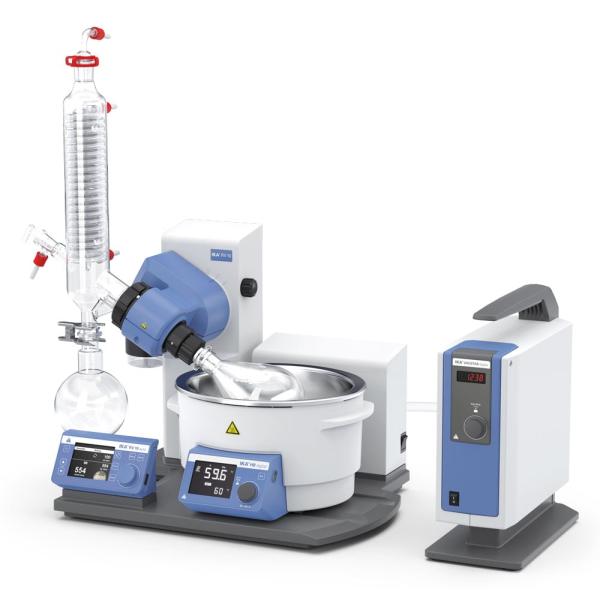
Laboratory processing often requires a liquid mixture to be concentrated before purification, analysis or further synthesis. Rotary Evaporators provide a practical way to remove suitable volatile solvents while giving researchers control over temperature, pressure and evaporation conditions. Their ability to combine rotation with controlled heating and reduced pressure makes them valuable in synthetic chemistry, pharmaceutical research, analytical preparation and many routine laboratory workflows.
Rather than relying on simple open evaporation, a rotary evaporator creates a closed processing arrangement in which solvent vapour can be removed from the sample and directed towards a condensation stage. This helps laboratories manage valuable samples more carefully while making solvent-removal procedures easier to control.
Where Does Rotary Evaporation Fit Into a Laboratory Workflow?
Rotary evaporation is often used after a preceding experimental step rather than as an isolated procedure.
A chemist may complete an extraction, synthesis, reaction or separation and then need to reduce the amount of solvent present. Removing that solvent can concentrate the dissolved material and prepare the sample for the next stage.
Typical objectives include concentrating reaction mixtures, reducing solvent volume, recovering appropriate volatile liquids and preparing fractions for further processing.
The exact operating conditions should always depend on the chemical system. Solvent characteristics, sample stability and desired final concentration all influence how the evaporation procedure should be approached.
Why Does Rotation Make a Difference?
The rotating flask is one of the defining features of the instrument.
As the flask turns, the liquid spreads across a greater area of its inner surface. Instead of remaining as a deep pool, the sample forms a moving film that is exposed to the controlled temperature of the bath.
This arrangement can improve contact between the liquid and the heated flask surface while supporting steady evaporation.
Rotation can also help maintain more uniform conditions within the sample. However, speed should be matched to the flask, liquid volume and physical properties of the mixture rather than simply being set as high as possible.
Controlled operation is generally more useful than aggressive processing.
Building the Evaporation Setup With Suitable Glassware
Rotary evaporation depends on several interconnected components, and suitable laboratory glassware is essential to creating a functional system.
Glass Components Distillation And Extraction provides relevant laboratory glassware for workflows in which vapour transfer, condensation, collection and chemical processing need to be managed through connected apparatus.
Correctly matched joints and components help maintain a stable system and reduce unnecessary disruption during operation.
Before beginning a run, laboratories should inspect glassware for visible damage and ensure that connections are properly seated. Damaged or poorly connected components can affect vacuum performance as well as overall operational safety.
Why Are Condensers Important?
Once a solvent leaves the rotating flask as vapour, it needs to be converted back into liquid if it is to be collected effectively.
Condensers provide the cooling stage required for this transition.
As solvent vapour enters the condenser, it encounters a cooler surface and loses sufficient thermal energy to return to liquid form. The recovered liquid can then move into a receiving vessel.
Good condensation performance is important because evaporation and collection should work together. If vapour production exceeds the ability of the condenser to recover it efficiently, the overall process can become less effective.
Researchers should therefore consider cooling conditions alongside heating and vacuum rather than treating them as separate issues.
Understanding the Role of Vacuum Pumps
Reduced pressure is another central feature of rotary evaporation.
Vacuum Pumps can provide the reduced-pressure environment needed for suitable evaporation procedures.
Lowering system pressure allows many volatile solvents to evaporate at lower temperatures than they would under normal atmospheric conditions. This can be valuable when a sample contains compounds that should not be exposed to excessive heating.
Vacuum should usually be introduced in a controlled manner. Changing pressure too quickly may cause sudden boiling or foaming in some samples.
Stable pressure control allows the operator to find conditions where evaporation proceeds steadily without unnecessary disturbance.
How Do Distillation Components Relate to Rotary Evaporation?
Rotary evaporation and traditional distillation use related principles involving evaporation and condensation, although their equipment arrangements and typical applications differ.
Distillation Bridges And Glass Apparatus support laboratory setups where vapour movement and liquid collection must be directed through connected glassware.
Understanding these principles helps researchers appreciate how a rotary evaporator manages solvent movement. The liquid becomes vapour, travels away from the original mixture, condenses and is collected separately.
The rotary format adds controlled flask movement and is especially useful where concentration or efficient removal of volatile solvent is the main objective.
Preventing Bumping and Sample Loss
One of the practical challenges in rotary evaporation is sudden vigorous boiling, often described as bumping.
If the pressure falls too rapidly or the sample reaches unstable boiling conditions, liquid may move unexpectedly through the system.
Several operating choices can help reduce this risk:
- Apply vacuum gradually
- Avoid excessive flask filling
- Use an appropriate bath temperature
- Increase rotation progressively
- Monitor the sample during early evaporation
These steps help the operator establish stable conditions before leaving the system to continue processing.
Foaming samples may also require slower pressure changes and closer monitoring.
Why Does Flask Loading Matter?
The amount of liquid placed into the evaporation flask affects performance.
A heavily filled flask leaves less internal surface available for formation of the moving liquid film. It can also increase the chance of sample movement towards the vapour pathway.
Using a suitably sized flask with adequate free volume can provide better operating control.
Laboratories that process different batch sizes should therefore select flask capacity according to the actual sample rather than always using the same vessel.
Solvent Properties Influence the Process
Different solvents do not behave identically under reduced pressure.
Volatility, boiling behaviour and interaction with the sample influence the conditions needed for removal.
A low-boiling solvent may require different pressure and cooling settings from a less volatile liquid. Mixtures containing several solvents may also change behaviour as their composition shifts during concentration.
Researchers should adjust operating conditions as the process develops rather than assuming one fixed setting will remain ideal from beginning to end.
Selecting a Rotary Evaporation System
Choosing equipment should begin with the laboratory workflow.
Researchers should consider typical sample volume, solvent types, available cooling, vacuum requirements, flask sizes and expected frequency of operation.
A system intended for occasional small-scale research may have different practical requirements from equipment used repeatedly for larger sample batches.
Compatibility between the evaporator, glassware, condenser and vacuum source is equally important because each component contributes to the effectiveness of the complete setup.
Creating a More Controlled Concentration Workflow
Rotary evaporators provide laboratories with a flexible approach to concentrating samples and handling suitable volatile solvents under controlled conditions.
Their effectiveness comes from the interaction of several elements rather than from rotation alone. Stable vacuum, appropriate heating, effective condensation, compatible glassware and careful sample loading all contribute to dependable operation.
When these factors are considered together, rotary evaporation becomes an efficient stage between chemical preparation and downstream analysis, helping laboratories manage solvent removal while preserving greater control over valuable experimental samples.