MEP sleeve drawing coordination
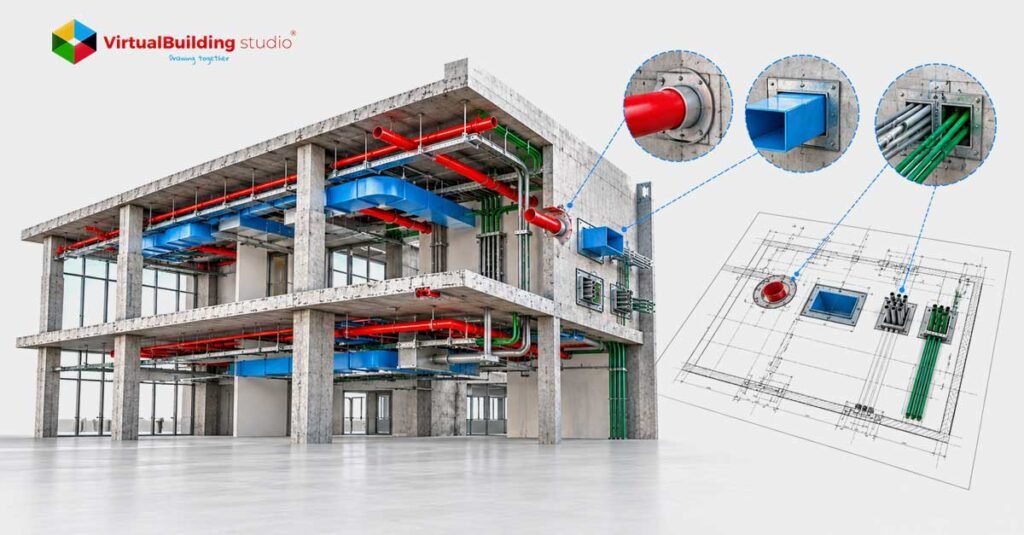
A concrete pour is not the place to discover a missed pipe penetration. By the time a crew notices a gap, the slab has already cured, and the only fix left is cutting into it. MEP sleeve drawing coordination exists to catch that problem earlier, while a conflict is still a line in a model instead of a hole in a structural deck. For contractors managing HVAC, plumbing, and electrical scopes across a single pour, this upfront coordination step has become less of an added service and more of a baseline expectation.
The Real Cost of Skipping Sleeve Coordination
Field teams that skip pre-pour coordination tend to pay for it twice. First comes the ground-penetrating radar scan needed before any post-pour drilling, then the diamond coring itself, and if a post-tension cable gets severed along the way, a structural repair bill follows. None of this shows up in the original budget. Pre-pour sleeve drawings BIM moves these decisions into the design phase, where a sleeve location can be adjusted in the model at no cost instead of chipped out of hardened concrete at a high one.
Where HVAC and Plumbing Sleeves Get Missed
HVAC pipe and conduit sleeves are often the penetrations that slip through coordination gaps, mainly because ductwork routing changes late in design while sleeve layouts stay fixed. A duct that grows by two inches during value engineering does not automatically update a sleeve drawn weeks earlier. Plumbing sleeve coordination runs into a similar issue when riser locations shift between floors but the original penetration schedule never gets revised. Both problems trace back to the same root cause: sleeve drawings that were never tied to a live, updated model in the first place.
Revit Sleeve Coordination and Clash Detection
Revit sleeve coordination resolves this by keeping the placement of the penetration tied to the actual MEP routing. When a duct or pipe moves, the sleeve that attaches to the duct or pipe in the model can be marked for review rather than being left behind. Paired with MEP clash detection services, this approach catches interference between sleeves, structural reinforcement, and hangers before anyone issues drawings for construction. The clash report becomes a working document, not a formality signed off without review.
Choosing the Right MEP Shop Drawings Services
Contractors evaluating MEP shop drawings services for a project with heavy concrete scope should look past general BIM capability and ask about sleeve-specific experience. Has the team coordinated penetrations against post-tension tendon sweeps? Can they export layout points for a Robotic Total Station instead of handing over static PDFs? These questions matter more than a firm’s overall portfolio size. Project teams researching a list of top 10 architectural BIM firms for this kind of work should weigh sleeve coordination depth and field-ready deliverables as heavily as modeling software proficiency, since not every BIM provider treats pre-pour sleeve work as a core service.
Core Drill Elimination BIM as a Contractor Priority
Core drill elimination BIM is not a marketing phrase so much as a measurable outcome. When sleeve locations, hanger envelopes, and anchor points are verified against the structural model before the pour, there is no gap left for the field to discover. For general contractors coordinating multiple trades on the same pour schedule, this matters beyond the MEP scope alone. A structural repair for a severed tendon delays every trade waiting on that deck, not just the one that caused it. MEP coordination for contractors, in that sense, protects the whole schedule, not a single trade’s piece of it.
Why This Matters Beyond a Single Project?
None of this is specific to one building type or one pour. Any project pouring structural concrete with MEP penetrations running through it faces the same choice: coordinate sleeves on paper now, or coordinate them in the field later at a higher cost. The firms getting this right are the ones treating sleeve drawings as a deliverable with its own dimensional standard, not an afterthought attached to the end of a clash detection report.
Conclusion
Sleeve coordination is a small line item on a drawing set and a large one on a change order log when it gets skipped. MEP sleeve drawing coordination gives contractors a way to close that gap before concrete goes down, using the same model-based workflow already driving HVAC, plumbing, and electrical design.
For a full walkthrough of how LOD 350/400 modeling, QA/QC verification, and Robotic Total Station layout fit together in a pre-pour workflow, read the complete guide here.