An everyday watch tells time. A dive watch has to keep telling time when pressure, cold, darkness, and salt try to stop it.
If you compare a slim office watch to a thick-bezel diver, the differences look cosmetic at first. They are not. Every extra millimeter, every bezel click, and every layer of lume exists for a reason underwater. That is what makes an automatic dive watch different from a watch built for the desk and street.
Water Resistance and Case Engineering
Everyday watches usually list 30 m or 50 m. That covers hand washing and rain, not swimming.
A true diver starts at 100 meters under ISO 6425, the standard for divers’ watches. Most modern tool divers aim higher: 200m, 300m, or 600m. Each step requires thicker gaskets, tighter tolerances, and testing for salt water and temperature swings.
True dive grade pieces go further. Some workshops build small numbered batches and pressure test every watch past 600 meters or 2000 feet, which equals 60 ATM, before it ships.
On an everyday piece the crown pulls out. On a diver it screws down against a tube with multiple seals, and the case back is screwed in with a heavy gasket. Many professional cases also add a helium escape valve at 9 o’clock.
The Bezel Is Not Decoration
The most visible difference is the bezel. Everyday watches sometimes have a tachymeter or no scale. A diver has a 60-minute scale that only turns one way.
Why Unidirectional Matters
ISO 6425 requires a unidirectional bezel that resists accidental movement. If you bump it underwater, it can only show more elapsed time, not less. That tells you to end the dive early.
Most good bezels use 120 clicks and a luminous triangle at zero visible in darkness from 25 centimeters.
Scale Legibility at Depth
On a daily wearer, markings can be thin. On a professional diving watch, the five-minute marks are stepped and different from the minute marks. The font is large, the contrast is high, and the insert is often ceramic or hardened steel.
Legibility in Low Light
Light disappears fast underwater. At 20 meters colors fade, and in silt you might read a watch from inches away.
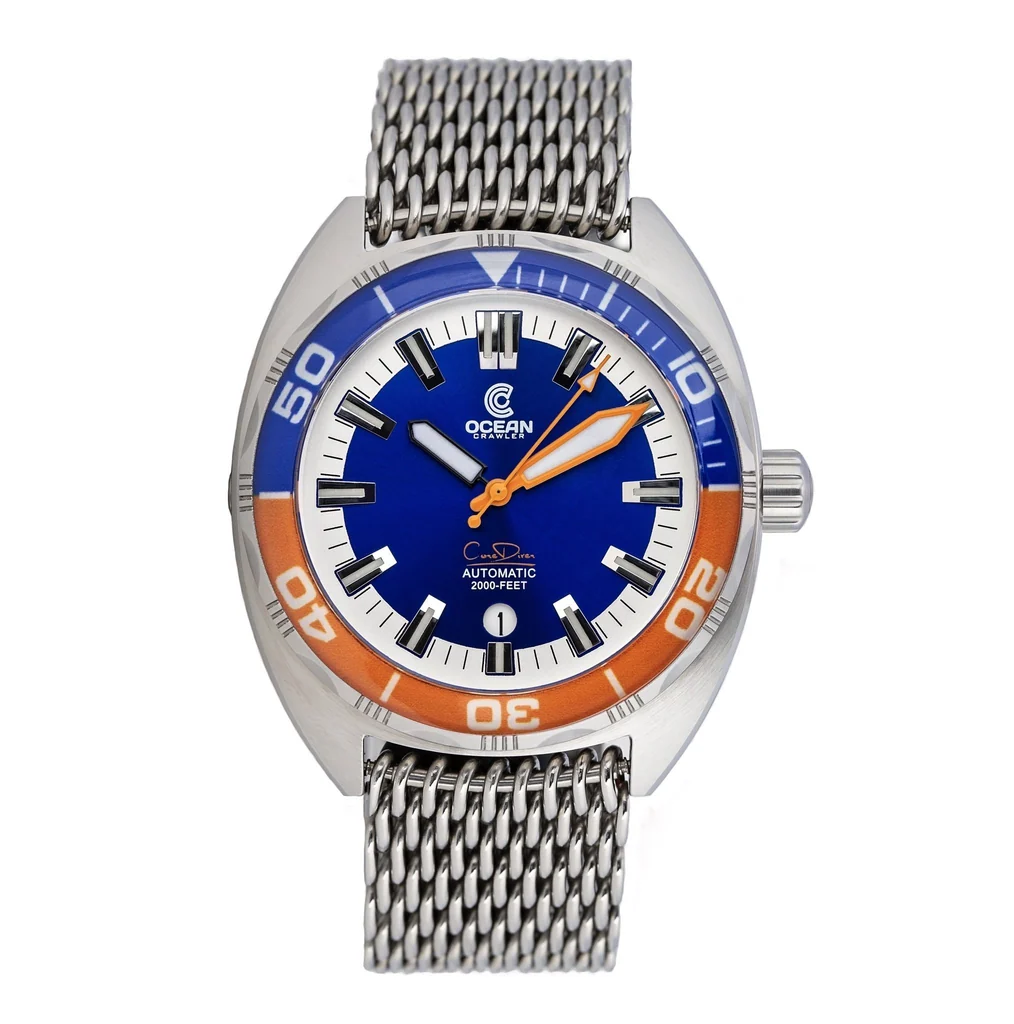
A diver dial uses broad hands, large block indices, and a seconds hand with a lumed tip. Lume is usually Swiss Super LumiNova C3 applied thick. ISO requires that time, elapsed time, and running indication remain readable at 25 cm in total darkness.
Everyday watches often use narrow hands and small indices. They look elegant in an office but wash out in low light.
Movement and Durability
Quartz works for diving, but automatics have advantages. It winds from wrist motion and does not depend on a battery. The Sellita SW200-1 beats at 28,800 vibrations per hour and holds about 40 hours of reserve. For diving, the movement must also handle magnetism to at least 4,800 A/m.
Everyday pieces can get by with 1 to 1.5 mm of sapphire. Divers need more, often 3.5 to 4.5 mm domed sapphire with an anti-reflective coating inside.
Serious tool divers also test for high shock levels. Tests to 6,000G with drop and hammer rigs simulate hits against ladders, tanks, and decks. A 38 to 40 mm case works for daily wear. Most divers sit at 41 to 44.2 mm diameter, 14 to 15 mm thick, and 48 to 52 mm lug to lug.
Everyday Timepiece Priorities
An everyday watch optimizes for thinness, lightweight, and versatile style. A 50 mm rating, a simple crown, and a smooth bezel keep the profile low.
That does not make it worse. It makes it purpose-built for a different job. If you never dive below a pool, you do not need a helium valve. If you dive or spend days in salt water, those details become requirements.
Choosing With Purpose
Ask three questions. Can I time an event without a phone? Can I read it in total darkness? Will it stay sealed after salt and knocks?
If yes, across the board, you are looking at a dive-grade tool. If yes, only in an office, you are looking at an everyday timepiece.
That level of overbuild is where Ocean Crawler lives. The company builds high-end mechanical dive watches in small batches in Rochester, New York, using Swiss movements and finishing by hand, with 600-meter resistance, domed sapphire, and 6,000G shock testing.
That focus is what separates an automatic dive watch built for real use from a stylish watch that looks like one, and why collectors who want a true professional diving watch often look to Ocean Crawler for that build.
Frequently Asked Questions
Is A Dive Watch Required To Be Automatic?
No, ISO 6425 does not require automatic. Quartz, solar, and automatic can all qualify.
What Depth Rating Do I Need?
100 m is minimum; 200 m gives extra margin. Below 100 m is splash only.
Can I Use the Dive Bezel on Land?
Yes. Align the zero marker with the minute hand to track parking or workouts.
Why Do Dive Watches Have Thicker Crystals?
Thicker domed sapphire resists pressure, impact, and scratching and reduces reflections.
Does A Helium Escape Valve Matter?
Not for recreational diving. It matters for saturation diving, where the watch lives in a helium chamber.