AlgoVerve
Algorithmic trading is changing how traders approach the financial markets by using predefined rules, technology, and automated systems to analyze market conditions and execute trading strategies. But what exactly is algorithmic trading, how does it work, and what are its advantages and disadvantages?
This comprehensive guide from AlgoVerve explains algorithmic trading in simple terms and covers everything beginners and experienced traders should understand before using automated trading systems.
Learn how algo trading works, how trading strategies are converted into systematic rules, and how technology can help traders build, test, monitor, and review strategies. The article also explains important concepts such as backtesting trading strategies, option trading strategies, live trading, automated execution, risk management, and paper trading.
If you are researching the best online trading platform in India, best trading app in India, online trading platforms, algo trading software in India, or a platform for algorithmic trading, it is important to understand the difference between manual trading, automated trading, and systematic algorithmic trading.
The guide explores popular algo trading strategies, including trend-following, momentum, mean reversion, breakout, and options-based strategies. It also explains why backtesting and paper trading can be useful before considering live deployment.
For traders interested in trading India markets, algorithmic trading can provide a structured way to define entry rules, exit conditions, position sizing, stop-loss rules, and other trading parameters. However, automation does not guarantee profits. Strategy quality, market conditions, execution, slippage, technology, and risk management remain important considerations.
AlgoVerve provides a no-code environment designed to help users build rule-based options strategies, test ideas, use paper trading with live market data, monitor strategy behavior, and review trading activity through a systematic workflow.
Whether you are searching for an online platform for trading, trading app, best application for trading, algorithmic trading software, algo trading platform, backtesting platform, or options trading strategy tools, understanding how algorithmic trading works is an important first step.
Read the complete guide to understand what algorithmic trading is, how algo trading works, its pros and cons, common trading strategies, backtesting, paper trading, and how to approach automated trading responsibly.
Build your strategy. Test your rules. Understand the risks. Trade systematically with AlgoVerve.
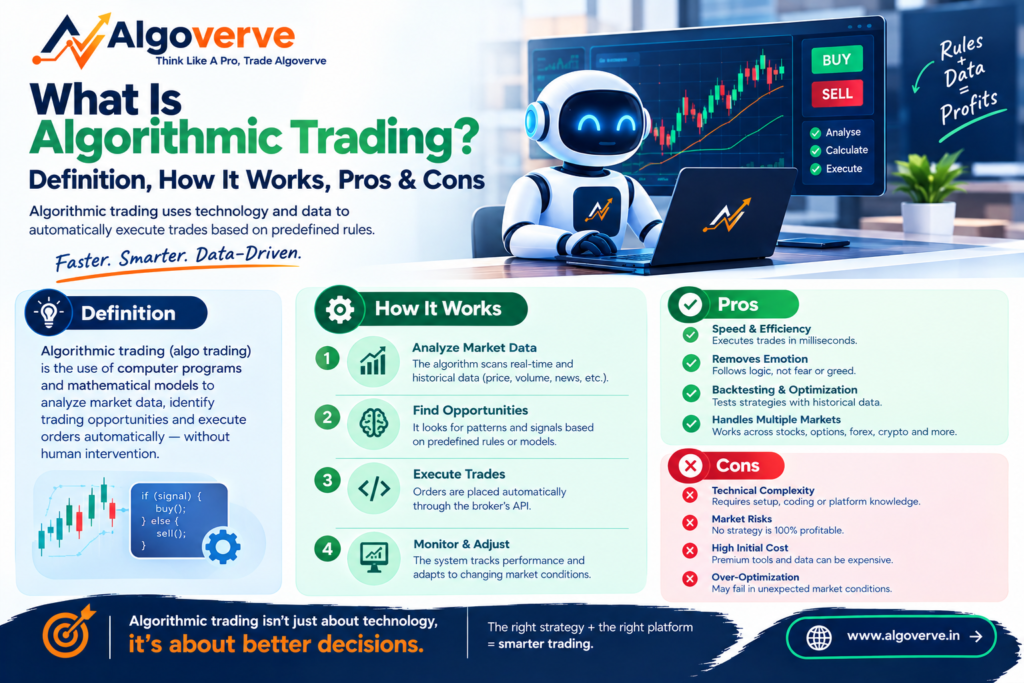
What Is Algorithmic Trading?
Algorithmic trading is a method of trading financial markets using computer-based rules to analyze market conditions and automate trading decisions or order execution.
Instead of manually watching charts and deciding when to buy or sell, traders can define specific conditions in advance. An algorithm then evaluates those conditions and acts according to the rules.
In simple words:
Algorithmic trading means using predefined rules and technology to automate part of the trading process.
For example, a trader may create a strategy that says:
- Enter when a specific technical condition occurs.
- Exit when the target is reached.
- Use a predefined stop-loss.
- Trade only during specific market hours.
- Limit the number of open positions.
- Avoid new trades after reaching a predefined risk limit.
These rules can be implemented through traditional programming or through modern no-code and low-code trading platforms.
Algorithmic trading is used across different financial markets, including stocks, futures, options, currencies, and other electronically traded instruments.
For traders in India, algo trading has become increasingly relevant as technology makes systematic strategy development, testing, and automation more accessible.
Algorithmic Trading Definition
The algorithmic trading definition is straightforward:
Algorithmic trading is the use of computer algorithms containing predefined instructions to analyze market conditions, generate trading signals, and/or execute orders.
An algorithm can use different inputs, including:
- Price
- Volume
- Time
- Technical indicators
- Volatility
- Open interest
- Market levels
- Options data
- Entry and exit conditions
- Risk parameters
The algorithm processes these inputs according to predefined rules.
Unlike discretionary trading, where a trader may change decisions based on emotions or market observations, systematic trading attempts to follow clearly defined conditions.
However, algorithmic trading does not guarantee profits. A computer can execute a strategy consistently, but it cannot automatically turn a poorly designed strategy into a successful one.
How Does Algorithmic Trading Work?
Algorithmic trading usually follows a sequence of steps.
1. Create a Trading Strategy
The first step is developing a trading idea.
For example:
Buy when the 20-period moving average crosses above the 50-period moving average and exit when the reverse condition occurs.
This idea needs to be converted into precise rules.
A complete strategy may define:
- Entry conditions
- Exit conditions
- Position size
- Stop-loss
- Profit target
- Trading hours
- Maximum positions
- Re-entry conditions
- Risk limits
The more clearly a strategy is defined, the easier it is to automate and test.
2. Convert the Rules Into an Algorithm
The next step is converting the trading strategy into instructions that a computer can understand.
Traditionally, this may require programming knowledge.
For example, developers can use programming languages and APIs to create automated trading systems.
However, no-code algo trading platforms allow users to configure many trading rules through visual interfaces, forms, and strategy builders.
This can make algorithmic trading more accessible to traders who understand markets but do not want to develop an entire software system themselves.
3. Connect to Market Data
An algorithm requires market information to evaluate its conditions.
Depending on the strategy, this could include:
- Live prices
- Historical prices
- Volume
- Open interest
- Volatility
- Technical indicators
- Options information
- Time and market sessions
The quality and reliability of market data are important because incorrect or delayed data can affect signals and testing results.
4. Generate Trading Signals
Once the algorithm receives market data, it checks whether the predefined conditions have been met.
For example:
Rule 1: Price moves above resistance.
Rule 2: Volume is above a specified level.
Rule 3: Trading is within the permitted market session.
If all conditions are satisfied, the system may generate a BUY signal.
If the exit conditions are satisfied later, it may generate a SELL signal.
5. Execute the Trade
Depending on the system and broker setup, the signal may be sent for order execution.
The order can contain information such as:
- Instrument
- Buy or sell
- Quantity
- Order type
- Price
- Stop-loss
- Target
Automated execution can reduce the need for manual order entry.
However, actual execution can still be affected by liquidity, market volatility, slippage, connectivity, broker infrastructure, and other factors.
6. Monitor and Manage the Position
Algorithmic trading does not necessarily stop after entering a position.
A system can continue checking:
- Stop-loss conditions
- Profit targets
- Trailing stops
- Exit signals
- Position limits
- Re-entry rules
- Trading-session restrictions
This creates a systematic workflow from entry through exit.
Algorithmic Trading in India
Algorithmic trading in India involves the use of automated or systematic trading technology within the Indian securities markets.
Indian traders may use algorithmic approaches for:
- Equity trading
- Futures trading
- Options trading
- Index strategies
- Systematic portfolios
- Intraday strategies
- Options strategies
The exact technology and operational requirements depend on the trading setup, broker, exchange, and applicable regulations.
Anyone considering automated trading should verify the current requirements applicable to their broker and strategy.
For traders researching online trading platforms in India, it is also useful to distinguish between a traditional brokerage platform, a trading app, and specialized algorithmic trading software.
A trading app may primarily provide manual order placement and market information, while an algorithmic trading platform can provide additional tools for defining, testing, monitoring, or automating rule-based strategies.
Popular Algorithmic Trading Strategies
Algorithmic trading is not a strategy by itself. It is a technology-driven method for implementing a strategy.
Here are some common approaches.
1. Trend-Following Strategies
Trend-following systems attempt to participate in sustained price movements.
They may use:
- Moving averages
- Breakouts
- Trend indicators
- Price structure
For example, an algorithm could enter when a shorter moving average crosses above a longer moving average.
2. Momentum Strategies
Momentum strategies attempt to identify instruments showing strong price movement.
Rules may use:
- Price changes
- Relative strength
- Volume
- Breakouts
- Technical indicators
The algorithm can scan for conditions and apply predefined entry and exit rules.
3. Mean-Reversion Strategies
Mean-reversion strategies are based on the concept that prices or spreads may move toward a reference value under certain conditions.
A strategy might identify an unusually large deviation from a historical range and define rules for entering and exiting.
Mean reversion does not always occur, so risk management remains important.
4. Breakout Strategies
Breakout strategies monitor predefined price levels.
For example:
Enter when the price moves above the highest price of the previous 20 trading sessions.
The system can continuously monitor the condition instead of requiring the trader to watch the chart manually.
5. Options Trading Strategies
Algorithmic systems can also be used for option trading strategies.
Options strategies may involve multiple legs, including:
- Calls
- Puts
- Buying options
- Selling options
- Spreads
- Hedging positions
Rules can define strike selection, expiry, entry conditions, stop-loss, targets, adjustments, and exits.
Because options can involve leverage and multiple interacting factors, traders should understand the risks before automating an options strategy.
What Is Backtesting Trading?
Backtesting trading strategies means testing a strategy against historical market data to understand how the rules would have behaved under past conditions.
For example, a trader may test:
What would have happened if this strategy had been applied to historical data over the last five years?
Backtesting can help analyze:
- Number of trades
- Winning and losing trades
- Drawdown
- Historical returns
- Trade frequency
- Entry and exit behavior
- Sensitivity to parameters
But backtesting has limitations.
Historical performance does not guarantee future results.
A strategy may perform well historically because of market conditions that do not continue.
Over-optimization can also create overfitting, where a strategy is tailored too closely to historical data.
Therefore, backtesting should be treated as one part of the strategy-development process rather than proof of future profitability.
What Is Paper Trading?
Paper trading allows traders to test a strategy using simulated capital instead of immediately risking real money.
A paper-trading environment can help traders observe:
- Entries
- Exits
- Position behavior
- Drawdowns
- Strategy execution
- Market conditions
For beginners, paper trading can be useful for understanding how a trading strategy behaves outside a purely historical backtest.
A common workflow is:
Build → Backtest → Paper Trade → Review → Consider Live Deployment
Pros of Algorithmic Trading
Algorithmic trading can provide several potential advantages.
Faster Execution
Computers can process predefined conditions quickly and can submit orders without requiring manual clicks for every trade.
Reduced Emotional Decisions
A systematic strategy can reduce discretionary decisions driven by fear, greed, hesitation, or excitement.
Consistent Execution
Once rules are defined, the system can apply those rules consistently, subject to technical and execution constraints.
Automated Monitoring
Algorithms can monitor markets and predefined conditions without requiring a trader to continuously watch charts.
Backtesting
Systematic strategies can often be tested against historical data, helping traders analyze how the rules behaved under previous market conditions.
Risk Controls
Strategies can include predefined stop-losses, position limits, trading-session restrictions, and other risk parameters.
Scalability
Automation can make it easier to apply systematic rules across multiple instruments or strategies, provided the infrastructure and risk controls are appropriate.
Cons of Algorithmic Trading
Automation also introduces risks and challenges.
Strategy Risk
A computer can execute a bad strategy consistently.
Automation does not make a strategy fundamentally sound.
Overfitting
A strategy can become excessively optimized for historical data and fail to perform similarly in future conditions.
Technical Problems
Automated systems can be affected by:
- Internet outages
- API failures
- Software bugs
- Server issues
- Broker connectivity problems
- Incorrect configurations
Slippage
The actual execution price may differ from the expected price.
This can be especially important during fast-moving or less-liquid markets.
Market-Regime Changes
A strategy designed for trending markets may behave differently during sideways or highly volatile periods.
Data Problems
Incorrect, delayed, or incomplete data can affect signals and backtesting.
Complexity
Building and managing automated systems requires an understanding of both trading and technology.
Algorithmic Trading vs Online Trading
The terms online trading and algorithmic trading are related but not identical.
Online trading generally refers to using internet-based platforms or applications to access financial markets and place orders.
Algorithmic trading focuses on using predefined computer rules to automate or systematize trading decisions and execution.
For example:
Online trading:
A trader opens a trading app, checks a chart, decides to buy, and manually places an order.
Algorithmic trading:
A predefined system detects the specified conditions and generates or executes the order according to the configured rules.
An online trading platform can therefore be used manually, while a specialized algorithmic trading platform may provide tools for systematic automation.
What Is Algo Trading Software in India?
Algo trading software in India refers to technology that helps traders develop, test, monitor, or execute rule-based trading strategies in the Indian market environment.
Depending on the platform, features can include:
- Strategy builders
- Backtesting
- Paper trading
- Market-data integration
- Risk controls
- Trading automation
- Monitoring
- Journaling
- Performance analysis
When comparing an algo trading platform, traders should look beyond marketing claims and evaluate practical factors such as strategy-building capabilities, testing tools, supported markets, execution infrastructure, risk controls, pricing, documentation, and broker compatibility.
How AlgoVerve Supports Systematic Trading
AlgoVerve is designed as a no-code options trading infrastructure for building, testing, paper trading, monitoring, and reviewing systematic options strategies.
Its strategy-building workflow allows users to configure trading rules without needing to write a complete trading program.
Depending on the strategy, users can define elements such as:
- Exchange
- Symbol
- Expiry
- Buy and sell legs
- Target
- Stop-loss
- Trailing rules
- Re-entry conditions
- Momentum or range rules
- Execution settings
AlgoVerve also provides paper trading using live NSE and BSE market data with virtual capital, allowing traders to observe strategy behavior before considering live deployment.
The goal is to create a structured workflow:
Build → Test → Paper Trade → Monitor → Review
This can be useful for traders who want to turn a trading idea into a defined set of rules and evaluate the strategy systematically.
How to Choose an Online Trading Platform
If you are researching the best online trading platform, best trading app, or best algo trading platform, there is no single feature that determines whether a platform is suitable for every trader.
Instead, compare platforms based on your requirements.
Consider:
Trading Markets
Does the platform support the markets and instruments you want to trade?
Strategy Tools
Can you create the type of strategy you want?
Backtesting
Does it provide suitable tools for testing historical behavior?
Paper Trading
Can you test your strategy using simulated capital?
Execution
Understand how orders are routed and what execution options are available.
Risk Controls
Look for tools that help define and manage trading risk.
Monitoring
Consider whether you can monitor positions, signals, logs, and strategy activity.
Pricing
Compare subscription costs and any additional charges relevant to your trading workflow.
Ease of Use
A platform should be understandable enough for you to build and manage your strategy correctly.
For algorithmic trading specifically, strategy development and testing capabilities can be more important than simply choosing a general-purpose trading app.
Common Algorithmic Trading Mistakes
Beginners should watch out for several common mistakes.
Automating Too Early
Do not automate a strategy simply because it sounds logical.
Ignoring Costs
Include brokerage, fees, taxes, slippage, and other relevant trading costs when evaluating a strategy.
Over-Optimizing
Too many parameters can make a strategy fit historical data rather than general market behavior.
Ignoring Drawdown
Do not focus only on returns. Understand how large and long historical losses were.
Skipping Paper Trading
Paper trading can provide useful information before live deployment.
Using Too Many Indicators
Adding more indicators does not automatically improve a strategy.
Forgetting Technical Risk
Automated systems depend on infrastructure. Have a process for handling failures and unexpected conditions.
Frequently Asked Questions
What is algorithmic trading in simple words?
Algorithmic trading is the use of predefined computer-based rules to analyze market conditions and automate trading decisions or order execution.
Is algorithmic trading the same as algo trading?
Yes. “Algo trading” is commonly used as a shorter term for algorithmic trading.
Is algorithmic trading profitable?
Algorithmic trading does not guarantee profits. Results depend on strategy quality, market conditions, execution, costs, risk management, and other factors.
Do I need coding skills for algorithmic trading?
Not necessarily. No-code and low-code platforms allow users to create some rule-based strategies without writing traditional programming code.
What is the role of backtesting?
Backtesting allows traders to evaluate how a strategy’s rules would have behaved using historical market data. It cannot guarantee future performance.
Is algorithmic trading suitable for beginners?
Beginners can learn algorithmic trading, but they should first understand trading fundamentals, risk management, strategy design, testing, and execution.
What is the difference between an online broker and an algo trading platform?
An online broker generally provides market access and order execution services. An algo trading platform may provide additional tools for creating, testing, monitoring, and automating systematic strategies. Some services can overlap.
What are the main risks of algorithmic trading?
Important risks include strategy failure, overfitting, technical failures, slippage, data problems, changing market conditions, and execution risks.
Final Thoughts
Algorithmic trading is fundamentally about turning a trading idea into a structured set of rules that technology can evaluate and, where supported, execute.
It can help traders create a more systematic workflow for strategy development, backtesting, paper trading, monitoring, and execution.
At the same time, automation should not be confused with guaranteed performance. A strategy still needs thoughtful design, realistic assumptions, testing, risk management, and ongoing review.
For traders exploring algo trading in India, the practical starting point is to understand the market, define a clear trading strategy, test the rules, use paper trading where appropriate, and carefully evaluate the risks before considering live trading.
For traders interested in algo trading software in India, algorithmic trading platforms, backtesting trading, and option trading strategies, AlgoVerve provides a no-code environment designed around a systematic strategy workflow.
Build, Test, and Review Your Trading Strategy With AlgoVerve
Ready to turn your trading idea into defined rules?
With AlgoVerve, you can build no-code options strategies, test your ideas, use paper trading with live market data, monitor strategy activity, and review your trading workflow.
Build your strategy. Test your rules. Understand the risks. Then make your own informed decision about live deployment.
Explore AlgoVerve and start building your systematic trading strategy.