One of the most common regulatory misunderstandings among small soap businesses is assuming that because they make soap, they’re subject to soap regulations.
In the United States, whether your product counts as “soap” is a narrow technical question, and most artisan bars don’t qualify. Getting this wrong can mean labeling that doesn’t meet requirements.
This is a general overview, not legal advice verify against current FDA guidance and consult a qualified professional for your specific product.
The narrow definition of “soap”
Under US regulation, a product is exempt from cosmetic requirements and treated as “soap” only if it meets a fairly restrictive set of conditions. Broadly, the bulk of the non-volatile matter must consist of an alkali salt of fatty acids and the product’s detergent properties must come from those compounds. Critically, it must be labeled, sold, and represented only as soap.
That last condition catches almost everyone.
The moment you market your bar as moisturizing, as soothing for dry skin, as aromatherapeutic, or as anything beyond cleaning you have made a cosmetic claim. Your product is then regulated as a cosmetic regardless of how it was made.
Adding a scent for its aromatic effect can push you across the line. So can claiming benefit from added oils or butters.
In practice, most handmade soap sold today is regulated as a cosmetic.
What cosmetic labeling requires
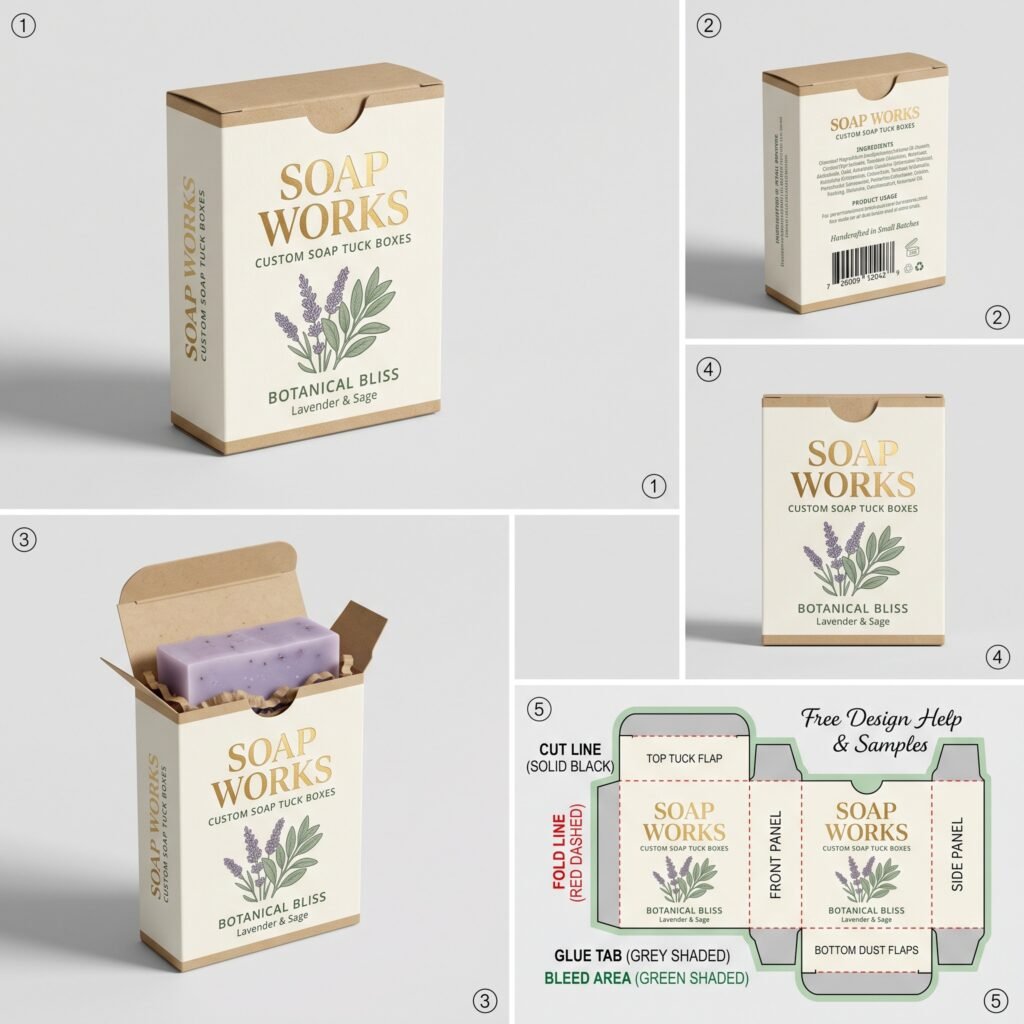
Cosmetic labeling in the US generally requires several elements, and the packaging has to accommodate them physically.
On the principal display panel (the front, what the customer sees on shelf):
- An identity statement what the product is
- A net quantity of contents declaration, in both US customary and metric units, positioned in the lower 30% of the panel
On the information panel (side or back):
- Full ingredient declaration, in descending order of predominance, using INCI nomenclature
- Name and place of business of the manufacturer, packer, or distributor
- Any necessary warning statements
Why this affects packaging design, not just copy
That ingredient list is the problem.
A moderately complex cold-process bar can have fifteen or more ingredients, each needing its INCI name which are considerably longer than common names. “Olive oil” becomes “Olea Europaea (Olive) Fruit Oil.” “Shea butter” becomes “Butyrospermum Parkii (Shea) Butter.”
That block of text needs to fit legibly on your packaging. There are minimum type size requirements, and “legible” is a real standard, not a suggestion.
Designers who don’t know this coming in routinely produce beautiful layouts with no room for the required information, then have to redesign. Building the ingredient panel into the layout from the start avoids that entirely.
Suppliers who specialize in this category understand the constraint. When you’re briefing a producer whether that’s a local printer or a specialist like printedsoapboxes.com flag the ingredient panel requirement early so the dieline gives you adequate flat surface for it.
The small package exemption
There are provisions for very small packages where full labeling is impractical, typically allowing certain information to be carried on an accompanying insert or tag rather than the package itself. If you’re producing sample sizes or guest bars, look into whether these apply to you.
Where people get into trouble
Drug claims. Saying a soap treats eczema, acne, or psoriasis moves the product into drug territory, which carries a substantially heavier regulatory burden. This is the most serious line to avoid crossing.
Missing net weight. Frequently forgotten and easy to correct.
Common names instead of INCI. “Coconut oil” is not sufficient where INCI nomenclature is required.
Illegible type. Very small ingredient text on a busy background is a genuine compliance risk, not just a design flaw.
Practical approach
Write your full compliant label copy before you brief a designer. Count the characters. Give the designer the actual text block, not a placeholder.
Then have someone who isn’t you read the printed proof at arm’s length under normal lighting. If they can’t read the ingredients, neither can a regulator.
Compliance handled at the design stage costs nothing. Handled after a print run, it costs the print run.