Thyristor Modules
Modern electrical systems are expected to do more than simply turn equipment on and off. They must regulate power accurately, withstand demanding operating conditions, protect expensive machinery, reduce energy waste, and maintain stable performance over long operating periods. Thyristor Modules have become an important part of this environment because they provide a reliable way to control substantial electrical loads using semiconductor technology.
These modules are widely associated with industrial power conversion, motor control, heating regulation, rectification, and heavy-duty automation. Their importance comes from their ability to combine high current capability, strong voltage handling, controlled switching, and compact packaging in a single component.
For engineers, technicians, and industrial buyers, understanding how Thyristor Modules behave inside a complete system is essential. Their performance is influenced not only by current and voltage ratings but also by thermal design, gate control, switching strategy, protection devices, mechanical installation, and operating conditions.
This makes them much more than simple electronic switches. They are critical elements in many high-power control systems.
What Are Thyristor Modules Designed to Achieve?
Thyristor Modules are designed to control electrical power in circuits where ordinary low-power semiconductor devices would be unsuitable.
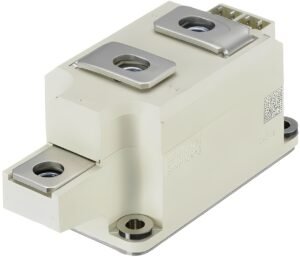
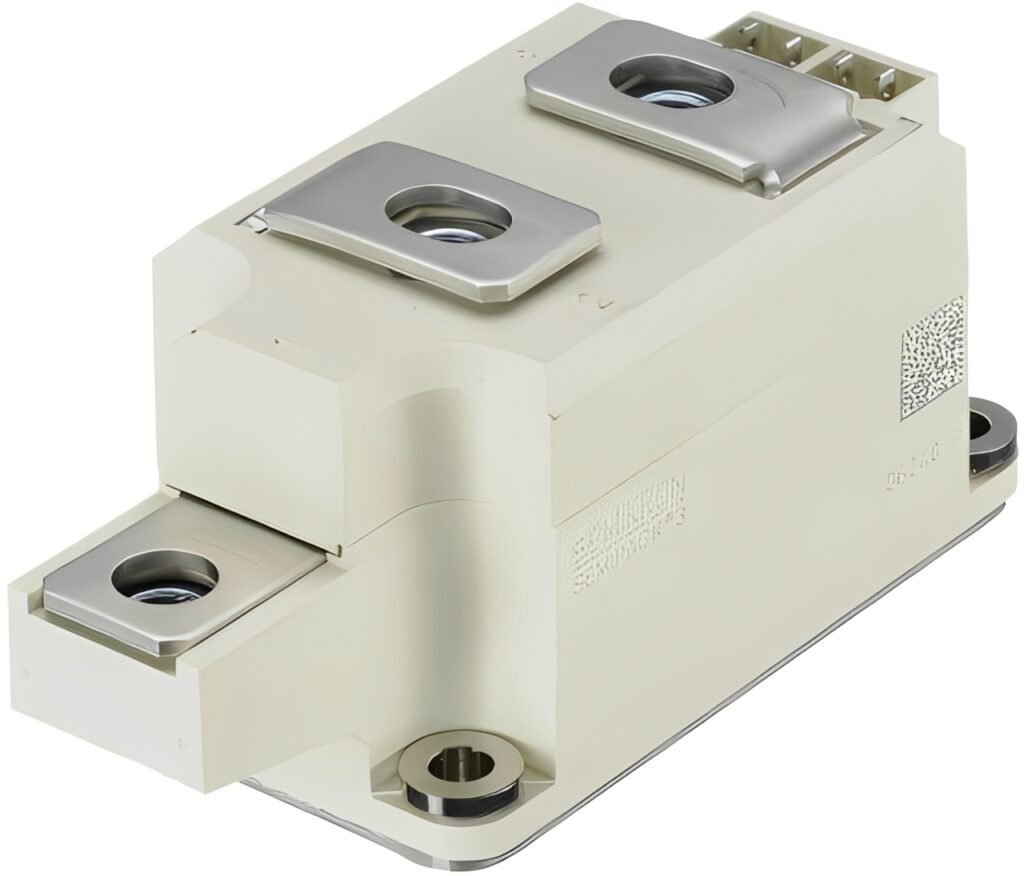
A typical module contains one or more thyristor semiconductor elements mounted inside an insulated and mechanically robust housing. These internal devices are connected in a predefined configuration, allowing engineers to incorporate them into a larger circuit without assembling each semiconductor individually.
The module approach provides several practical advantages:
- Simplified power circuit construction
- High current handling capability
- Strong voltage-blocking performance
- Improved heat transfer
- Fewer external connections
- Compact equipment design
- Easier replacement and maintenance
- Reliable mechanical mounting
These characteristics make Thyristor Modules particularly attractive for equipment that must operate continuously under significant electrical stress.
How Does a Thyristor Behave Inside a Power Circuit?
The behaviour of a thyristor is different from that of a conventional mechanical switch.
A thyristor remains in a blocking state until a suitable trigger signal is applied to its gate. Once activated, it allows current to flow through the main power path.
After switching on, the device generally continues conducting even when the original gate signal disappears. It remains active until the current through the device falls below a specific holding level.
This characteristic is particularly useful in alternating-current systems.
Because AC current repeatedly passes through zero, the thyristor naturally switches off at the end of each half-cycle. The controller can then decide when to trigger it again during the next portion of the waveform.
By controlling this timing, engineers can regulate the amount of energy reaching a connected load.
Why Are Thyristor Modules Important in AC Power Control?
AC power regulation is one of the strongest applications for Thyristor Modules.
Many industrial loads do not require full electrical power continuously. Instead, the amount of power must be adjusted according to changing process requirements.
A furnace may need high power during warm-up and reduced power once the target temperature is reached. A motor may need controlled voltage during startup but normal operating voltage afterward. An industrial process may require gradual adjustments rather than abrupt switching.
Thyristor-based systems make this possible.
By controlling the conduction period of each AC cycle, the system can determine how much energy is transferred to the load.
This allows better regulation of:
- Heat output
- Motor acceleration
- Electrical current
- DC rectifier output
- Industrial process loads
- High-power resistive equipment
The result is more flexible power control than simple mechanical switching can provide.
How Does Phase-Angle Control Work?
Phase-angle control is one of the most widely recognised methods of regulating AC power with thyristors.
In a standard AC waveform, voltage rises and falls continuously during each cycle.
Instead of allowing current to flow from the beginning of the cycle, the controller delays the thyristor trigger.
If the thyristor is triggered early, most of the waveform reaches the load and more power is delivered.
If the trigger is delayed, only part of the waveform reaches the load, reducing the average energy supplied.
This allows the system to make fine adjustments to output.
Phase-angle control is useful in applications that require rapid or continuously variable regulation, including:
- Industrial furnaces
- Electric heating systems
- Lighting controls
- Test equipment
- Certain motor applications
- Power conditioning equipment
The method offers excellent control flexibility, although it can create harmonics and electrical interference that must be considered during system design.
What Is Zero-Cross or Burst-Firing Control?
Not every application needs phase-angle control.
In many resistive heating systems, zero-cross or burst-firing control may provide a simpler and cleaner solution.
Instead of switching during part of each AC cycle, the thyristor allows complete cycles to pass through the load and blocks other complete cycles.
For example, a controller might deliver power for several cycles and then stop for several cycles.
The ratio between active and inactive cycles determines the average output.
Advantages may include:
- Lower electrical noise
- Reduced electromagnetic interference
- Efficient heater regulation
- Less switching stress
- Simple control of resistive loads
Burst firing is particularly effective for systems with thermal inertia because heaters do not usually need instant changes within every individual AC cycle.
How Are Thyristor Modules Used in Industrial Heating?
Industrial heating is one of the most common application areas.
Many manufacturing processes depend on precise thermal control. Excessive heat may damage materials, while insufficient heat may reduce quality or slow production.
Thyristor Modules can regulate power delivered to heating elements without relying on mechanical contacts.
They are commonly used in:
- Industrial ovens
- Furnaces
- Plastic extrusion lines
- Moulding machinery
- Drying systems
- Packaging equipment
- Kilns
- Heat-treatment processes
- Environmental chambers
Electronic switching is especially valuable where heaters are switched frequently.
Mechanical contactors can wear due to repeated switching, whereas semiconductor switching avoids physical contact movement.
This can help reduce maintenance requirements while improving temperature stability.
Why Are Thyristor Modules Used in Motor Soft Starters?
Large electric motors can create very high inrush current when started directly across the supply.
This sudden current demand can cause several problems.
It may produce voltage dips, place stress on electrical infrastructure, and create mechanical shock in connected equipment.
Thyristor-based soft starters address this problem by gradually increasing the voltage applied to the motor.
At startup, the thyristors conduct for only part of each AC cycle. As the motor accelerates, the conduction period increases until normal voltage is reached.
This controlled approach may provide benefits such as:
- Reduced starting current
- Smoother acceleration
- Lower mechanical stress
- Reduced belt wear
- Lower coupling stress
- Less pressure on pumps and pipelines
- Reduced electrical disturbance
Soft starters are often used with pumps, fans, conveyors, compressors, mixers, and other industrial motor loads.
What Role Do Thyristor Modules Play in Rectification?
Rectification converts alternating current into direct current.
A basic diode rectifier produces an output determined mainly by the input voltage. A controlled rectifier using thyristors provides greater flexibility because the firing angle can be changed electronically.
By adjusting the switching point, the average DC output can be controlled.
This is useful in applications such as:
- Industrial DC drives
- Battery charging equipment
- Electroplating systems
- Electrolysis processes
- High-current power supplies
- Welding equipment
- Laboratory power systems
Controlled rectification gives engineers the ability to regulate output voltage or current according to process requirements.
What Are the Main Thyristor Module Configurations?
Different applications require different internal circuit arrangements.
Manufacturers therefore offer Thyristor Modules in several configurations.
Common types include:
- Single thyristor modules
- Dual thyristor modules
- Thyristor-thyristor combinations
- Thyristor-diode combinations
- Common-anode arrangements
- Common-cathode arrangements
- Series-connected devices
- Bridge-related configurations
The correct module depends on the topology of the circuit.
Choosing a configuration that matches the intended design can reduce external wiring and simplify installation.
It can also improve the consistency of the finished equipment because internal semiconductor connections are already completed inside the package.
Which Voltage Ratings Matter Most?
Voltage rating is a critical selection parameter.
A thyristor in the off state must withstand the voltage applied across it without entering uncontrolled conduction or suffering breakdown.
Engineers should consider more than the normal operating voltage.
Industrial circuits may experience temporary voltage spikes caused by:
- Inductive loads
- Switching events
- Transformer behaviour
- Motor operation
- Grid disturbances
- Lightning-related transients
- Fault conditions
For this reason, designers typically provide a suitable voltage safety margin.
Operating too close to the absolute maximum rating can reduce reliability and increase the risk of failure during transient conditions.
How Should Current Ratings Be Evaluated?
Current ratings can appear straightforward, but they require careful interpretation.
A Thyristor Module may have several current-related specifications, including:
- Average current
- RMS current
- Surge current
- Peak non-repetitive current
- Repetitive current capability
- Maximum current under specified cooling conditions
These values are not always interchangeable.
The actual current a module can safely handle depends heavily on temperature, cooling performance, conduction angle, and duty cycle.
A device rated for high current under ideal laboratory conditions may need to operate at a lower current inside a warm enclosure with limited airflow.
This is why engineers must consider the full thermal and electrical environment rather than relying on a single headline rating.
Why Is Thermal Management Critical?
Heat is one of the most important factors affecting semiconductor reliability.
Whenever current passes through a thyristor, some electrical energy is lost as heat.
At low currents, the amount may be modest. At high currents, even a small on-state voltage drop can produce significant thermal energy.
If this heat is not removed effectively, the semiconductor junction temperature may rise above safe limits.
Proper thermal management can include:
- Heat sinks
- Forced-air cooling
- Thermal interface compounds
- Insulating thermal pads
- Liquid cooling
- Temperature monitoring
- Correct enclosure ventilation
The thermal path extends from the semiconductor junction through the module base, thermal interface material, heat sink, and finally into the surrounding environment.
Each part of this path must be considered carefully.
Why Does Mounting Technique Matter?
Even a correctly selected Thyristor Module can perform poorly if installed incorrectly.
Mechanical mounting influences both electrical safety and thermal performance.
Important installation factors include:
- Correct mounting torque
- Flat heat-sink surfaces
- Clean contact areas
- Proper thermal compound application
- Correct terminal torque
- Adequate electrical clearance
- Strong mechanical support
Too little mounting pressure may reduce heat transfer.
Excessive pressure can damage the module or distort the baseplate.
Loose electrical terminals can create localised resistance, which may generate additional heat and eventually damage the connection.
Following manufacturer mounting instructions is therefore essential.
How Are Thyristor Modules Protected from Electrical Stress?
Protection is a major part of reliable power-electronic design.
Industrial systems can experience abnormal events such as short circuits, rapid voltage changes, overloads, or cooling failures.
A Thyristor Module should therefore be supported by appropriate protection components.
Common methods include:
- Semiconductor fuses
- RC snubber circuits
- Surge suppressors
- Current sensors
- Temperature sensors
- Overcurrent shutdown
- Gate-drive isolation
- Cooling alarms
High-speed semiconductor fuses can interrupt fault currents quickly enough to protect power devices.
Standard fuses may not always respond fast enough in high-energy semiconductor applications.
What Is the Purpose of an RC Snubber?
Rapid voltage changes can cause problems in thyristor circuits.
A thyristor may respond to a high rate of voltage rise even without a normal gate trigger.
An RC snubber is commonly connected across the device to control these rapid voltage transitions.
The network usually contains a resistor and capacitor designed to absorb or limit transient energy.
Proper snubber design can help provide:
- More stable switching
- Reduced unwanted triggering
- Lower transient stress
- Improved noise behaviour
- Greater device protection
The component values must be selected according to circuit voltage, load type, switching conditions, and semiconductor characteristics.
How Does Gate Drive Affect Performance?
The gate drive system is responsible for triggering the thyristor at the correct moment.
An unreliable gate signal can create inconsistent switching.
The control circuit must provide sufficient gate current and voltage while maintaining appropriate electrical isolation between the low-voltage control system and the high-power circuit.
Gate-drive design may involve:
- Pulse transformers
- Optically isolated drivers
- Dedicated trigger circuits
- Synchronisation with the AC waveform
- Noise filtering
- Controlled firing-angle timing
Correct gate control improves repeatability and helps prevent false triggering.
This becomes increasingly important in industrial environments where electrical noise can be significant.
How Can Thyristor Modules Support Process Efficiency?
Power control can influence much more than electrical consumption.
In many industrial processes, accurate energy regulation directly affects product quality.
For example, temperature variations in a manufacturing line can change material properties, curing times, dimensions, or surface finish.
A thyristor controller can adjust power rapidly and repeatedly according to feedback from sensors.
This can support:
- Better temperature stability
- More consistent manufacturing
- Reduced process variation
- Lower energy waste
- Improved automation
- More repeatable output
The module itself does not create efficiency automatically, but it enables control strategies that can improve how energy is used.
What Can Cause Thyristor Module Failure?
Thyristor Modules are robust, but they are not immune to failure.
Common causes include:
- Excessive current
- Inadequate heat dissipation
- Voltage transients
- Incorrect gate triggering
- Loose terminals
- Short circuits
- Poor ventilation
- Insufficient protection
- Mechanical installation errors
- Repeated overloads
One of the most common mistakes is replacing a failed module without identifying the root cause.
If the original failure was caused by poor cooling or a defective control circuit, the replacement may fail in the same way.
What Should Maintenance Teams Inspect?
Routine maintenance can significantly improve long-term reliability.
Maintenance teams should inspect both the semiconductor module and the surrounding system.
Useful checks include:
- Terminal tightness
- Heat-sink cleanliness
- Fan operation
- Airflow
- Thermal interface condition
- Signs of overheating
- Fuse condition
- Gate-drive signals
- Cable condition
- Insulation integrity
Discolouration around terminals may indicate excessive heat.
Dust accumulation can reduce cooling.
A noisy or failing fan may cause junction temperatures to rise gradually over time.
Preventive inspection helps identify these issues before they develop into major failures.
How Do Thyristor Modules Compare with IGBTs and MOSFETs?
Modern power electronics offers several semiconductor technologies.
MOSFETs are known for fast switching and are widely used in high-frequency applications.
IGBTs provide a balance of voltage, current, and switching performance and are common in inverters, drives, and power converters.
Thyristors are different.
They are particularly strong in applications that require:
- Very high current
- High blocking voltage
- Low conduction losses
- Moderate switching frequency
- Rugged industrial operation
Their switching speed is lower than that of many modern devices, but high-speed operation is not necessary in every application.
For mains-frequency heating, controlled rectification, and certain motor-control systems, thyristors can remain highly effective.
Why Are Thyristor Modules Suitable for Harsh Industrial Environments?
Industrial equipment often operates in conditions that are far less controlled than laboratory environments.
Temperature variation, vibration, dust, electrical noise, high current, and continuous operation all affect component reliability.
Thyristor Modules are often designed with robust construction that supports operation under these conditions.
Their advantages include:
- Strong mechanical packaging
- High power capability
- Electrically isolated mounting options
- Simple circuit integration
- Long-established technology
- Predictable electrical behaviour
However, environmental conditions must still be considered during system design.
Dust, humidity, contamination, and inadequate ventilation can reduce performance if not properly managed.
How Are Thyristor Modules Used in Automated Systems?
Modern industrial control increasingly combines digital intelligence with high-power hardware.
A programmable logic controller or digital control system can analyse information from sensors and decide how much electrical power is needed.
The Thyristor Module then performs the high-power switching required to implement that decision.
For example, a manufacturing process may continuously measure temperature.
If the temperature falls below the target, the controller increases thyristor conduction.
If the temperature rises, it reduces power.
This creates a closed-loop control system combining:
- Sensors
- Digital controllers
- Gate-drive circuits
- Thyristor Modules
- High-power loads
Such systems can provide precise and repeatable operation without requiring continuous manual intervention.
What Should Buyers Consider Before Choosing a Module?
Selecting the correct Thyristor Module requires a system-level approach.
Important considerations include:
- Maximum operating voltage
- Continuous load current
- Surge current
- Thyristor configuration
- Gate requirements
- Cooling method
- Junction temperature limits
- Electrical isolation
- Mounting dimensions
- Terminal arrangement
- Control strategy
- Environmental conditions
Buyers should also consider long-term availability, documentation, and manufacturer support.
Choosing only by price or maximum current rating can lead to poor system performance.
The correct component is the one that matches the actual electrical, thermal, and mechanical requirements of the application.
How Are Thyristor Modules Supporting Modern Energy Systems?
The growth of electrification is increasing demand for reliable power-control technology.
Industrial energy management, grid equipment, renewable systems, charging infrastructure, and large electrical processes all require dependable semiconductor switching.
While newer semiconductor technologies continue to expand, thyristor-based solutions remain useful in applications where high current and high voltage are dominant requirements.
Their established performance makes them relevant for:
- Industrial power conversion
- Grid control
- Renewable energy support equipment
- High-power rectification
- Electrical heating
- Heavy motor systems
- Infrastructure applications
This continued relevance shows that mature technologies can remain valuable when their electrical characteristics match the application.
Why Do Thyristor Modules Remain a Strong Choice for Power Control?
Thyristor Modules continue to provide a highly practical solution for controlling large electrical loads.
Their advantages come from a combination of electrical capability, compact construction, thermal performance, and proven reliability.
They can support industrial heating, motor soft starting, controlled rectification, automation, process control, and many other demanding applications.
However, dependable performance requires more than selecting a module with the correct current rating.
Engineers must consider voltage margin, heat dissipation, gate triggering, protection, mounting, maintenance, and operating conditions as part of one complete system.
When all of these factors are managed correctly, Thyristor Modules can deliver stable and efficient control over high-power equipment for long periods.
As industrial systems continue to become more automated, electrified, and energy-conscious, these modules are likely to remain an important part of power-electronic design. Their combination of ruggedness, controllability, and high-load capability ensures they continue to serve applications where dependable electrical power management is essential.