Market Overview
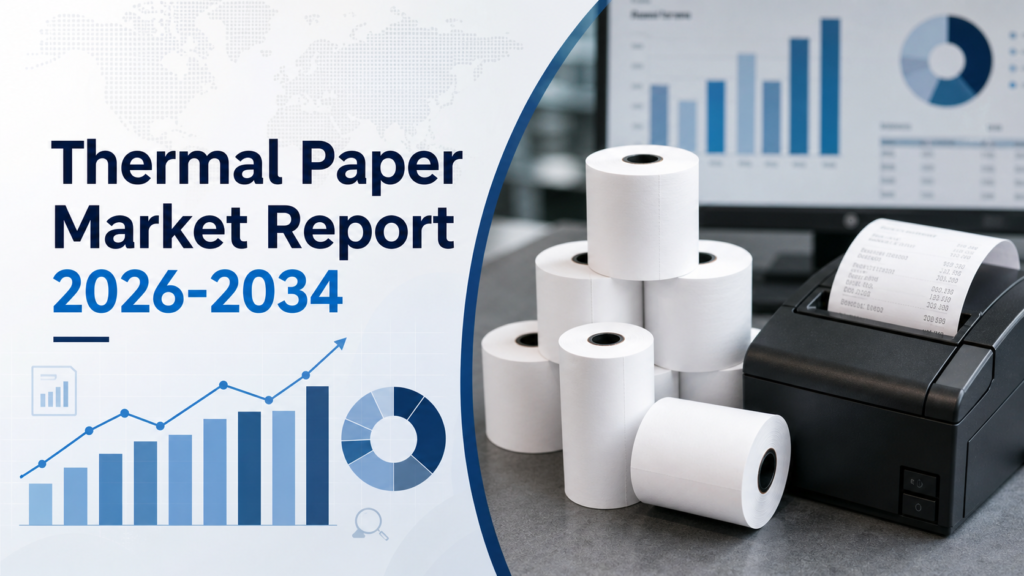
According to IMARC Group’s latest research publication, “Thermal Paper Market Size, Share, Trends and Forecast by Technology, Application, and Region 2026-2034“, the global thermal paper market size grew from USD 4.7 Billion in 2025 to USD 5.0 Billion in 2026. Looking forward, IMARC Group estimates the market to reach USD 6.9 Billion by 2034, exhibiting a CAGR of 4.22% during 2026-2034.
This detailed analysis primarily encompasses industry size, business trends, market share, key growth factors, and regional forecasts. The report offers a comprehensive overview and integrates research findings, market assessments, and data from different sources. It also includes pivotal market dynamics like drivers and challenges, while also highlighting growth opportunities, financial insights, technological improvements, emerging trends, and innovations. Besides this, the report provides regional market evaluation, along with a competitive landscape analysis.
How E-Commerce and Sustainability are Reshaping the Future of Thermal Paper Market
-
With over 33% of the world’s population shopping online, eCommerce is now a USD 6.8 Trillion industry and will reach the USD 8 Trillion mark by 2027.
-
In April 2024, Lecta launched Termax TCLLX, a new phenol-free thermal paper designed for linerless label applications, certified by Ineris.
-
In November 2024, Canadian paper manufacturer Domtar announced the acquisition of Iconex Paper, a U.S.-based thermal paper producer, from Atlas Holdings.
-
According to reports, 177 Million American adults are eco-friendly shoppers in 2024, up 7.44% year-over-year (YoY).
-
As of 2024, digital payments in the Asia-Pacific region have reached a transaction value of USD 4.37 Trillion.
Grab a sample copy of this report: https://www.imarcgroup.com/thermal-paper-market/requestsample
Key Trends in the Thermal Paper Market
-
Thriving E-commerce Sector: The rising demand for thermal paper due to the thriving e-commerce sector is propelling the growth of the market. According to reports, with over 33% of the world’s population shopping online, eCommerce is now a USD 6.8 Trillion industry and will reach the USD 8 Trillion mark by 2027. People are increasingly preferring online shopping on account of its enhanced convenience, doorstep delivery, and wide accessibility to a variety of products. Moreover, the growing need for shipping labels, packing slips, and invoices is offering a positive market outlook. Thermal paper offers improved speed and efficiency in generating these essential documents. Furthermore, e-commerce companies rely on thermal printing technology to ensure accurate order fulfilment and shipping while enhancing the satisfaction of buyers. Additionally, thermal paper is resistant to smudging and fading, making it a preferred choice for printing shipping labels.
-
Favorable Government Initiatives: Governing agencies of various countries are encouraging the adoption of thermal paper to maintain environmental sustainability, which is propelling the growth of the market. Traditional carbon-based paper often contains chemicals like bisphenol-A (BPA) that are harmful to the environment. Moreover, governing authorities are imposing stringent regulations and guidelines promoting the use of eco-friendly paper alternatives. They are also incentivizing the recycling of thermal paper to reduce waste and encourage responsible disposal, which is impelling the market growth. According to reports, 177 Million American adults are eco-friendly shoppers in 2024, up 7.44% year-over-year (YoY).
-
Advancements in Printing Technology: Advancements in printing technology assist in offering improved quality, efficiency, and versatility. These technological developments encompass various aspects of the printing process, ranging from hardware to software, resulting in several notable advancements. Digital innovations allow for on-demand printing with minimal setup and cost. It enables the production of high-quality prints with precision, consistency, and customization. Inkjet technology offers faster printing speeds, higher resolutions, and broader color gamuts. Three-dimensional (3D) printing, also known as additive manufacturing, creates 3D objects layer by layer. Ultraviolet (UV)-curable ink technology improves print durability and versatility.
-
Expansion of Automated and Contactless Transaction Systems: The thermal paper market is experiencing growth due to the expansion of automated and contactless transaction systems across industries. The increasing use of self-service kiosks in the transportation, entertainment, and banking sectors is propelling the demand for high-performance thermal paper. Regulatory emphasis on digital record-keeping and traceability in logistics and food packaging is further encouraging adoption.
-
Rising Popularity of Eco-Friendly Thermal Paper: Advances in chemical coatings and longer image life also enhance product appeal across applications requiring durability and legibility. In April 2024, Lecta launched Termax TCLLX, a new phenol-free thermal paper designed for linerless label applications. Certified by Ineris, the facestock supports barcode and variable data printing, especially for logistics and retail. It offers strong moisture and grease resistance, making it suitable for food packaging, retail scales, and take-out services.
Growth Factors in the Thermal Paper Market
-
Expansion of E-Commerce and Courier Services: The growing popularity of e-commerce and courier services requires consistent labeling and shipping documentation, boosting thermal paper usage. Thermal paper offers improved speed and efficiency in generating essential documents like shipping labels, packing slips, and invoices. As e-commerce companies rely on thermal printing technology to ensure accurate order fulfilment and shipping, demand for thermal paper continues to rise.
-
Growth of Point-of-Sale Systems: Point of sale (PoS) leads the market with around 55.2% of market share, driven by the technology’s speed, reliability, and low operational cost. Thermal paper is extensively used in printing receipts, transaction logs, and invoices across retail chains, supermarkets, restaurants, hospitality, and service sectors. With the rapid expansion of organized retail and digital payment infrastructure in developing economies, the demand for PoS terminals is surging.
-
Regulatory Emphasis on Digital Record-Keeping: Regulatory emphasis on digital record-keeping and traceability in logistics and food packaging is further encouraging adoption. Regulatory requirements for detailed transaction logs in banking and hospitality further drive adoption. The demand for sustainable alternatives is also shaping the market direction, prompting innovation in phenol-free and recyclable thermal paper products across various sectors.
-
Energy Efficiency and Compatibility with Portable Printers: Thermal printing’s energy efficiency and compatibility with portable printers support its use in field services and mobile point-of-sale terminals. This versatility expands the addressable market for thermal paper across diverse applications and industries.
-
Technological Advancements in Chemical Coatings: Advances in chemical coatings and longer image life also enhance product appeal across applications requiring durability and legibility. These innovations improve the performance and reliability of thermal paper, supporting market growth across various end-use sectors.
Leading Companies Operating in the Global Thermal Paper Industry
-
Appvion Operations Inc
-
Gold Huasheng Paper Co. Ltd.
-
Hansol Paper Ltd.
-
Henan JiangHE Paper CO. LTD
-
Jujo Thermal Ltd. (Nippon Paper Industries Co. Ltd)
-
Koehler Group
-
Lecta Group
-
Mitsubishi Paper Mills Limited
-
Nakagawa Manufacturing Inc.
-
Oji Holdings Corporation
-
Ricoh Company Ltd.
-
Thermal Solutions International Inc.
Thermal Paper Market Report Segmentation
Breakup By Technology
-
Direct Thermal
-
Thermal Transfer
Direct thermal stands as the largest component, holding around 70.0% of the market. Direct thermal technology involves a simple and cost-effective process where thermal paper is coated with a heat-sensitive layer. When heat is applied through a thermal printhead, the paper changes color, creating images, text, or barcodes without the need for ribbons or ink. This technology is commonly used for applications like receipt printing, shipping labels, and point-of-sale (POS) systems due to its ease of use and cost efficiency. It is preferred for applications where short-term print durability is sufficient, as direct thermal prints may fade over time when exposed to heat, light, or friction.
Breakup By Application
-
Point of Sale (PoS)
-
Lottery and Gaming
-
Tags and Labels
-
Others
Point of sale (PoS) leads the market with around 55.2% of market share, driven by the technology’s speed, reliability, and low operational cost. Thermal paper is extensively used in printing receipts, transaction logs, and invoices across retail chains, supermarkets, restaurants, hospitality, and service sectors. With the rapid expansion of organized retail and digital payment infrastructure in developing economies, the demand for PoS terminals is surging. This, in turn, is boosting thermal paper consumption. Additionally, businesses prioritize thermal printing for its quiet operation and minimal maintenance needs, reinforcing its dominance in transaction-intensive environments and sustaining long-term growth.
Breakup By Region
-
Asia Pacific (China, Japan, India, South Korea, Australia, Indonesia, Others)
-
North America (United States, Canada)
-
Europe (Germany, France, United Kingdom, Italy, Spain, Russia, Others)
-
Latin America (Brazil, Mexico, Others)
-
Middle East and Africa
Asia-Pacific accounted for the largest market share of over 42.2%. This dominance can be attributed to its strong manufacturing base, rapid urbanization, and expanding retail and logistics sectors. Countries such as China, India, Japan, and South Korea are witnessing increased deployment of Point-of-Sale (PoS) terminals across retail outlets, fueling consistent demand for thermal receipts. The rise in e-commerce transactions and widespread adoption of ATMs, billing counters, and ticketing machines further support market growth. Additionally, lower production costs, availability of raw materials, and favorable trade policies make the region a global hub for thermal paper production and export. Growing digital payments, organized retail penetration, and governmental push toward cashless economies also contribute to the sustained demand, positioning Asia Pacific as the dominant player in the global thermal paper market. For instance, industry reports highlight that as of 2024, digital payments in the Asia-Pacific region have reached a transaction value of USD 4.37 Trillion. Digital wallets dominate the payment landscape, accounting for 69% of e-commerce transactions and 44% of point-of-sale (POS) payments.
Recent News and Developments in Thermal Paper Market
-
July 2025: Wampolet announced it will showcase its expanded thermal product solutions portfolio at Labelexpo Europe 2025. The lineup includes thermal papers, BOPP films, PSA materials, and specialty in-mold labels designed for various printing and labeling applications.
-
May 2025: Ricoh Industrie France announced it will showcase a world-first tree-free, top-coated thermal paper made from sugar cane agricultural residue at Labelexpo Europe 2025. The paper is phenol-free and certified for home compostability, highlighting Ricoh’s commitment to sustainability. This innovation aims to reduce environmental impact through eco-friendly materials and processes.
-
May 2025: NYSCC announced its participation in the 2025 Paper Expo China, held from June 5–7 in Guangzhou. Specializing in thermal chemical materials, NYSCC will showcase its advanced thermal paper and BOPP coatings. The company aims to attract international brands and buyers from China and Southeast Asia.
-
April 2025: Beontag launched Phenol-Free Direct Thermal Papers in the US, eliminating harmful Bisphenol-A and Bisphenol-S from their labeling materials. These safer, high-performance facestocks support industries like food packaging and logistics while ensuring compliance with evolving US regulations. The move reinforces Beontag’s commitment to sustainable and health-conscious labeling solutions.
-
October 2024: Appvion launched Alpha® 185 E, a phenol-free, non-top-coated direct thermal label facestock under its EarthChem™ sustainability portfolio. Designed for distribution, logistics, and cross-docking, it offers enhanced resistance to heat, water, and alcohol, and can be recycled with packaging materials without label removal.
Note: If you require specific details, data, or insights that are not currently included in the scope of this report, we are happy to accommodate your request. As part of our customization service, we will gather and provide the additional information you need, tailored to your specific requirements. Please let us know your exact needs, and we will ensure the report is updated accordingly to meet your expectations.
About Us
IMARC Group is a global management consulting firm that helps the world’s most ambitious changemakers to create a lasting impact. The company provide a comprehensive suite of market entry and expansion services. IMARC offerings include thorough market assessment, feasibility studies, company incorporation assistance, factory setup support, regulatory approvals and licensing navigation, branding, marketing and sales strategies, competitive landscape and benchmarking analyses, pricing and cost research, and procurement research.
Contact Us
IMARC Group
134 N 4th St. Brooklyn, NY 11249, USA
Email: sales@imarcgroup.com
Tel No:(D) +91 120 433 0800
United States: +1-201971-6302