Smart Shelves Market Overview
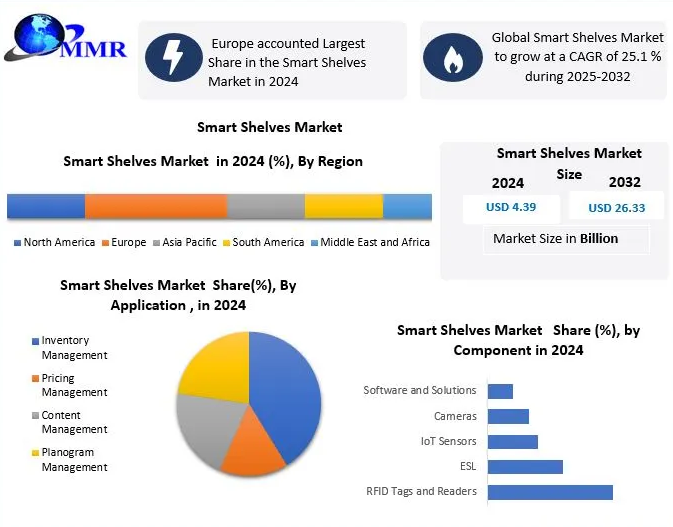
The global Smart Shelves Market was valued at USD 4.39 billion in 2024 and is expected to reach USD 26.33 billion by 2032, registering a compound annual growth rate (CAGR) of 25.1% during the forecast period from 2025 to 2032. The market is witnessing significant growth as retailers increasingly adopt intelligent technologies to improve inventory visibility, automate store operations, minimize product shortages, and deliver enhanced customer experiences. The integration of the Internet of Things (IoT), radio-frequency identification (RFID), artificial intelligence (AI), computer vision, and electronic shelf labels (ESLs) is transforming conventional retail shelving into connected, data-driven systems.
Dive deeper into market insights, trends, segmentation, and competitive landscape here: https://www.maximizemarketresearch.com/request-sample/94487/
Smart shelves are advanced retail shelving solutions equipped with sensors, RFID tags and readers, cameras, digital displays, and software platforms that enable real-time monitoring of product availability, shelf conditions, inventory movement, and customer interactions. These systems help retailers identify low-stock situations, monitor product placement, improve pricing accuracy, and generate actionable insights into shopping behavior. By connecting physical shelves with centralized software platforms and cloud-based analytics, smart shelf solutions support automated replenishment, planogram compliance, dynamic pricing, and more efficient store management.
The growing emphasis on retail digitalization, omnichannel commerce, and operational efficiency is accelerating the adoption of smart shelves across supermarkets, hypermarkets, convenience stores, specialty retail outlets, pharmacies, and other commercial environments. Retailers are increasingly looking for technologies that can reduce manual inventory checks, improve stock accuracy, prevent revenue losses associated with out-of-stock products, and provide consistent pricing across online and offline channels.
Europe dominated the Smart Shelves Market in 2024, supported by the strong presence of electronic shelf label manufacturers, established retail technology providers, and the widespread adoption of digital retail infrastructure. Companies such as SES-imagotag, now operating under the VusionGroup identity, and Pricer AB have contributed to the development of connected shelf technologies across the region. Meanwhile, North America is benefiting from investments in retail automation, AI-enabled inventory management, and autonomous stores. The Asia-Pacific region is also expected to offer substantial growth opportunities due to expanding retail networks, increasing digitalization, and rising demand for intelligent store management systems.
Smart Shelves Market Dynamics
Market Drivers and Trends
Growing Demand for Real-Time Inventory Management
The increasing need for accurate and efficient inventory management is one of the primary drivers of the Smart Shelves Market. Traditional inventory management practices often depend on manual stock counting, periodic shelf inspections, and employee-driven replenishment activities. These processes can be time-consuming and may result in inventory discrepancies, delayed replenishment, and missed sales opportunities.
Dive deeper into market insights, trends, segmentation, and competitive landscape here: https://www.maximizemarketresearch.com/request-sample/94487/
Smart shelves address these challenges by continuously monitoring product availability and notifying store personnel when stock levels fall below predefined thresholds. RFID tags, weight sensors, and computer vision technologies help retailers detect product movement, identify misplaced items, and maintain better visibility across store locations. Improved inventory accuracy enables businesses to optimize replenishment schedules, reduce unnecessary stockholding, and respond more quickly to changing consumer demand.
The ability to access real-time inventory information also supports omnichannel retail operations, including click-and-collect services, ship-from-store fulfillment, and online inventory synchronization. As retailers seek to improve product availability and operational productivity, smart shelf technology is becoming an important component of modern retail infrastructure.
Integration of Artificial Intelligence and the Internet of Things
The integration of AI and IoT is emerging as a major trend in the Smart Shelves Market. IoT-enabled sensors collect continuous data about stock levels, shelf activity, and product movement, while AI-powered analytics interpret these signals to identify patterns and recommend operational improvements.
Advanced smart shelf platforms can support predictive demand forecasting, automated replenishment recommendations, anomaly detection, and shelf compliance monitoring. Computer vision systems can identify gaps on shelves, detect misplaced products, and compare actual product arrangements with approved planograms. These capabilities help retailers reduce manual inspections and improve consistency across multiple outlets.
Cloud computing and edge processing are further improving the scalability and responsiveness of smart shelf systems. Retailers can use centralized dashboards to monitor several stores while processing selected data locally to support faster operational decisions. Continued improvements in sensor accuracy, connectivity, and analytics are expected to strengthen the commercial value of these solutions.
Enhanced Customer Experience and Digital Pricing
Changing consumer expectations are encouraging retailers to provide more informative, convenient, and personalized shopping experiences. Electronic shelf labels allow stores to update prices digitally, reducing the time and labor required to replace conventional paper labels. They can also help retailers maintain consistent pricing across store locations and respond more quickly to promotional changes.
Smart shelves can support digital product information, interactive displays, and context-sensitive promotions. Depending on the system configuration, shoppers may access product specifications, availability information, or promotional content through shelf displays and connected mobile applications.
Dynamic pricing and automated price synchronization are particularly relevant to retailers managing extensive product catalogs. By reducing pricing errors and simplifying promotional execution, smart shelves can improve operational efficiency while supporting a more consistent customer experience.
Expansion of Autonomous and Cashierless Retail
The growing interest in autonomous and cashierless retail formats is creating additional opportunities for smart shelf adoption. These environments depend on accurate product identification, inventory visibility, and reliable tracking of items removed from or returned to shelves.
Smart shelf sensors, RFID technology, and computer vision can contribute to automated product recognition and transaction verification when integrated with appropriate store systems. These capabilities may reduce the need for traditional checkout processes and support frictionless shopping models.
Although the level of automation varies by retailer and technology provider, the development of unattended convenience stores, automated vending environments, and compact retail outlets is expected to encourage investment in intelligent shelving infrastructure.
Growing Importance of Retail Analytics
Smart shelves generate valuable information about inventory movement, shelf availability, replenishment patterns, and product interactions. Retailers can use this information to improve category planning, evaluate promotional effectiveness, optimize product placement, and identify operational inefficiencies.
Retail analytics can also support collaboration between retailers and consumer goods manufacturers by providing better visibility into product availability and merchandising execution. As businesses increasingly adopt data-driven decision-making, the demand for smart shelf platforms that combine sensing technologies with advanced analytics is expected to rise.
Primary Market Constraints
High Initial Installation and Integration Costs
The high upfront cost of implementing smart shelf infrastructure remains a significant challenge for the market. A comprehensive deployment may require RFID tags and readers, IoT sensors, cameras, electronic shelf labels, connectivity infrastructure, software licenses, and integration with existing inventory and point-of-sale systems.
For small and medium-sized retailers operating with limited technology budgets, these investments can create financial barriers. Additional expenses associated with maintenance, device replacement, system upgrades, employee training, and cybersecurity management can further affect the overall cost of ownership.
Retailers may therefore adopt smart shelf solutions gradually, beginning with high-value product categories or selected store locations before expanding across their entire networks. Vendors offering modular systems, flexible pricing models, and measurable return-on-investment benefits may be better positioned to attract cost-conscious customers.
Consumer Privacy and Data Security Concerns
Privacy and data security concerns may restrict the adoption of certain smart shelf technologies, particularly systems that combine product tracking with cameras, customer analytics, or identifiable consumer information. RFID technology generally identifies tagged products rather than automatically identifying individual shoppers; however, concerns can arise when tracking systems are linked with personal data or used beyond their intended purposes.
Retailers must ensure that data collection practices are transparent, proportionate, and compliant with applicable privacy regulations. Systems connected to cloud platforms and store networks must also be protected against unauthorized access, data breaches, and cyberattacks.
Clear data governance policies, secure device authentication, encryption, and appropriate access controls can help address these challenges. Nevertheless, consumer trust and regulatory compliance will remain important considerations as smart shelf deployments become more sophisticated.
Technical Complexity and Interoperability Challenges
Smart shelves frequently combine hardware and software from multiple technology providers. Integrating these components with existing enterprise resource planning systems, warehouse management platforms, point-of-sale systems, and retail analytics applications can be complex.
Differences in communication protocols, data formats, and vendor-specific platforms may increase implementation time and limit interoperability. Retailers may also encounter difficulties when scaling pilot projects across stores with different layouts, network capabilities, and operational requirements.
The availability of standardized interfaces, flexible integration tools, and vendor-neutral software platforms can help reduce these challenges. Continued development of interoperable solutions will be important for achieving broader market adoption.
Operational Reliability and Maintenance Requirements
Smart shelf systems depend on reliable sensors, connectivity, power supplies, and software services. Device failures, connectivity interruptions, inaccurate sensor readings, or damaged labels can affect inventory visibility and operational performance.
Retail environments with high product turnover, changing shelf configurations, and demanding operating conditions may require regular maintenance and recalibration. Retailers must therefore evaluate system reliability, technical support availability, and long-term maintenance costs before implementing smart shelf technologies at scale.
Smart Shelves Market Segment Analysis
The Smart Shelves Market is segmented by component, enterprise size, application, and region. Each segment contributes to market development by addressing specific retail automation requirements, inventory challenges, and customer engagement objectives.
By Component
Based on component, the market is segmented into RFID Tags and Readers, Electronic Shelf Labels (ESLs), IoT Sensors, Cameras, and Software and Solutions.
The Software and Solutions segment is expected to account for a significant share of the market as retailers increasingly require integrated platforms to collect, process, and analyze information generated by connected shelf devices. These solutions connect shelf hardware with cloud servers, gateways, inventory management systems, and retail analytics applications. Key functions include inventory optimization, store monitoring, pricing management, promotional compliance, category analysis, and planogram monitoring.
The RFID Tags and Readers segment plays an important role in identifying products and tracking their movement throughout retail environments. RFID-based solutions can improve stock visibility, simplify inventory audits, and support automated product identification.
Electronic shelf labels are gaining traction because they enable centralized price updates and reduce the labor associated with changing paper labels. IoT sensors provide information about shelf occupancy and product movement, while cameras and computer vision systems support product recognition, shelf-gap detection, and merchandising compliance. The combined use of these components enables retailers to develop comprehensive, connected retail environments.
By Enterprise Size
Based on enterprise size, the market is divided into Small and Medium-sized Enterprises (SMEs) and Large Enterprises.
Large enterprises are important adopters of smart shelf solutions because they operate extensive retail networks, manage large product inventories, and require standardized processes across multiple locations. Supermarket chains, hypermarkets, department stores, and multinational retailers can use smart shelves to improve inventory visibility, automate pricing operations, and monitor store-level performance through centralized platforms.
SMEs represent an emerging growth opportunity as technology providers introduce more affordable and scalable solutions. Smaller retailers can implement electronic shelf labels, selected inventory sensors, or cloud-based inventory management applications without necessarily investing in a fully integrated smart store. The availability of modular deployment models and subscription-based software can help reduce initial investment barriers.
By Application
Based on application, the market is segmented into Inventory Management, Pricing Management, Content Management, and Planogram Management.
Inventory Management: Inventory management is a key application of smart shelf technology. Sensors, RFID systems, and computer vision enable retailers to monitor stock availability, identify shelf gaps, detect misplaced products, and support timely replenishment. Improved visibility can help reduce lost sales, limit excess inventory, and strengthen store-level operational efficiency.
Pricing Management: Pricing management is expected to experience strong demand as retailers seek to maintain consistent prices across physical stores and digital channels. Electronic shelf labels allow retailers to update prices centrally, implement promotional campaigns, and reduce manual pricing errors. Automated pricing processes are particularly valuable for businesses managing frequent promotions and extensive product assortments.
Content Management: Content management enables retailers to display and update product descriptions, promotional messages, advertising content, and other relevant information through compatible digital shelf displays. These capabilities can improve product communication and support more engaging in-store experiences.
Planogram Management: Planogram management focuses on ensuring that products are displayed according to approved merchandising layouts. Cameras and computer vision applications can help identify incorrect placements, missing products, and shelf-layout deviations. Retailers can use these insights to improve merchandising compliance and optimize the use of shelf space.
Dive deeper into market insights, trends, segmentation, and competitive landscape here: https://www.maximizemarketresearch.com/request-sample/94487/
Smart Shelves Market Regional Insights
Europe
Europe dominated the Smart Shelves Market in 2024 and is expected to remain a prominent regional market during the forecast period. The region benefits from established retail technology infrastructure, the presence of major electronic shelf label providers, and the growing adoption of digital price displays across supermarkets and other retail formats.
France, Germany, Italy, Belgium, Sweden, and other European countries have contributed to the development of the regional market. Companies such as SES-imagotag (VusionGroup), Pricer AB, and Bizerba support the market through connected labeling, retail automation, and store management technologies.
The increasing emphasis on operational efficiency, pricing accuracy, and digital retail transformation is expected to sustain demand. The extent of future growth will depend on retailers’ investment priorities, technology integration requirements, and the economics of large-scale deployments.
North America
North America is an important market for smart shelves, driven by retail automation initiatives, established technology ecosystems, and growing interest in AI-enabled store operations. Retailers in the United States and Canada are exploring connected shelf solutions to improve inventory accuracy, reduce stockouts, automate pricing, and strengthen omnichannel fulfillment.
The region also benefits from the presence of technology companies and solution providers such as Avery Dennison Corporation, Honeywell International Inc., Intel Corporation, AWM Smart Shelf, and Focal Systems. Their capabilities across RFID, sensing, computing, and retail analytics support the development of integrated smart store solutions.
Continued investment in computer vision, real-time inventory tracking, and automated retail processes is expected to create opportunities for market participants.
Asia-Pacific
The Asia-Pacific Smart Shelves Market is expected to offer considerable growth opportunities due to the expansion of organized retail, increasing smartphone and digital technology adoption, and investments in connected retail infrastructure. Countries such as China, Japan, South Korea, India, and Australia are important markets for retail digitalization.
The presence of technology manufacturers and electronics companies, including Huawei Technologies, Samsung Electronics, and E Ink Holdings, supports the development of enabling technologies for smart shelves. Retailers are increasingly interested in electronic labels, AI-enabled inventory monitoring, and integrated store analytics to improve productivity and respond to changing shopping patterns.
The region’s large consumer base and diverse retail formats create opportunities for both premium smart shelf deployments and cost-effective solutions designed for smaller stores. However, adoption rates may vary according to infrastructure readiness, investment capacity, and retail market maturity.
Middle East and Africa
The Middle East and Africa region presents emerging opportunities as retailers invest in modern store formats, digital infrastructure, and automated inventory management. The expansion of shopping centers, supermarkets, and technology-enabled retail operations in parts of the Gulf Cooperation Council (GCC) region is creating demand for more efficient store management solutions.
Smart shelves can help retailers improve product availability, reduce manual stock checks, and manage pricing across large product assortments. However, adoption may be influenced by implementation costs, access to specialized technical support, and the maturity of retail technology infrastructure.
South America
South America is gradually exploring smart shelf technologies as retailers seek to improve inventory control, reduce operational inefficiencies, and modernize in-store experiences. Brazil and Argentina represent important markets for retail technology adoption in the region.
The implementation of RFID, electronic shelf labels, and connected inventory platforms can help retailers address stock discrepancies and improve merchandising execution. Further growth will depend on technology affordability, economic conditions, connectivity infrastructure, and the willingness of retailers to invest in digital transformation.
Smart Shelves Market Key Trends
- Deeper AI and IoT Integration: Smart shelves are increasingly incorporating AI algorithms and connected sensors to improve inventory visibility, identify shelf gaps, predict replenishment needs, and automate routine store operations.
- Personalized and Interactive Shopping Experiences: Digital displays and connected applications are enabling retailers to provide product information, targeted promotional content, and more engaging shopping experiences.
- Expansion of Electronic Shelf Labels: Retailers are adopting ESL technology to simplify price changes, improve pricing accuracy, and reduce the labor required to manage paper-based labels.
- Growth of Autonomous Retail: Smart shelves are supporting automated product recognition and inventory tracking in cashierless stores, unattended retail environments, and other frictionless shopping formats.
- Increasing Use of Retail Analytics: Data generated by connected shelves is helping businesses optimize product placement, monitor promotional effectiveness, improve category planning, and understand product movement.
- Focus on Shrinkage Reduction: Retailers are exploring smart shelf technologies to identify inventory discrepancies, monitor unusual product movement, and strengthen loss-prevention processes. These systems can support shrinkage management but do not eliminate theft independently.
- Cloud-Based and Scalable Deployments: Cloud-connected platforms and modular solutions are helping retailers manage multiple stores through centralized dashboards while expanding deployments according to operational needs.
Smart Shelves Market Competitive Landscape
The Smart Shelves Market is characterized by competition among electronic shelf label manufacturers, RFID technology providers, retail automation companies, software developers, and technology infrastructure suppliers. Market participants are focusing on product innovation, strategic partnerships, acquisitions, and integrated hardware-software offerings to strengthen their competitive positions.
SES-imagotag, now associated with VusionGroup, is a prominent participant in electronic shelf labels and digital retail solutions. Pricer AB provides electronic shelf labeling and in-store communication technologies. Avery Dennison Corporation contributes RFID-enabled identification and intelligent labeling solutions, while Samsung Electronics supports digital display and connected technology applications. Honeywell International Inc. and Intel Corporation offer broader automation, computing, and technology capabilities relevant to smart retail deployments.
Other companies, including AWM Smart Shelf, Focal Systems, Bizerba, E Ink Holdings, Huawei Technologies, and Trax Retail, participate in different parts of the retail technology ecosystem.
Competitive differentiation increasingly depends on system accuracy, ease of integration, scalability, analytics capabilities, reliability, and total cost of ownership. Providers that combine connected shelf hardware with software platforms and actionable retail insights may be well positioned to address the needs of retailers seeking measurable operational improvements.
Smart Shelves Market Scope and Research Methodology
The Smart Shelves Market report provides an in-depth assessment of market size, growth opportunities, technological developments, competitive positioning, and regional performance. The study examines the factors influencing adoption across retail environments and evaluates the opportunities and challenges facing technology providers and end users.
The research covers historical market developments, current industry dynamics, and forecasts for the period from 2025 to 2032. It also considers the impact of technological innovation, changing consumer expectations, retail digitalization, and investment in automated inventory management.
Smart Shelves Market Report Coverage
| Report Parameter | Details |
|---|---|
| Market Name | Smart Shelves Market |
| Base Year | 2024 |
| Historical Data | 2019–2024 |
| Forecast Period | 2025–2032 |
| Market Size in 2024 | USD 4.39 Billion |
| Market Size by 2032 | USD 26.33 Billion |
| CAGR | 25.1% |
| Segments Covered | Component, Enterprise Size, Application, and Region |
| Study Focus | Market drivers, restraints, opportunities, trends, and competitive landscape |
Smart Shelves Market Segmentation
By Component
- RFID Tags and Readers
- Electronic Shelf Labels (ESLs)
- IoT Sensors
- Cameras
- Software and Solutions
By Enterprise Size
- Small and Medium-sized Enterprises (SMEs)
- Large Enterprises
By Application
- Inventory Management
- Pricing Management
- Content Management
- Planogram Management
By Region
- North America: United States, Canada, and Mexico
- Europe: United Kingdom, France, Germany, Italy, Spain, Sweden, Austria, and the Rest of Europe
- Asia-Pacific: China, South Korea, Japan, India, Australia, Indonesia, Malaysia, Vietnam, Taiwan, Bangladesh, Pakistan, and the Rest of Asia-Pacific
- Middle East and Africa: South Africa, GCC countries, Egypt, Nigeria, and the Rest of the Middle East and Africa
- South America: Brazil, Argentina, and the Rest of South America
Smart Shelves Market Key Players
The major companies operating in the Smart Shelves Market include:
Europe
- SES-imagotag (France)
- Pricer AB (Sweden)
- Bizerba (Germany)
- Spryker Systems GmbH (Germany)
North America
5. AWM Smart Shelf (United States)
6. Avery Dennison Corporation (United States)
7. Honeywell International Inc. (United States)
8. Intel Corporation (United States)
9. Focal Systems Inc. (United States)
Asia-Pacific
10. Huawei Technologies Co., Ltd. (China)
11. Samsung Electronics Co., Ltd. (South Korea)
12. E Ink Holdings Inc. (Taiwan)
13. Happiest Minds Technologies Limited (India)
14. Lenovo Group Ltd. (Hong Kong)
Middle East and Africa
15. Trax Retail (Singapore)
16. Adroit Worldwide Media, Inc. (United States)
South America
17. Trax Technology Solutions Pte. Ltd. (Singapore)
These companies participate in different areas of the smart retail ecosystem, including electronic shelf labels, RFID identification, digital displays, computer vision, IoT infrastructure, and inventory analytics. Their competitive strategies include technological innovation, product development, partnerships, and the expansion of connected retail solutions.
Frequently Asked Questions (FAQs)
1. What was the global Smart Shelves Market size in 2024?
The global Smart Shelves Market was valued at USD 4.39 billion in 2024, reflecting growing demand for connected shelving, real-time inventory tracking, and retail automation technologies.
2. What is the projected Smart Shelves Market size by 2032?
The global Smart Shelves Market is expected to reach USD 26.33 billion by 2032, according to the provided market estimates.
3. What is the expected CAGR of the Smart Shelves Market during 2025–2032?
The Smart Shelves Market is projected to grow at a CAGR of 25.1% during the forecast period from 2025 to 2032.
4. Which region dominated the Smart Shelves Market in 2024?
Europe dominated the Smart Shelves Market in 2024, supported by the established electronic shelf label industry, retail digitalization, and the presence of major market participants such as SES-imagotag and Pricer AB.
5. What are the major factors driving the Smart Shelves Market?
The primary growth drivers include the rising demand for real-time inventory management, increasing adoption of RFID and IoT technologies, AI-enabled retail analytics, electronic shelf labels, automated pricing, and the expansion of autonomous retail formats.
Conclusion
The Smart Shelves Market is undergoing rapid transformation as retailers increasingly integrate connected technologies into traditional store operations. The market’s projected expansion from USD 4.39 billion in 2024 to USD 26.33 billion by 2032 highlights the growing importance of inventory automation, digital pricing, AI-powered analytics, and real-time product visibility.
Although high implementation costs, integration challenges, and privacy concerns may influence adoption, continued advancements in RFID, IoT, computer vision, and electronic shelf labels are creating new opportunities for technology providers and retailers. Europe remains a leading regional market, while North America and Asia-Pacific offer significant potential as retailers modernize their operations.
As digital retail strategies continue to evolve, smart shelves are expected to become an increasingly important part of connected store infrastructure, helping businesses improve operational efficiency, strengthen inventory accuracy, and deliver more consistent shopping experiences.
Connect With Us:
MAXIMIZE MARKET RESEARCH PVT. LTD.
2nd Floor, Navale IT park Phase 3,
Pune Banglore Highway, Narhe
Pune, Maharashtra 411041, India.
+91 9607365656
sales@maximizemarketresearch.com
About Maximize Market Research:
Maximize Market Research is one of the fastest-growing market research and business consulting firms serving clients globally. Our revenue impact and focused growth-driven research initiatives make us a proud partner of majority of the Fortune 500 companies. We have a diversified portfolio and serve a variety of industries such as IT & telecom, chemical, food & beverage, aerospace & defense, healthcare and others.