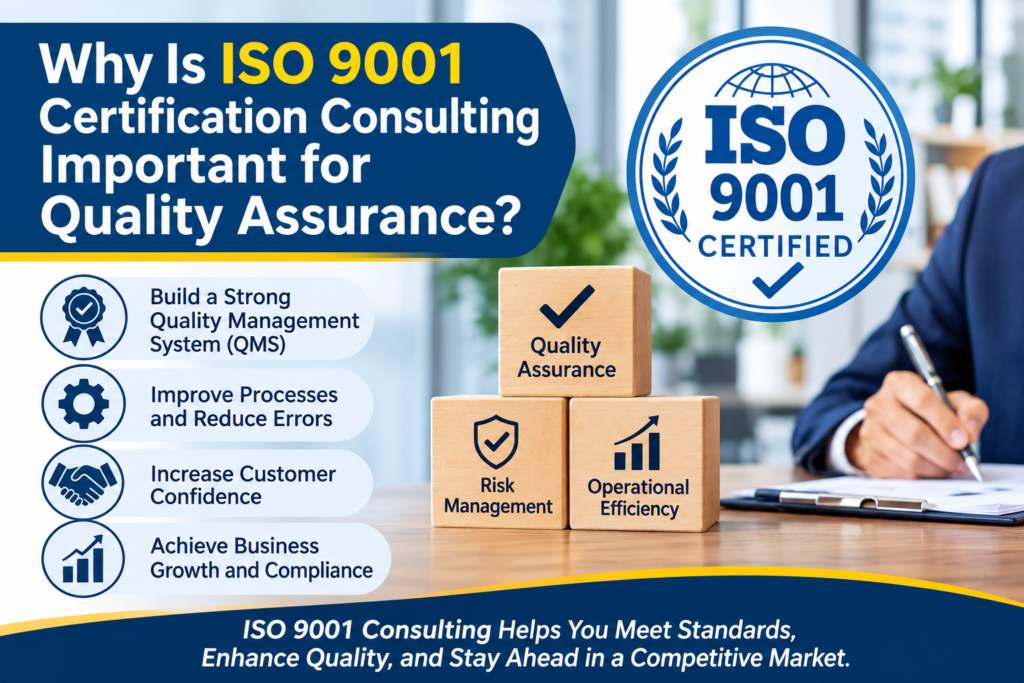
ISO 9001 certification consulting helps organizations establish, implement, and maintain a quality management system (QMS) that meets international standards. It provides guidance on process improvement, documentation, risk management, and compliance. With the right support, businesses can strengthen quality assurance, reduce operational inconsistencies, and prepare for a more structured certification process.
Maintaining consistent product and service quality is important for building customer trust and improving business performance. However, achieving these goals requires more than inspecting finished products. Organizations need reliable processes that identify problems, manage risks, and support continuous improvement. This is where professional consulting can make a difference.
What Is the Role of ISO 9001 Certification Consulting?
ISO 9001 certification consulting helps businesses understand the requirements of the ISO 9001 standard and apply them to their daily operations. Consultants assess existing processes, identify gaps, and recommend improvements to help establish an effective quality management system.
The process generally includes several activities:
- Reviewing current quality management practices.
- Identifying gaps between existing processes and ISO 9001 requirements.
- Developing or improving QMS documentation.
- Supporting employee training and awareness.
- Helping organizations conduct internal audits.
- Preparing teams for external certification audits.
The consultant’s role is to guide implementation rather than issue the certification. An independent certification body evaluates the management system and decides whether the organization meets the applicable requirements.
How Does ISO 9001 Compliance Improve Quality Assurance?
ISO 9001 compliance encourages organizations to manage quality through documented processes, measurable objectives, and regular performance reviews. Instead of depending only on individual employees to maintain standards, businesses can create consistent procedures across departments.
This approach supports quality assurance in several ways.
Consistent processes: Documented procedures help employees understand their responsibilities and follow established methods. This can reduce variations in how tasks are performed.
Better risk management: Organizations identify potential problems before they affect products, services, or customers. Risk-based thinking also helps teams prioritize preventive measures.
Improved customer satisfaction: Businesses can establish processes for understanding customer requirements, handling complaints, and monitoring feedback.
Corrective action: When a problem occurs, teams can investigate its root cause and take action to prevent recurrence.
Continuous improvement: Regular reviews and performance monitoring help organizations identify opportunities to improve their QMS.
These practices make quality management an ongoing business activity rather than a one-time certification exercise.
Why Should Businesses Work With ISO 9001 Certification Consultants?
Implementing ISO 9001 can be challenging, particularly for organizations that do not have an experienced internal quality management team. ISO 9001 certification consultants provide structured guidance and help businesses interpret standard requirements in the context of their operations.
Their support can be useful for several reasons:
- Understanding requirements: Consultants explain relevant ISO 9001 clauses and help organizations determine how they apply to specific processes.
- Identifying process gaps: A review of existing operations can reveal missing controls, inconsistent procedures, or documentation issues.
- Building a practical QMS: Consultants can help create a management system that supports actual business activities instead of unnecessary paperwork.
- Preparing employees: Training helps staff understand quality objectives, process requirements, and their individual responsibilities.
- Improving audit readiness: Internal assessments can help identify nonconformities before the external certification audit.
Experienced consultants can also help organizations avoid common implementation problems, such as creating excessive documentation or treating certification as a purely administrative task.
What Does ISO 9001 QMS Consulting Include?
ISO 9001 QMS consulting focuses on developing and improving the organization’s quality management system. The goal is to ensure that processes work together to meet customer and regulatory requirements while supporting consistent operational performance.
The scope of consulting may include the following areas.
Quality Management System Gap Analysis
A gap analysis compares current business practices with the requirements of ISO 9001. It helps identify areas that need improvement before implementation or certification.
The review may cover leadership responsibilities, process controls, employee competence, documented information, performance evaluation, and corrective actions.
QMS Documentation Development
Organizations need appropriate documented information to support their quality management system. Consultants can help prepare or improve documents such as:
- Quality policies and objectives
- Process descriptions and procedures
- Work instructions
- Risk and opportunity records
- Internal audit reports
- Corrective action records
Documentation should reflect how the organization actually operates. Creating unnecessary paperwork can make the system difficult to maintain.
Employee Training and Awareness
Employees play an important role in maintaining quality standards. Training helps them understand the quality policy, relevant procedures, and their responsibilities.
Depending on the organization’s needs, training may cover ISO 9001 awareness, internal auditing, process management, and corrective action methods.
Internal Audit Support
Internal audits help determine whether the QMS meets planned requirements and is being implemented effectively. Consultants may help develop audit schedules, prepare checklists, train internal auditors, and review audit findings.
The organization remains responsible for ensuring that its internal audit process is objective and effective.
How Do ISO 9001 Appraisal Services Support Certification Readiness?
ISO 9001 appraisal services can help organizations evaluate how effectively their quality management system meets relevant standard requirements. These assessments may identify weaknesses in documentation, process implementation, employee awareness, and performance monitoring.
An appraisal can be useful before a formal certification audit because it provides an opportunity to address potential nonconformities.
A typical appraisal may involve:
- Reviewing existing QMS documents and records.
- Examining selected operational processes.
- Interviewing employees and relevant managers.
- Checking whether established procedures are followed.
- Identifying gaps and areas requiring corrective action.
- Preparing findings and recommendations.
The exact scope depends on the service provider and the organization’s requirements. An appraisal or consulting review does not replace an independent certification audit or guarantee certification.
What Are the Main Stages of the ISO 9001 Certification Process?
A structured implementation process helps organizations move from initial assessment to certification readiness.
Stage 1: Initial assessment
The organization reviews its current quality management practices and identifies areas that need improvement.
Stage 2: QMS planning
Management defines the scope of the QMS, establishes quality objectives, assigns responsibilities, and plans the implementation.
Stage 3: Documentation and implementation
Relevant processes, procedures, and controls are documented and introduced across the organization.
Stage 4: Employee training
Employees receive the necessary guidance to understand and follow the quality management system.
Stage 5: Internal audit
The organization evaluates whether its QMS meets ISO 9001 requirements and identifies nonconformities.
Stage 6: Management review
Top management reviews QMS performance, audit results, customer feedback, risks, and improvement opportunities.
Stage 7: External certification audit
An independent certification body assesses the QMS. If the organization meets the applicable requirements and completes the certification body’s process, certification may be granted.
How Should You Choose the Right ISO 9001 Consulting Provider?
Choosing a suitable consulting provider is important because the quality of implementation guidance can influence how effectively the QMS works over time.
Consider these factors before making a decision:
- Relevant experience: Look for consultants with experience in your industry and organizational size.
- Knowledge of ISO 9001: Confirm that they understand the current standard and its practical requirements.
- Clear scope of services: Ask whether the engagement includes gap analysis, documentation, training, internal audit support, and readiness assessment.
- Practical approach: Choose a provider that adapts the QMS to your operations rather than relying on generic templates.
- Transparent pricing: Understand the expected costs, deliverables, and implementation timeline.
- Independence: Confirm that consulting activities are appropriately separated from independent certification decisions.
A good consultant should help build a manageable system that supports long-term quality performance, not simply prepare an organization for an audit.
Frequently Asked Questions
Is ISO 9001 certification mandatory for every business?
No. ISO 9001 certification is generally voluntary. However, some customers, contracts, industries, or procurement requirements may make it necessary for an organization to demonstrate conformity.
How long does ISO 9001 implementation take?
The timeline depends on the organization’s size, operational complexity, existing processes, and available resources. Businesses with established quality controls may need less implementation time than those developing a QMS from the beginning.
Can a business implement ISO 9001 without consultants?
Yes. Organizations can implement ISO 9001 internally if they have the necessary knowledge, resources, and personnel. Consultants can provide additional guidance and help reduce implementation challenges.
Do ISO 9001 certification consultants issue certificates?
No. Consultants provide implementation and readiness support. Certification decisions are made by independent certification bodies following their assessment process.
What is the difference between ISO 9001 consulting and appraisal services?
Consulting generally provides guidance to develop, implement, and improve a QMS. Appraisal services focus on evaluating the system’s current condition and identifying gaps or improvement opportunities. The exact scope can vary by provider.
Conclusion
ISO 9001 certification consulting plays an important role in helping organizations establish effective quality management systems and strengthen quality assurance. Through gap analysis, documentation support, employee training, and audit preparation, consultants can help businesses understand and apply ISO 9001 requirements.
Whether an organization needs ISO 9001 QMS consulting, compliance guidance, or appraisal services, the objective should be to create a practical system that supports consistent processes and continuous improvement. A well-implemented QMS can help businesses maintain customer confidence while supporting long-term operational performance.