Market Overview
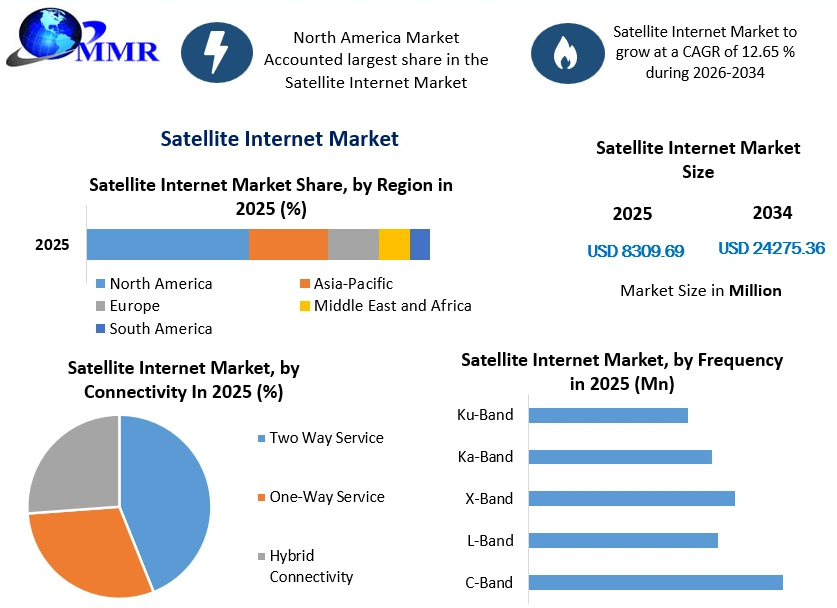
The Satellite Internet Market is entering a high-growth phase as governments, enterprises, telecommunications providers, and consumers increasingly seek reliable broadband connectivity beyond the reach of conventional terrestrial networks. According to the provided market analysis, the global Satellite Internet Market was valued at USD 8,309.69 million in 2025 and is projected to expand at a CAGR of 12.65% from 2026 to 2034, reaching approximately USD 24,275.36 million by 2034.
Dive deeper into the market dynamics and future outlook: https://www.maximizemarketresearch.com/request-sample/125907/
Satellite internet is a broadband connectivity service that transmits and receives data through satellites positioned in orbit and ground-based infrastructure. Unlike conventional fiber, cable, or fixed wireless networks, satellite connectivity can serve locations where terrestrial infrastructure is expensive, geographically difficult, or commercially impractical to deploy. This makes satellite broadband particularly important for rural communities, isolated islands, mountainous regions, maritime operations, aviation, defense applications, and remote industrial sites.
The market is being transformed by the rapid deployment of Low Earth Orbit (LEO) satellite constellations, high-throughput satellites, advanced ground equipment, and electronically steered antenna systems. LEO networks are particularly significant because their lower orbital altitude can support reduced latency compared with traditional geostationary satellite systems. The emergence of large-scale satellite constellations is consequently increasing the potential for satellite internet to compete with terrestrial broadband across an expanding range of applications.
Track Market Financial Performance
The financial outlook for the Satellite Internet Market demonstrates strong long-term expansion. From a market value of USD 8.31 billion in 2025, revenues are expected to nearly triple to USD 24.28 billion by 2034. The projected 12.65% CAGR reflects increasing investment in satellite infrastructure, growing subscriber demand, expanding enterprise applications, and the development of multi-orbit connectivity models.
Dive deeper into the market dynamics and future outlook: https://www.maximizemarketresearch.com/request-sample/125907/
The commercial landscape is moving beyond traditional residential broadband. Satellite internet providers are increasingly targeting telecommunications backhaul, transportation and logistics, aviation, marine connectivity, enterprise networks, military communications, scientific research, and IoT applications. This diversification is creating multiple revenue streams for satellite operators, service providers, equipment manufacturers, and technology companies.
Investment in LEO constellations is also influencing the financial structure of the industry. Operators are allocating substantial capital toward satellite manufacturing, launch capacity, spectrum, ground stations, network management, and customer terminals. As constellation scale increases, providers are expected to focus increasingly on network utilization, customer acquisition, enterprise contracts, and operational efficiency.
Analyze Key Market Drivers
Expanding Demand for Connectivity in Remote Areas
One of the strongest growth drivers is the persistent demand for internet connectivity in underserved and remote locations. Rural communities often face limited access to fiber-optic infrastructure because of high deployment costs and difficult terrain. Satellite internet can overcome these geographical barriers by providing broadband coverage without requiring extensive terrestrial cable networks.
This capability is especially important in developing economies, where governments and telecommunications companies are seeking cost-effective approaches to bridge the digital divide. Access to broadband enables remote communities to participate in digital education, telemedicine, e-commerce, financial services, government platforms, and remote employment.
Rapid Advancements in Satellite Technology
Technological innovation is another major factor supporting market growth. High-throughput satellites provide greater capacity, while LEO constellations are designed to improve latency and coverage. Modern ground terminals and phased-array antennas are also improving the efficiency and usability of satellite connections.
The expansion of LEO networks led by major industry participants has demonstrated the potential for satellite broadband to deliver high-speed connectivity on a global scale. Continued improvements in satellite payloads, launch economics, network automation, spectrum utilization, and customer terminals are expected to strengthen the competitiveness of satellite internet.
Rising Adoption of IoT and Smart Devices
The increasing adoption of connected devices is opening another important growth avenue. IoT applications require dependable communications across a wide range of locations, including areas where terrestrial connectivity is unavailable.
In agriculture, satellite connectivity can support precision farming by transmitting data from field sensors, machinery, weather-monitoring systems, and autonomous equipment. In oil and gas, mining, logistics, utilities, and environmental monitoring, satellite networks can connect remote assets and facilitate real-time data exchange.
The partnership between John Deere and SpaceX illustrates this trend. The collaboration is designed to use Starlink connectivity to improve connectivity for agricultural machinery, supporting capabilities such as autonomy, real-time data sharing, remote diagnostics, and machine-to-machine communication.
Government Support for Digital Connectivity
Government investment and broadband initiatives are also accelerating satellite internet adoption. Public authorities increasingly view satellite connectivity as a strategic tool for expanding broadband access and improving digital inclusion.
Funding programs, rural broadband initiatives, spectrum policies, and partnerships between governments and private satellite companies are creating favorable conditions for market development. Satellite connectivity is also becoming increasingly relevant for emergency communications and disaster recovery because satellite networks can provide communications when terrestrial infrastructure is damaged or unavailable.
Evaluate Core Segments & Distribution
By Connectivity
Based on connectivity, the market is segmented into Two Way Service, One-Way Service, and Hybrid Connectivity.
Two Way Service accounted for the dominant position in 2025 because it supports both uploading and downloading data, making it suitable for interactive broadband applications. It is particularly important for residential internet, enterprise communications, remote monitoring, and real-time digital services.
One-Way Service remains relevant for applications where information is primarily distributed in one direction and cost efficiency is important.
Hybrid Connectivity is emerging as a flexible model that combines satellite and terrestrial or wireless technologies. This approach can improve service responsiveness and reliability by selecting the most appropriate connectivity route according to network conditions and application requirements.
By Vertical
The market serves a broad range of industries, including telecommunication and backhaul, media and entertainment, business and enterprise, transportation and logistics, scientific research and development, aviation, marine, retail and consumer, military, and other applications.
Transportation and marine connectivity are gaining particular attention as logistics operators seek uninterrupted communication across oceans and remote routes. The collaboration between A.P. Moller Maersk and Starlink demonstrates the increasing role of satellite broadband in maritime operations, with connectivity supporting crew welfare and operational efficiency.
By Frequency
The Satellite Internet Market is segmented into C-Band, L-Band, X-Band, Ka-Band, and Ku-Band. Different frequency bands serve different performance, coverage, capacity, and application requirements. Ka-Band and Ku-Band are particularly important for broadband-oriented satellite communications, while other frequency ranges remain valuable for specialized communication and mobility applications.
By Orbit
The market is categorized into LEO Orbit and MEO/GEO Orbit. LEO is experiencing significant attention because of its potential for lower latency and high-speed broadband services. MEO and GEO systems continue to provide important coverage and capacity advantages for established satellite communication applications.
Dive deeper into the market dynamics and future outlook: https://www.maximizemarketresearch.com/request-sample/125907/
Regional Market Insights
North America held the leading position in the Satellite Internet Market in 2025. The region benefits from advanced telecommunications infrastructure, significant private investment, established satellite operators, and strong demand for broadband in rural areas. The United States is at the center of industry innovation, with major initiatives involving Starlink and Amazon’s Project Kuiper.
Asia Pacific is expected to remain one of the fastest-growing regions as governments and private companies work to improve broadband coverage across geographically diverse populations. India, China, Japan, Australia, and other countries are investing in satellite communications to reach underserved communities and support enterprise and government applications.
Europe is also developing its satellite connectivity capabilities through public and private initiatives, while Latin America, the Middle East, and Africa offer considerable opportunities because of rural connectivity gaps and limited terrestrial infrastructure.
Major Key Players
The competitive environment includes satellite operators, telecommunications companies, broadband providers, technology manufacturers, and emerging constellation developers. Major companies identified in the market landscape include:
- Singtel Group
- EchoStar Corporation
- Thuraya Telecommunications Company
- Viasat, Inc.
- DSL Telecom
- Starlink
- Hughes Network Systems, LLC
- Telesat
- Speedcast
- SES S.A.
- Intelsat
- L3 Technologies, Inc.
- SKY Perfect JSAT Group
- Gilat Satellite Networks
- Cobham Limited
- Embratel
- Freedomsat
- OneWeb
- Skycasters
- SpaceX
Competition is increasingly centered on constellation scale, network capacity, latency, geographic coverage, service affordability, terminal technology, enterprise solutions, and strategic partnerships.
Recent industry activity highlights this competitive evolution. John Deere’s collaboration with SpaceX demonstrates the expansion of satellite broadband into precision agriculture. Amazon’s Project Kuiper has progressed through prototype satellite testing as it develops a large-scale LEO network. Meanwhile, partnerships involving satellite operators and ground infrastructure providers are strengthening multi-orbit and high-throughput connectivity capabilities.
The market is also seeing continued investment in LEO infrastructure. Recent developments provided in the market analysis include Iridium Communications’ partnership with SKYWAVE to integrate LEO connectivity into industrial IoT terminals, continued Starlink constellation upgrades, expanding LEO revenues reported by Eutelsat Group, and an Airbus contract to manufacture additional OneWeb satellites. These developments reflect the industry’s shift toward larger constellations, greater network capacity, and specialized enterprise connectivity.
Satellite Internet Market Outlook
The outlook for the Satellite Internet Market remains positive through 2034. Rising demand for high-speed connectivity, declining barriers to satellite deployment, improvements in launch economics, and increasing LEO constellation capacity are expected to support continued market expansion.
The industry is also moving toward multi-orbit connectivity, where LEO, MEO, and GEO satellites can complement one another depending on application requirements. This approach could improve network resilience and allow service providers to balance latency, coverage, capacity, and cost.
At the same time, the market faces challenges such as high infrastructure investment, spectrum availability, regulatory requirements, orbital congestion, launch dependency, and the cost of user terminals. Addressing these challenges will be important for maintaining sustainable growth.
Nevertheless, the increasing integration of satellite connectivity with IoT, autonomous systems, cloud platforms, smart agriculture, maritime logistics, emergency communications, and enterprise networks creates significant opportunities. As satellite technology becomes more accessible and scalable, satellite broadband is positioned to become an increasingly important component of the global connectivity ecosystem.
Frequently Asked Questions
1. What is driving the growth of the Satellite Internet Market?
The major growth driver is the expanding demand for reliable broadband connectivity in remote, rural, and underserved regions where traditional terrestrial infrastructure is unavailable or economically challenging to deploy.
2. What is the major opportunity in the Satellite Internet Market?
The rising adoption of IoT and smart connected devices represents a major opportunity. Satellite internet can connect remote sensors, machinery, vehicles, agricultural equipment, industrial assets, and other devices that require dependable connectivity.
3. Which region is expected to lead the Satellite Internet Market?
North America is expected to maintain its leading position during the forecast period, supported by advanced satellite infrastructure, significant investment, technological innovation, and strong adoption of LEO-based services.
4. What is the projected size of the Satellite Internet Market?
The Satellite Internet Market was valued at USD 8,309.69 million in 2025 and is expected to grow at a CAGR of 12.65% from 2026 to 2034, reaching approximately USD 24,275.36 million by 2034.
5. What segments are covered in the Satellite Internet Market report?
The market report covers Connectivity, Vertical, Frequency, Orbit, and Region. Connectivity includes Two Way Service, One-Way Service, and Hybrid Connectivity, while verticals include telecommunications, media and entertainment, business and enterprise, transportation and logistics, scientific research, aviation, marine, retail and consumer, military, and other applications.
Conclusion
The Satellite Internet Market is transitioning from a specialized connectivity solution into an increasingly important component of global broadband infrastructure. With the market projected to increase from USD 8,309.69 million in 2025 to USD 24,275.36 million by 2034, the industry presents substantial opportunities for satellite operators, telecommunications providers, technology companies, enterprises, and investors.
Most performing reports:
Global HSE Consulting and Training Services Market I https://www.maximizemarketresearch.com/market-report/global-hse-consulting-and-training-services-market/31389/
Call Center Outsourcing Market https://www.maximizemarketresearch.com/market-report/call-center-outsourcing-market/201324/
Sports Betting Market https://www.maximizemarketresearch.com/market-report/global-sports-betting-market/31896/
Connect With Us:
MAXIMIZE MARKET RESEARCH PVT. LTD.
2nd Floor, Navale IT park Phase 3,
Pune Banglore Highway, Narhe
Pune, Maharashtra 411041, India.
+91 9607365656
sales@maximizemarketresearch.com
About Maximize Market Research:
Maximize Market Research is one of the fastest-growing market research and business consulting firms serving clients globally. Our revenue impact and focused growth-driven research initiatives make us a proud partner of majority of the Fortune 500 companies. We have a diversified portfolio and serve a variety of industries such as IT & telecom, chemical, food & beverage, aerospace & defense, healthcare and others.