Market Overview
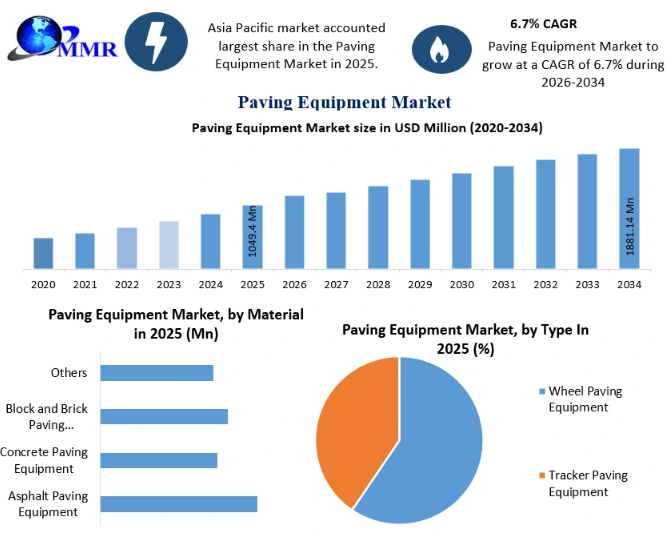
The Paving Equipment Market was valued at approximately US$ 1,049.4 million in 2025 and is expected to reach nearly US$ 1,881.14 million by 2034, expanding at a CAGR of 6.7% during 2026–2034. Paving equipment plays an important role in modern construction activities, including road development, highways, bridges, pavements, walkways, flyovers, and underpasses. These machines are designed to handle and accurately place materials such as asphalt, concrete, blocks, and bricks while maintaining the required thickness, elevation, and surface quality.
Download PDF Brochure: https://www.maximizemarketresearch.com/request-sample/68947/
Increasing expenditure on transportation infrastructure, urban expansion, highway modernization, and road connectivity is supporting demand for paving equipment worldwide. Governments and infrastructure developers are increasingly investing in efficient construction machinery to reduce project completion time, improve material utilization, and maintain consistent paving quality.
Paving equipment generally incorporates components such as material hoppers, augers, screeds, conveyors, vibrators, guides, and other control systems. Technological improvements in these systems are enabling contractors to achieve greater accuracy and productivity while reducing material wastage and operating costs.
Market Drivers and Trends
A major factor supporting the growth of the paving equipment market is the continued development of road and transportation infrastructure. Emerging and developed economies are allocating significant resources toward highways, urban roads, bridges, airports, and other transportation projects. Expansion of road networks improves connectivity between cities and commercial centers while supporting logistics and economic activity.
Download PDF Brochure: https://www.maximizemarketresearch.com/request-sample/68947/
Urbanization and population growth are also increasing the requirement for new roads and the rehabilitation of existing infrastructure. Growing cities require wider roads, improved pedestrian infrastructure, parking areas, and transportation corridors, creating opportunities for manufacturers of paving machinery.
Another important trend is the increasing adoption of automated and intelligent paving technologies. Modern paving equipment can incorporate machine-control systems, automated steering, digital grade control, sensors, and productivity monitoring. These technologies can reduce dependence on manual measurements and help contractors achieve greater consistency during paving operations.
The industry is also moving toward lower-emission and fuel-efficient equipment. Environmental regulations and sustainability objectives are encouraging manufacturers to develop machines with improved fuel efficiency, reduced emissions, and more efficient hydraulic and power systems. Hybrid and electrically assisted technologies may gain greater attention as construction companies seek to reduce operating costs and environmental impact.
Three-dimensional paving and digital machine-control technologies represent another emerging trend. Digital models and automated control systems can help contractors maintain precise paving profiles and reduce the need for conventional stringline-based processes.
Manufacturers are additionally focusing on operator comfort, remote monitoring, telematics, predictive maintenance, and connected construction equipment. These capabilities can improve equipment utilization and provide contractors with operational information for maintenance planning and fleet management.
Primary Market Constraints
Despite positive growth prospects, the paving equipment market faces several challenges. High initial equipment costs can limit adoption among small and medium-sized contractors. Advanced paving machines equipped with automation, digital controls, and telematics typically require higher upfront investments than conventional machinery.
Maintenance and operating costs are another consideration. Paving equipment operates in demanding environments involving dust, heat, vibration, heavy loads, and continuous operation. Regular maintenance of engines, hydraulic systems, screeds, conveyors, and other components is essential for maintaining productivity.
The market is also influenced by fluctuations in construction activity and infrastructure spending. Delays in public infrastructure projects, changes in government budgets, economic uncertainty, and fluctuations in raw-material prices can affect equipment purchasing decisions.
A shortage of skilled equipment operators and technicians can create additional challenges. As paving machinery becomes increasingly automated and digitally connected, contractors require personnel capable of operating advanced systems and interpreting machine data.
Environmental regulations may also increase development and compliance costs for manufacturers, particularly as governments introduce stricter standards for emissions and fuel consumption.
Key Market Segments
The Paving Equipment Market is segmented by material, type, fuel, and region.
By Material
Asphalt Paving Equipment represents an important segment because asphalt remains widely used in highways, urban roads, airport surfaces, and other transportation infrastructure. The demand for asphalt paving equipment is closely associated with road construction and rehabilitation activities.
Concrete Paving Equipment is used for concrete roads, industrial floors, pavements, airport infrastructure, and other applications requiring durable surfaces. Growing investment in long-life infrastructure can support demand for specialized concrete paving machinery.
Block and Brick Paving Equipment is primarily used for applications involving paving blocks, bricks, and related construction materials. These machines are particularly relevant for sidewalks, driveways, pedestrian areas, landscaping, and urban infrastructure.
The Others category includes specialized equipment designed for specific paving and construction applications.
By Type
The market is divided into Wheel Paving Equipment and Tracked Paving Equipment.
Wheel paving equipment offers mobility and relatively easy transportation between work locations. Its maneuverability makes it suitable for various construction applications where frequent movement is required.
Tracked paving equipment provides stability and traction, making it suitable for larger paving projects and challenging working environments. These machines can support paving operations across wide road surfaces, although their transportation requirements can be comparatively more complex.
By Fuel
Based on fuel, the market includes Diesel, Gasoline, and Others. Diesel-powered equipment remains significant in heavy construction applications because of its power and suitability for extended operations. At the same time, manufacturers are developing more efficient powertrains and exploring alternative technologies in response to emissions regulations and sustainability requirements.
Download PDF Brochure: https://www.maximizemarketresearch.com/request-sample/68947/
Regional Market Analysis
Asia Pacific is expected to remain a significant region in the paving equipment market, supported by substantial infrastructure investment, urban development, and expansion of road and rail networks. Countries including China, India, Japan, and Australia have extensive transportation infrastructure and continue to invest in road modernization and connectivity.
India is witnessing increasing infrastructure development, including highways, expressways, urban roads, and transportation corridors. Such projects can generate demand for road construction machinery and advanced paving solutions.
China’s large-scale transportation infrastructure programs and investments in roads, tunnels, and urban development also create opportunities for paving equipment manufacturers. Japan’s established infrastructure network and ongoing modernization activities contribute to demand for technologically advanced construction machinery.
North America represents another important market because of highway rehabilitation, road maintenance, infrastructure modernization, and demand for advanced construction equipment. The United States, in particular, has significant requirements for road resurfacing and infrastructure renewal.
Europe is characterized by established road networks and increasing attention toward infrastructure modernization, energy efficiency, emissions reduction, and sustainable construction. Demand for technologically advanced and environmentally efficient paving machinery can support market development across the region.
Meanwhile, Latin America and the Middle East & Africa provide growth opportunities through transportation infrastructure expansion, urban development, and investment in road connectivity. Increasing infrastructure projects in emerging economies can create additional demand for paving equipment.
Major Industry Players
The competitive landscape includes established construction-equipment manufacturers and specialized paving-equipment companies. Key industry participants include Ingersoll Rand, LeeBoy, Vögele, Dynapac, Roadtec, Terex Road Building, Caterpillar, BOMAG, Atlas Copco, Volvo Construction Equipment, Liebherr Construction Machines, GOMACO Corporation, Besser, HEM Paving, Rexcon LLC, Power Curbers Inc., and Allen Engineering Corporation.
Companies in the market are focusing on product innovation, equipment efficiency, automation, digital machine control, emissions reduction, operator productivity, and expanded product portfolios. Strategic partnerships can also help manufacturers integrate advanced positioning, machine-control, and digital technologies into paving equipment.
Recent developments demonstrate this shift toward technology-enabled paving. Vögele launched its Dash 5 Generation paving equipment line in North America at CONEXPO 2026, introducing the SUPER 2000-5 X tracked paver and SUPER 2003-5 X wheeled paver along with associated screed systems. The company highlighted productivity improvements and technologies such as EcoPlus and AutoTrac.
Dynapac partnered with Leica Geosystems to integrate automated 3D machine-control capabilities into selected paver models through the Leica iCON pave system. Such developments illustrate the industry’s movement toward digitally controlled and more precise paving operations.
Frequently Asked Questions
1. What was the size of the Global Paving Equipment Market in 2025?
The Global Paving Equipment Market was valued at approximately US$ 1,049.4 million in 2025.
2. What will be the size of the Paving Equipment Market by 2034?
The market is expected to reach approximately US$ 1,881.14 million by 2034.
3. What is the expected CAGR of the Paving Equipment Market?
The market is projected to grow at a CAGR of 6.7% from 2026 to 2034.
4. What are the major segments of the Paving Equipment Market?
The market is segmented by Material, Type, Fuel, and Region. Material includes asphalt, concrete, block and brick, and others. Type includes wheel and tracked paving equipment, while fuel includes diesel, gasoline, and others.
5. Which region is expected to hold a significant share of the market?
Asia Pacific is expected to remain a significant regional market, supported by infrastructure investment, urbanization, and road and rail network development.
Conclusion
The global Paving Equipment Market is entering a period of continued expansion as governments and construction companies increase investments in road infrastructure, urban development, and transportation connectivity. The market’s projected growth from US$ 1,049.4 million in 2025 to US$ 1,881.14 million by 2034 reflects the growing requirement for productive, accurate, and technologically advanced paving solutions.
Connect With Us:
MAXIMIZE MARKET RESEARCH PVT. LTD.
2nd Floor, Navale IT park Phase 3,
Pune Banglore Highway, Narhe
Pune, Maharashtra 411041, India.
+91 9607365656
sales@maximizemarketresearch.com
About Maximize Market Research:
Maximize Market Research is one of the fastest-growing market research and business consulting firms serving clients globally. Our revenue impact and focused growth-driven research initiatives make us a proud partner of majority of the Fortune 500 companies. We have a diversified portfolio and serve a variety of industries such as IT & telecom, chemical, food & beverage, aerospace & defense, healthcare and others.