Hospitals are adding operation theatres faster than they can staff them. Every new OT needs someone who can sterilise instruments correctly, set up equipment before a surgeon walks in, and stay sharp for hours at a stretch.
That gap is exactly why enrolment in an Operation Theatre course has picked up over the last few years, and why it’s worth understanding what the training involves before you sign up.
Why This Field Is Growing
India’s hospital infrastructure has expanded significantly over the past decade, and every new surgical centre, trauma unit, or day-care surgery facility needs trained OT staff to function. Add in the rise of laparoscopic and robotic-assisted procedures, both of which need technicians familiar with more advanced equipment, and the demand curve keeps climbing.
Government hospitals, private multi-speciality chains, and standalone surgical centres are all recruiting for this role, not just in metro cities but increasingly in tier-2 towns as well.
Course Structure and Duration
An operation theatre technician course is offered at three levels:
- Certificate course: Around 1 year, best suited to students who want to enter the workforce quickly
- Diploma course: Usually 2 years, the most commonly chosen option, balancing depth with time
- Degree course (B.Voc/B.Sc in OT Technology): 3 years, useful for students who eventually want supervisory or teaching roles
Eligibility across most institutes is a pass in 10+2 with science subjects (Physics, Chemistry, Biology.
What You’ll Study
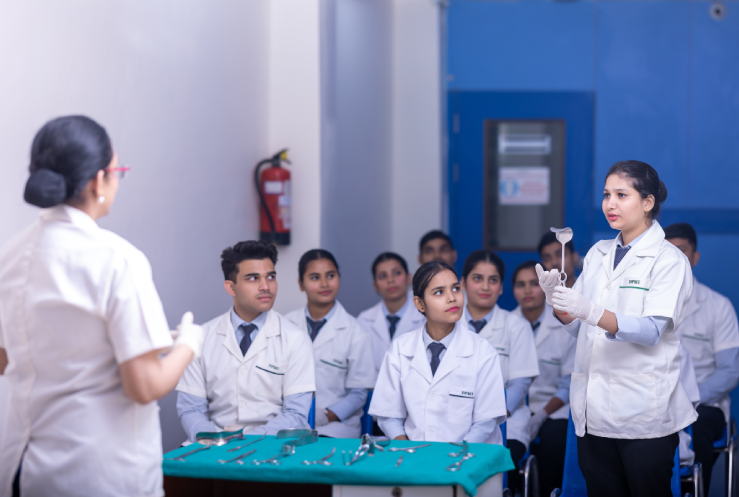
The curriculum mixes classroom theory with clinical practice, so students aren’t just memorising terms but actually handling the equipment they’ll use on the job. Core areas covered include:
- Anatomy and physiology
- Microbiology and infection control protocols
- Sterilisation techniques for surgical instruments
- Anaesthesia technology
- Surgical instrumentation and equipment handling
Skills That Matter Beyond the Syllabus
The technician role also demands the ability to stay calm when a procedure runs long or something unexpected happens on the table, quick reflexes when a surgeon asks for an instrument mid-procedure, and the discipline to follow sterile protocol without shortcuts, even on a busy day.
Multitasking and clear communication with the surgical team matter just as much as knowing which instrument goes where.
Career Paths After the Course
Graduates of an OT technician course aren’t limited to one job title. The training opens up several directions depending on interest and experience level:
- Operation Theatre Technician
- Surgical Assistant
- Anaesthesia Technician
- OT In-charge or Supervisor, after a few years of experience
- ICU/CCU Technician, with additional specialisation
- Roles in specialised surgical areas such as neurosurgery, orthopaedics, or robotic surgery
Salaries vary by city, employer type, and specialisation, but the field offers steady growth as technicians build experience with more complex procedures.
Choosing the Right Institute
Not every institute offering an Operation Theatre course provides the same quality of clinical exposure, and that’s the detail that matters most. Look for programmes with tie-ups to real hospitals for internship placements, labs equipped with actual OT equipment rather than just textbooks, and a placement cell that has a track record of connecting graduates with employers.
Accreditation and years of operation are worth checking too; an institute that’s been training paramedical students for a decade or more usually has stronger hospital relationships than one that opened last year.
Conclusion
Every surgery that goes smoothly owes something to the person managing the OT behind the scenes. Choosing an operation theatre course means choosing to be that person the one hospitals rely on to keep operating rooms running safely and on schedule.
It’s a demanding role, but for the right student, it’s also one of the more direct paths into a stable healthcare career.