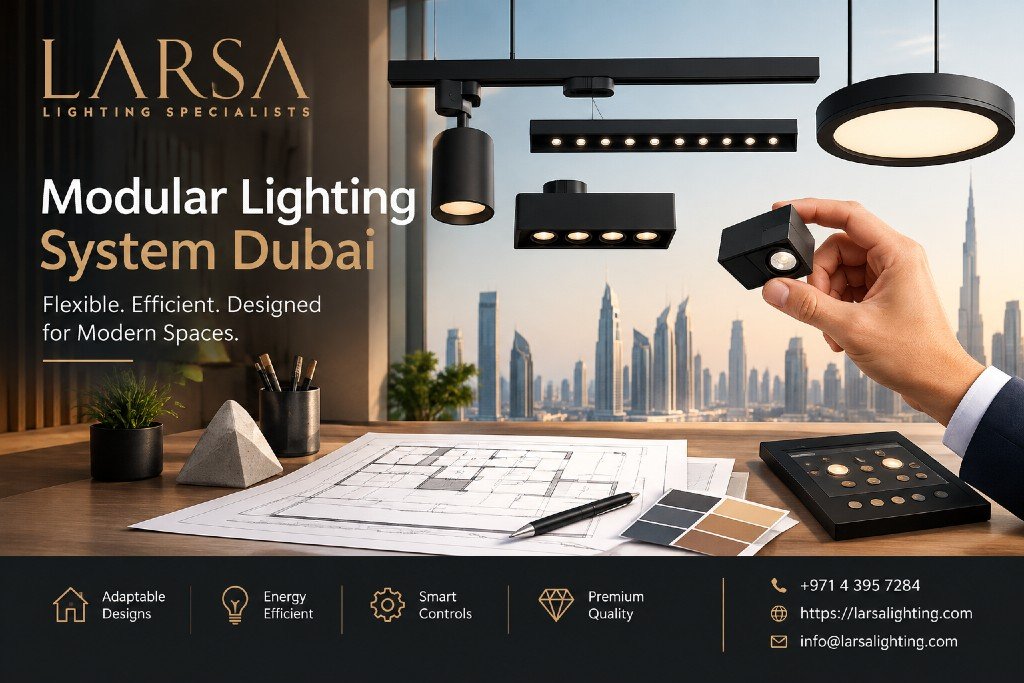
Lighting requirements can change significantly between the design, construction, and operational stages of a project. Furniture layouts move, ceilings are coordinated with HVAC and fire services, and interior finishes evolve before handover. A Modular Lighting System Dubai can address these changes by providing a flexible lighting framework rather than relying entirely on fixed, individual luminaires.
For architects, interior designers, developers, and property owners, choosing the right modular system involves more than selecting an attractive fixture. Light quality, compatibility, controls, installation, maintenance, and future adaptability all influence whether the system will perform effectively over time.
What Is a Modular Lighting System?

A modular lighting system combines a shared infrastructure with interchangeable lighting modules. Depending on the application, this infrastructure may take the form of a magnetic track, low-voltage track, recessed profile, linear channel, or surface-mounted system.
Different modules can then be integrated into the same platform. These may include adjustable spotlights, downlights, linear diffusers, wall washers, pendants, and other specialized elements.
The main difference from conventional lighting is the coordinated approach. Instead of specifying separate fixture families for every room, designers can create a consistent visual and technical framework while using different modules for different lighting tasks.
However, modularity does not mean that every component is universally compatible. Load limits, driver requirements, dimming protocols, mounting arrangements, and module compatibility must be checked before specification.
Why Consider Modular Lighting for Modern Spaces?
One of the main reasons to consider a Modular Lighting System Dubai is flexibility. Modern interiors often need to accommodate changing layouts and functions. A retail display may be rearranged, an office may change its workstation configuration, or a villa may receive new furniture and artwork.
A modular platform can make these changes easier by allowing suitable lighting modules to be repositioned or replaced without redesigning the entire ceiling infrastructure.
Design continuity is another advantage. A single track or profile can visually connect several areas while still providing different lighting effects. For example, a hospitality space might use the same infrastructure for ambient lighting in a lounge, accent lighting for artwork, and focused illumination over dining tables.
Where Should Modular Lighting Be Used?
Residential Interiors
In villas and apartments, modular systems can support a combination of general, accent, and decorative lighting. Adjustable spotlights can highlight artwork or architectural features, while linear modules can provide softer ambient illumination.
The system can be particularly useful in open-plan living areas where one ceiling plane needs to serve multiple activities.
Retail Spaces
Retail environments frequently change according to product displays, seasonal campaigns, and merchandising requirements. Adjustable modules can help redirect light toward new displays without extensive electrical alterations.
Beam angle should be selected carefully. Narrow beams may emphasize individual products, while wider distributions can provide more balanced general illumination.
Hospitality Projects
Hotels, restaurants, lounges, and reception areas often require different lighting scenes throughout the day. Modular systems can combine decorative and functional modules within a coordinated ceiling arrangement.
Control integration is especially important in these applications. Dimming, scene setting, and maintenance access should be considered during the design stage rather than after installation.
Offices and Workplaces
Modern workplaces require a balance between task illumination and visual comfort. Modular lighting can provide general workplace lighting while incorporating focused illumination for meeting areas, presentation walls, and circulation zones.
Glare and reflections should be assessed carefully, particularly around computer screens and polished surfaces.
Key Factors When Choosing a Modular System
1. Light Quality
Start by assessing color temperature, color rendering, color consistency, flicker, and glare. A fixture that looks impressive visually may not produce comfortable or effective illumination.
For interiors containing artwork, natural materials, food, or merchandise, good color rendering can be particularly important.
2. Beam Angles and Optics
Different spaces require different light distributions. Narrow-beam optics can create dramatic accent lighting, while wider beams are generally better suited to broader areas.
Lighting calculations should establish suitable spacing, illumination levels, uniformity, and vertical light before final fixture selection. This helps prevent excessive brightness in some areas and insufficient illumination in others.
3. Controls and Dimming
Control compatibility should be confirmed at the beginning of the project. Depending on the requirements, a system may need to work with DALI, 0–10V, phase dimming, wireless controls, or building-management systems.
A well-designed control strategy can also improve energy performance by allowing lighting levels and operating schedules to respond to actual occupancy and use.
4. Installation Requirements
Recessed systems require accurate ceiling preparation, while surface-mounted and suspended systems require appropriate structural coordination. Long linear profiles also need careful alignment to achieve a clean appearance.
The system should be coordinated with air-conditioning equipment, fire protection, access panels, speakers, sensors, and other ceiling services before installation begins.
5. Maintenance and Replacement
Long-term maintenance should be part of the selection process. Check whether individual modules, drivers, optics, connectors, and other components can be replaced independently.
Component availability is also important. A system may be technically flexible at installation but become difficult to maintain if compatible replacement parts are unavailable later.
Balancing Cost and Long-Term Value
The initial purchase price should not be the only factor when comparing modular lighting systems. Tracks, profiles, connectors, drivers, specialty optics, and installation details can increase the upfront cost compared with conventional downlights.
However, future adaptability may provide practical value in spaces where layouts are expected to change. The better comparison considers the total installed cost, expected maintenance, energy performance, flexibility, controls, and lifespan of the system.
It is also important to avoid overusing modular lighting. A visible magnetic track may work well in a contemporary retail environment but may not suit every residential or traditional hospitality interior. The lighting infrastructure should support the architecture rather than dominate it.
Planning the Right System
The best approach is to begin with the purpose of each space. Determine whether the primary requirement is task lighting, ambient illumination, accent lighting, wall washing, visual comfort, or architectural emphasis.
Once these requirements are defined, compare modular infrastructure with alternatives such as recessed downlights, wall lights, decorative pendants, or conventional track lighting.
For prominent areas, a full-scale mock-up can be useful. It allows the project team to evaluate glare, beam spread, finishes, dimming performance, and the relationship between light and actual materials such as stone, timber, fabric, and paint.
Larsa Lighting can be considered as part of this specification process, with attention given to the relationship between technical performance and the intended interior design.
Making the Final Choice
Selecting a Modular Lighting System Dubai should be treated as a design and technical decision rather than simply a fixture purchase. The right system should provide appropriate illumination today while allowing reasonable flexibility for future changes.
Before approval, review light quality, optics, controls, compatibility, installation requirements, finishes, maintenance access, replacement components, and long-term availability. When these factors are considered together, modular lighting can create a visually consistent and adaptable solution for modern residential, commercial, retail, hospitality, and workplace environments.
A carefully specified system does more than create a clean ceiling. It provides a structured lighting framework that can evolve with the space while maintaining comfort, functionality, and design discipline.