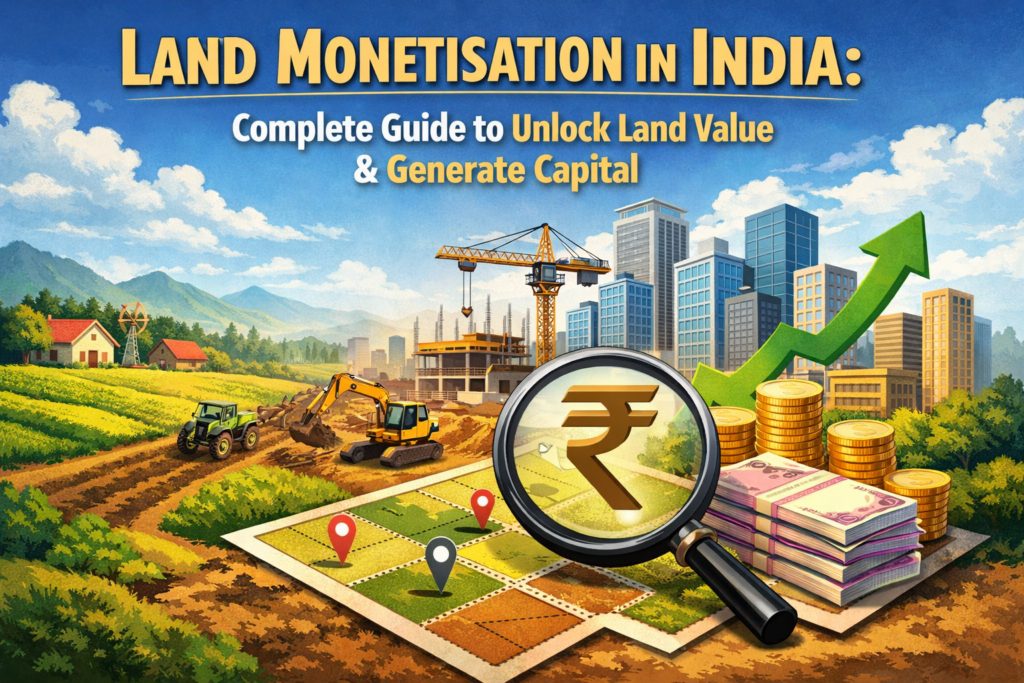
Land Monetisation in India: Complete Guide to Unlocking Land Value
Introduction
Land has always been considered one of the most valuable assets in India. However, a significant portion of land—whether owned by individuals, businesses, or government bodies—remains underutilized or idle. In recent years, the concept of Land Monetisation in India has gained strong momentum as a strategic financial tool to unlock the hidden value of land without necessarily selling it. With rising infrastructure needs and increasing demand for capital, land monetisation is emerging as a powerful solution for both public and private stakeholders.
What is Land Monetisation?
Land monetisation refers to the process of converting land assets into revenue-generating resources. Instead of keeping land idle, owners can lease, develop, or use it for structured financial transactions to generate income or raise capital.
In simple terms, it is about transforming “dead assets” into productive financial instruments.
For government bodies, monetisation often involves transferring revenue rights of land to private players for a specific period while retaining ownership. This allows them to receive upfront payments and ongoing income streams.
Why Land Monetisation is Gaining Importance in India
The importance of land monetisation in India has grown significantly due to several economic and structural factors:
1. Rising Infrastructure Demand
India is investing heavily in infrastructure such as highways, metro projects, industrial corridors, and smart cities. Land monetisation helps generate funds for these projects without increasing debt burden.
2. Fiscal Constraints
Government budgets are limited, and traditional funding methods like taxation and borrowing are not always sufficient. Monetising land provides an alternative funding mechanism.
3. Urbanization and Land Value Growth
As cities expand, land values increase. Monetisation allows stakeholders to capture this appreciation and convert it into immediate capital.
4. Shift Towards Asset-Based Financing
Land monetisation supports asset-backed financing models, enabling upfront capital generation by unlocking land value.
Types of Land Monetisation Models in India
There are multiple ways through which land can be monetised:
1. Lease Model
Landowners lease their land to businesses for industrial, commercial, or residential use. This ensures steady long-term income without losing ownership.
2. Joint Development Agreements (JDA)
Landowners partner with developers to build projects such as housing, malls, or warehouses. Profits are shared between both parties.
3. Public-Private Partnerships (PPP)
Government agencies collaborate with private players to develop land for infrastructure or commercial use.
4. Real Estate Investment Trusts (REITs)
Land and property assets are pooled into investment structures that generate income for investors while monetising land holdings.
5. Sale with Revenue Sharing
In some cases, land may be partially sold while retaining a share in future revenues or appreciation.
Government Initiatives Supporting Land Monetisation
The Indian government has actively promoted land monetisation as part of its broader asset monetisation strategy.
National Land Monetisation Corporation (NLMC)
The government established NLMC to manage and monetise surplus land owned by public sector enterprises and government bodies.
National Monetisation Pipeline (NMP)
The NMP aims to unlock value from public assets, including land, to fund infrastructure development and economic growth.
Gati Shakti & Infrastructure Push
Land monetisation plays a key role in funding large-scale infrastructure initiatives under programs like Gati Shakti and the National Infrastructure Pipeline.
Benefits of Land Monetisation in India
1. Unlocks Hidden Value
Large amounts of land in India remain unused. Monetisation helps convert these into income-generating assets.
2. Generates Capital Without Selling
One of the biggest advantages is that landowners can retain ownership while still earning income or raising funds.
3. Reduces Debt Dependence
For governments and businesses, monetisation reduces reliance on loans and borrowing.
4. Boosts Economic Growth
By funding infrastructure and development projects, land monetisation contributes to overall economic expansion.
5. Encourages Efficient Land Use
Idle land becomes productive, supporting industrialization, housing, and urban development.
Challenges in Land Monetisation
Despite its advantages, land monetisation in India faces several challenges:
1. Legal and Title Issues
Unclear land titles and disputes can delay or prevent monetisation.
2. Market Dependency
The success of monetisation depends on real estate demand and market conditions.
3. Regulatory Complexity
Multiple approvals and regulations can slow down the process.
4. Risk of Overdependence
Excessive reliance on land monetisation may lead to financial instability if land values fluctuate.
5. Planning and Execution Risks
Improper planning can result in inefficient land use or stalled projects.
Land Monetisation for Private Landowners
Land monetisation is not limited to the government. Private landowners can also benefit significantly.
Key Opportunities:
- Leasing land for warehouses, factories, or agriculture
- Partnering with developers for residential or commercial projects
- Using land as collateral for structured financing
- Entering revenue-sharing agreements
This approach allows landowners to generate recurring income while maintaining ownership, making it a powerful wealth-building strategy.
Role of Technology and Platforms
Modern platforms and advisory firms are simplifying land monetisation by connecting landowners with investors, developers, and financial institutions. These platforms offer services such as:
- Land valuation and feasibility analysis
- Legal structuring and compliance
- Investor matchmaking
- End-to-end project execution
This ecosystem is making land monetisation more accessible and transparent across India.
Future of Land Monetisation in India
The future of land monetisation in India looks highly promising. As infrastructure demand grows and government budgets tighten, monetisation will become a central funding mechanism.
Recent developments show that land is no longer treated as a passive asset but as a strategic financial resource.
Key trends shaping the future include:
- Increased use of REITs and InvITs
- Growth in industrial and logistics land demand
- Expansion of smart cities and urban infrastructure
- Greater private sector participation
Conclusion
Land Monetisation in India is transforming the way land assets are perceived and utilized. It offers a win-win solution for both landowners and the economy—unlocking value, generating capital, and supporting development without the need to sell assets outright.
Whether it is the government funding infrastructure or private landowners seeking financial growth, land monetisation is emerging as a game-changing strategy in India’s economic landscape. With the right planning, legal clarity, and strategic partnerships, land can truly become one of the most powerful tools for wealth creation and sustainable development.