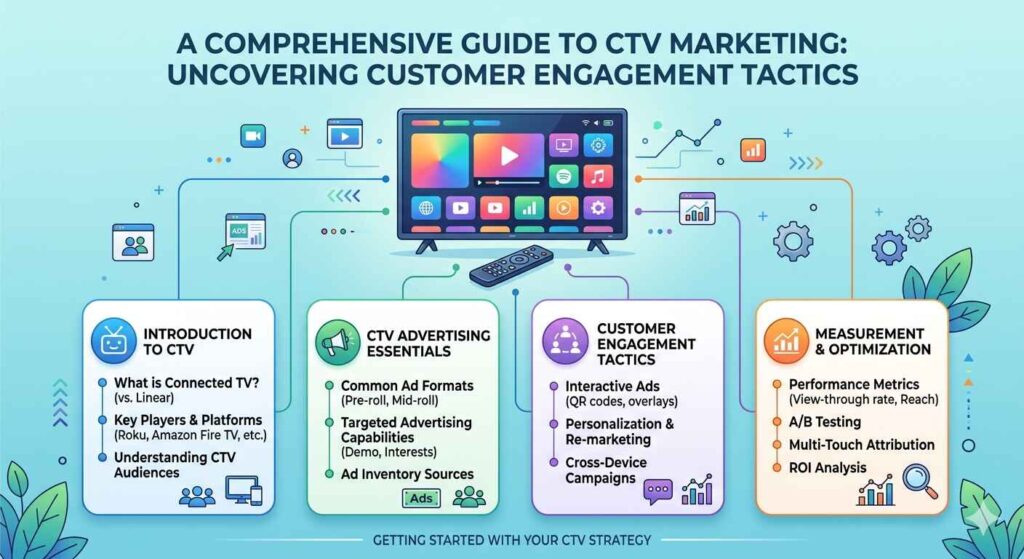
Audiences have moved from television to streaming platforms. Consequently, brands today are looking to reach viewers at scale. This natural shift makes CTV marketing a strong tool in advertising. It mixes television’s immersive storytelling with targeting and measurement. Connected TV also lets brands reach audiences in meaningful ways, from awareness to conversion, it gives brands a way to reach people with data-based ads.
This guide will break down how CTV works, its benefits, and the challenges marketers may face while implementing it.
What Is CTV Marketing?
Connected TV marketing is advertising that shows up on internet-enabled TV devices such as smart TVs, streaming sticks, and gaming consoles. The ads appear within streaming platforms and apps. It allows brands to reach viewers who watch on-demand or live content.
Unlike linear TV, Connected TV marketing lets brands target audiences, control how often the ads run, and measure how the ads perform. Thus, CTV advertising focuses on results rather than just aiming to create awareness in people.
Benefits of CTV Marketing
As streaming is becoming the primary way of people watching television content, brands are turning to CTV advertising to get reach and relevance. CTV offers data-driven targeting, viewing feel, and clear performance numbers, making it an impactful marketing channel. Here are some benefits as to why CTV marketing is getting readily adopted by advertisers:
1. Measurable Campaign Performance
Traditional TV does not provide data, whereas CTV advertising gives performance insights like impressions, completed views, and household-level engagement. Such metrics help brands adjust campaigns in real-time and see impact clearly.
2. Precision Audience Targeting
One of the benefits of CTV marketing is audience targeting. Advanced audience targeting allows brands to reach viewers based on a viewer’s age, gender, interests or how they watch content. This differentiated targeting reduces wasted ad displays and improves relevance.
3. High Viewability and Completion Rates
CTV ads usually run in full-screen and non-skippable modes, unlike other platforms that have skipping features. As ad completion rates are much higher with this media format compared to mobile or desktop videos, brands can deliver their messages completely without any interruption.
5. Seamless Omnichannel Integration
CTV works best as part of a broader media plan. Brands can retarget households that have already seen ads through mobile, display or social channels. Brands repeat their messaging, guiding users through the funnel.
Key Ways of Buying CTV Marketing
More than just choosing placements, purchasing CTV inventory requires strategic alignment with business objectives, audience insights, and measurement capabilities. A well-defined buying framework is essential for efficient execution of CTV campaigns that reach the right viewers and have an impact on all stages of the marketing funnel.
1. Define Campaign Objectives
Begin with figuring out what to achieve like brand awareness, consideration or performance driven outcomes. Clear objectives also guide which ad formats to pick and which measurement metrics to track.
2. Choose the Right Buying Model
Brands can buy CTV inventory programmatically through demand‑side platforms (DSPs) for scale and flexibility or buy CTV inventory through direct publisher deals for premium placements and guaranteed inventory.
3. Select Target Audiences
Use first-party data, contextual signals or third-party audience segments to decide who you want to reach. The audience precision is very important for getting the most out of CTV marketing.
4. Set Budgets and Frequency Caps
Set budgets based on expected reach and outcomes. Then add frequency caps so the audience does not see the ad too often. These caps maintain viewer engagement and also improve campaign efficiency.
Challenges That Advertisers May Face
Although CTV advertising comes with numerous benefits, marketers must navigate challenges to unlock its potential. Some of these challenges are:
- Platform fragmentation- A CTV ecosystem covers multiple devices, apps, and operating systems, making consistent execution a complex task.
- Measurement and attribution gaps- Most CTV measurement happens at the household level, that hinders granular attribution, making ROI analysis harder.
- Creative fatigue risks- Ad slots and repeated exposure cause fatigue, which becomes more prominent when the frequency is not managed properly.
- Data and privacy limitations- Privacy-first regulations limit data usage, forcing brands to use first‑party data and more contextual signals.
- Higher production costs- CTV creative often requires more production quality than digital videos, affecting upfront investment, which can go up.
Conclusion
The media world is even more connected than it previously was. As streaming consumption is rising, CTV marketing is now a link between brand stories and data-based results. While consumers feel they’re still watching TV, brands get an added benefit of tracking their ads, unlike traditional TV.
Thus, efficient planning with the right tech partners can bring a lot of value. When brands plan carefully and pick the tech partners, CTV advertising can give brands a lot of value from awareness and engagement to achieving long term growth.