Connected devices have quietly become part of everyday business operations. Smart factories monitor equipment in real time, logistics companies track shipments across continents, and healthcare providers use connected devices to improve patient monitoring. Such rapid adoption raises an important question: Is Internet of Things Application Development Services the Next Big Thing?
The answer is becoming increasingly clear. Businesses across the USA are investing in digital ecosystems that combine connected devices, cloud platforms, artificial intelligence, and secure data networks. As a result, demand for internet of things application development services continues to rise across industries looking for efficiency, automation, and competitive advantage.
What Are Internet of Things Application Development Services?
Internet of things application development services involve creating software applications that connect physical devices, sensors, machines, and systems through the internet. These applications collect, process, and analyze data generated from connected environments.
A complete IoT ecosystem generally includes:
| Component | Purpose |
| Sensors | Capture environmental or operational data |
| Connectivity | Transfer information through networks |
| Cloud Platform | Store and process collected data |
| Analytics Engine | Generate actionable insights |
| User Application | Present information through dashboards |
Modern organizations use these systems to improve visibility, automate workflows, and make informed business decisions based on real-time information.
Why IoT Application Development Is Important for Modern Businesses?
Many organizations still depend on manual reporting, delayed insights, and disconnected systems. Such limitations often create inefficiencies and increase operational costs.
Understanding why IoT application development is important becomes easier when examining business outcomes:
- Faster decision-making through real-time data
- Reduced operational expenses
- Better asset utilization
- Improved customer experiences
- Enhanced productivity across departments
- Greater business scalability
A connected business environment transforms raw information into strategic intelligence, helping organizations react quickly to changing market conditions.
How Does IoT Application Development for Businesses Improve Operations?
Operational efficiency remains one of the strongest reasons behind IoT adoption.
IoT application development for businesses creates an environment where machines, software platforms, and employees work with synchronized information. Instead of waiting for reports, managers receive instant updates regarding equipment status, inventory levels, or customer activity.
Common operational improvements include:
Manufacturing
- Predictive maintenance
- Production monitoring
- Equipment performance tracking
Logistics
- Fleet management
- Route optimization
- Real-time shipment visibility
Healthcare
- Remote patient monitoring
- Asset tracking
- Smart medical devices
Retail
- Inventory automation
- Customer behavior analytics
- Smart checkout systems
Such improvements help businesses reduce waste while increasing productivity.
What Are the Major Benefits of IoT Application Development Services?
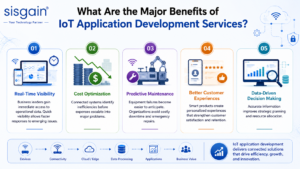
The benefits of IoT application development services extend beyond simple device connectivity. A well-designed solution creates measurable business value across multiple departments.
Key Benefits
1. Real-Time Visibility
Business leaders gain immediate access to operational data. Quick visibility allows faster responses to emerging issues.
2. Cost Optimization
Connected systems identify inefficiencies before expenses escalate into major problems.
3. Predictive Maintenance
Equipment failures become easier to anticipate. Organizations avoid costly downtime and emergency repairs.
4. Better Customer Experiences
Smart products create personalized experiences that strengthen customer satisfaction and retention.
5. Data-Driven Decision Making
Accurate information improves strategic planning and resource allocation.
The growing demand for internet of things application development services largely stems from these measurable advantages.
What Are the Most Important IoT Application Development Trends?
Technology continues evolving at a rapid pace. Several IoT application development trends are shaping the future of connected solutions.
| Trend | Business Impact |
| Edge Computing | Faster processing and reduced latency |
| AI Integration | Smarter automation and analytics |
| Digital Twins | Virtual simulation of physical assets |
| 5G Connectivity | Faster and more reliable communication |
| Cybersecurity Enhancements | Better protection of connected systems |
| Sustainable IoT | Improved energy efficiency |
Organizations that embrace these trends often achieve stronger digital transformation outcomes.
How Does IoT Work Alongside AR and Blockchain Technologies?
IoT rarely operates in isolation. Many advanced business solutions combine multiple emerging technologies.
Custom AR Development Services
When IoT data is integrated with custom ar development services, field technicians can visualize equipment performance directly through smart glasses or mobile devices.
Examples include:
- Equipment diagnostics
- Maintenance guidance
- Remote support systems
The combination of connected devices and custom ar development services significantly improves workforce productivity.
Blockchain Integration
A trusted blockchain development agency can enhance IoT ecosystems through secure and transparent data management.
Blockchain technology helps with:
- Device authentication
- Secure transactions
- Supply chain transparency
- Data integrity verification
Partnerships with a professional blockchain development agency often strengthen security within large-scale connected environments.
What Challenges Do Businesses Face During IoT Adoption?
Despite significant advantages, successful implementation requires careful planning.
Common Challenges
| Challenge | Solution |
| Security Risks | Strong encryption and authentication |
| Data Management | Scalable cloud infrastructure |
| Device Compatibility | Standardized protocols |
| Network Reliability | Redundant connectivity options |
| Compliance Requirements | Regulatory-focused architecture |
Organizations that address these concerns early often achieve smoother implementation and stronger long-term results.
What Does the Future of IoT Application Development Look Like?
The future of IoT application development points toward increasingly intelligent and autonomous systems. Connected devices are becoming smarter, networks are becoming faster, and analytics capabilities are becoming more advanced.
Several developments are expected to influence future growth:
- AI-powered automation
- Autonomous industrial systems
- Smart city infrastructure
- Advanced healthcare monitoring
- Sustainable energy management
- Intelligent transportation networks
Organizations investing early in connected technologies often gain a significant advantage in operational efficiency and innovation.
The future of IoT application development will likely involve deeper integration between connected devices, artificial intelligence, immersive technologies, and secure digital ecosystems.
How Can Businesses Choose the Right Development Partner?
Selecting the right technology partner often determines project success.
Important evaluation criteria include:
Technical Expertise
Experience with cloud platforms, analytics, mobile applications, and connected devices remains essential.
Industry Knowledge
Understanding industry-specific challenges leads to more practical solutions.
Security Capabilities
Security should be integrated throughout the development lifecycle rather than added later.
Scalability Planning
Solutions must support future growth without requiring major architectural changes.
Many organizations also evaluate providers offering iot app development services alongside complementary technologies such as AI, blockchain, and immersive applications.
A reliable technology partner helps businesses move from concept to deployment while reducing implementation risks. Companies searching for comprehensive iot app development services often prioritize long-term support, innovation capabilities, and proven project experience.
Why Are Businesses Turning to SISGAIN Technology?
Technology investments require more than software development expertise. Businesses need a partner capable of understanding operational goals, industry challenges, and long-term growth objectives.
SISGAIN Technology helps organizations build scalable digital solutions across mobile applications, enterprise software, artificial intelligence, healthcare platforms, cloud systems, blockchain solutions, and connected technologies. A strong focus on innovation, security, and business outcomes allows organizations to accelerate digital transformation while maintaining operational reliability. Industry-specific expertise and modern development practices help businesses create sustainable competitive advantages in rapidly evolving markets.
Conclusion
The rapid growth of connected technologies demonstrates that IoT is no longer an emerging concept. Smart devices, intelligent analytics, cloud infrastructure, and automation have become essential components of modern business operations. Understanding why IoT application development is important helps organizations recognize opportunities for greater efficiency, stronger customer experiences, and data-driven decision-making.
From manufacturing and healthcare to logistics and retail, connected ecosystems continue creating measurable business value. Current IoT application development trends also indicate a future shaped by artificial intelligence, edge computing, blockchain integration, and immersive technologies. Businesses that invest in strategic connected solutions today will be better positioned to innovate, scale operations, and remain competitive in an increasingly digital economy.