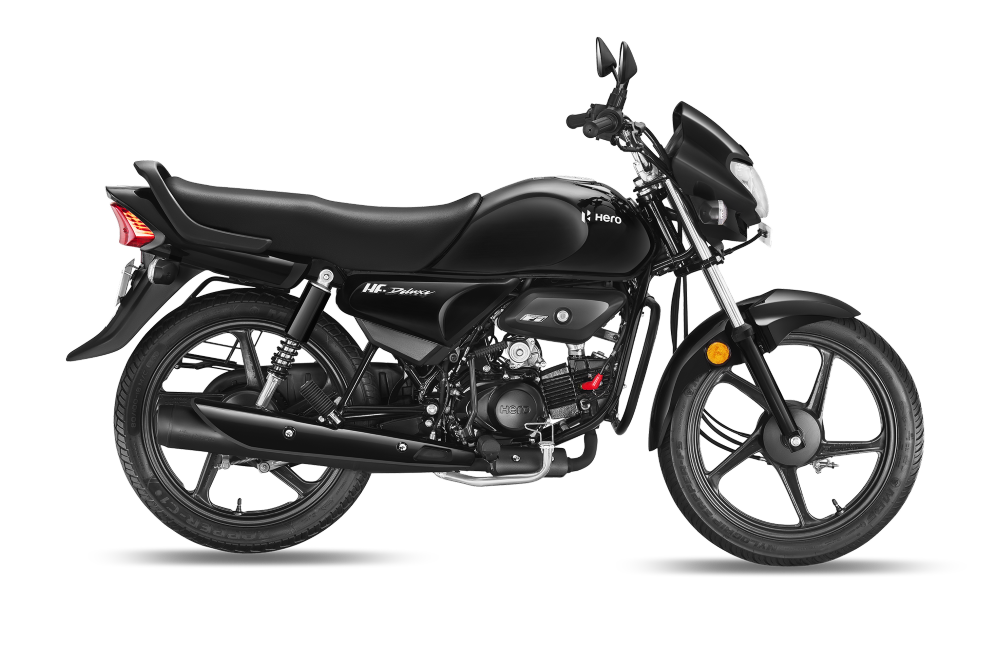
The Hero HF Deluxe is designed around the kind of daily travel that rarely demands excitement but always demands reliability. Office commutes, local errands, school runs and repeated short-distance journeys put far more emphasis on fuel cost, manoeuvrability and service access than on peak horsepower.
That is why Hero HF Deluxe mileage remains one of the strongest reasons buyers consider the motorcycle. Hero currently lists mileage of up to 72 km/l under specified conditions. Real-world results will vary, but the figure reflects a platform engineered specifically for low running cost.
The 97.2cc Engine Keeps Things Simple
The current Hero HF Deluxe uses a 97.2cc air-cooled, four-stroke, single-cylinder engine. Maximum power is 5.9 kW at 8,000 rpm and peak torque is 8.05 Nm at 6,000 rpm.
These figures are modest, but the motorcycle is not trying to compete with 125cc or 160cc performance bikes. Its purpose is to deliver predictable acceleration at city speeds while using as little fuel as reasonably possible.
Why Hero HF Deluxe Mileage Matters So Much
A rider covering 30 to 50 km every working day can travel more than 10,000 km a year. At that distance, fuel consumption becomes one of the largest recurring ownership costs.
Even a difference of a few kilometres per litre can add up over several years. This is where the HF Deluxe’s small engine, fuel-injection system and i3S stop-start technology become financially relevant.
The i3S System Is Useful in Urban Traffic
Selected variants use Hero’s idle stop-start technology. When the motorcycle remains stationary under suitable conditions, the system can shut the engine off and restart it when needed.
The effect on one traffic signal may be small, but daily riders encounter hundreds of such stops every month. The technology therefore supports the motorcycle’s broader efficiency focus.
Current Pricing Keeps It in the Budget Segment
Official city-level pricing varies. In Mumbai, current ex-showroom HF Deluxe prices begin around ₹65,000 and rise into the low-₹70,000 range depending on variant, while some cities show lower starting prices.
Buyers should always check the exact local ex-showroom and on-road quotation because registration, insurance and state taxes can meaningfully change the final figure.
Different Variants Let Buyers Prioritise Cost or Convenience
The current line-up includes kick-start, self-start, i3S and higher-feature versions. This allows a very price-sensitive buyer to stay near the entry point while another rider can spend more for electric start and added convenience.
The best variant is not automatically the most expensive. Someone riding short local routes may not need every feature, while a high-frequency office commuter may appreciate self-start and i3S every day.
A 9.6-Litre Fuel Tank Supports Long Gaps Between Stops
The HF Deluxe uses a 9.6-litre fuel tank in current specification. Combined with the engine’s strong efficiency, this can provide useful range between refuelling visits.
For commuters travelling through areas where fuel stations are inconvenient, this range is more important than it may initially appear.
Tubeless Tyres Add Everyday Convenience
Current HF Deluxe variants use tubeless tyres. These can offer slower air loss in many puncture situations compared with tube-type tyres, helping the rider maintain control while finding a repair point.
Correct tyre pressure is also essential for achieving good fuel economy. Underinflation increases rolling resistance and can reduce both mileage and tyre life.
The Motorcycle Is Easy to Handle in Dense Traffic
One of the strongest arguments for a small commuter is physical manageability. The HF Deluxe is much easier to push, turn and park than a larger-capacity motorcycle.
This matters in crowded markets, apartment basements and narrow lanes where a heavy motorcycle can become unnecessarily tiring.
Maintenance Is Designed to Be Straightforward
The HF Deluxe uses a conventional commuter layout that is familiar to technicians across Hero’s service network. Routine engine oil, chain, brake and filter maintenance is easy to understand and widely supported.
For buyers who depend on the motorcycle for work, this simplicity reduces downtime and makes servicing easier to plan.
Where the HF Deluxe Is Not the Best Choice
Riders who frequently travel on highways or carry a pillion at higher speeds may want more engine capacity. A 125cc motorcycle gives stronger acceleration and more relaxed open-road performance.
The HF Deluxe is at its best when used primarily for city and semi-urban commuting rather than sustained high-speed riding.
How It Compares with More Expensive Commuters
Larger commuter motorcycles can offer more features, stronger brakes and better performance, but they also cost more to buy and usually consume more fuel.
The HF Deluxe makes sense when the rider values low total cost over premium equipment. That is why it remains competitive even as the market becomes more technologically sophisticated.
Is Hero HF Deluxe the Best Budget Bike?
For daily riders focused on fuel economy, easy maintenance and low purchase cost, the HF Deluxe is one of the strongest choices in the market. Its current 72 km/l claimed mileage, simple 97.2cc engine and wide service access create a very rational ownership package.
It will not satisfy riders looking for strong acceleration or premium features, but that is not its job. As a budget commuter, the Hero HF Deluxe succeeds by keeping everyday travel affordable and uncomplicated.
Why It Still Makes Sense in 2026
Motorcycle technology changes rapidly, but the basic economics of commuting do not. Riders still need a machine that starts every morning, uses little fuel and is inexpensive to service.
The HF Deluxe continues to answer that need directly. For buyers who view a motorcycle primarily as dependable transport, that clarity of purpose is its biggest strength.
What a Daily Commuter Should Check During a Test Ride
A budget motorcycle should be evaluated in the environment where it will spend most of its life. Riders should check clutch effort in crawling traffic, how easily the bike pulls away from low speed, whether the seat remains comfortable after twenty to thirty minutes and how confidently both feet reach the ground. The ease of reversing out of a parking space is also worth testing because this happens every day.
It is equally useful to ride over a few rough patches and speed breakers. Suspension comfort matters more to a high-frequency commuter than a cosmetic feature that is noticed only occasionally. A short showroom loop can hide these differences, so a realistic test route gives a much better picture of ownership.