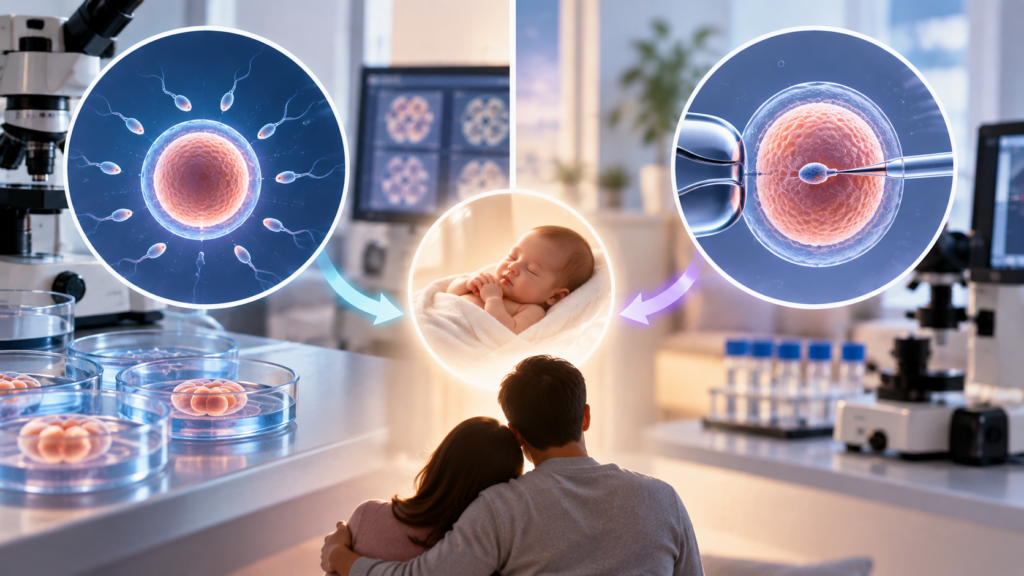
ICSI is a specialized form of IVF in which a single sperm is injected directly into an egg. It may be considered in cases such as significant male-factor infertility or previous fertilization failure, while routine ICSI is not recommended for every IVF cycle
When couples explore fertility treatment, they may come across two terms frequently: IVF and ICSI. Although both treatments involve fertilizing an egg in a laboratory, the way sperm is used for fertilization is different.
Understanding ICSI vs IVF can help you have a more informed discussion with your fertility specialist. Conventional IVF allows sperm and egg to interact in a laboratory dish, while ICSI involves injecting a single selected sperm directly into the egg.
So, when is ICSI recommended? It depends on factors such as sperm quality, previous IVF results, fertilization problems, and the couple’s overall fertility assessment.
What Is IVF?
In vitro fertilization, commonly known as IVF, is an assisted reproductive treatment in which eggs are retrieved from the ovaries and combined with sperm in a laboratory.
In conventional IVF, thousands of sperm are placed around each mature egg. One sperm may naturally penetrate the egg and fertilize it.
The general IVF process includes:
- Ovarian stimulation
- Monitoring follicle development
- Egg retrieval
- Fertilization in the laboratory
- Embryo development
- Embryo transfer into the uterus
IVF gives the fertility team the opportunity to monitor fertilization and embryo development before an embryo is transferred.
What Is ICSI?
ICSI stands for Intracytoplasmic Sperm Injection. It is a laboratory fertilization technique commonly performed as part of an IVF cycle.
Instead of allowing sperm and egg to fertilize naturally in the laboratory, an embryologist uses a specialized micromanipulation technique to inject one selected sperm directly into a mature egg.
The process generally involves:
- Retrieving mature eggs
- Selecting an individual sperm
- Injecting the sperm directly into the egg
- Monitoring the egg for fertilization
- Culturing resulting embryos
- Transferring an appropriate embryo when planned
ICSI does not replace the entire IVF process. It changes the fertilization method used during an IVF cycle.
ICSI vs IVF: Key Differences
The main difference between conventional IVF and ICSI is how fertilization is attempted.
| Factor | Conventional IVF | ICSI |
|---|---|---|
| Fertilization method | Sperm and egg are placed together | One sperm is injected into the egg |
| Sperm selection | Sperm must reach and penetrate the egg | Embryologist selects a sperm for injection |
| Micromanipulation | Not required for fertilization | Required |
| Egg retrieval | Required | Required |
| Embryo culture | Yes | Yes |
| Embryo transfer | May be performed | May be performed |
| Common use | Many causes of infertility | Selected cases involving fertilization concerns |
This means ICSI is generally considered a fertilization technique within IVF, rather than a completely separate treatment from IVF.
When Is ICSI Recommended?
A common question is when is ICSI recommended?
ICSI may be considered when there are specific concerns that could make conventional IVF fertilization more difficult.
1. Male-Factor Infertility
ICSI is often considered when sperm count, movement, or morphology is significantly affected.
For example, if there are very few sperm available or sperm have difficulty reaching or penetrating the egg, direct sperm injection may be considered.
2. Previous IVF Cycle With Poor Fertilization
If a previous conventional IVF cycle resulted in very low or no fertilization, a fertility specialist may consider ICSI in a subsequent cycle.
The decision depends on why fertilization was unsuccessful and the overall clinical picture.
3. Surgically Retrieved Sperm
In some cases, sperm may need to be retrieved through a surgical procedure because sperm are not present in the ejaculate.
When only a limited number of sperm are available, ICSI may be considered because an individual sperm can be selected for injection.
4. Certain Fertility Preservation Cases
ICSI may sometimes be considered when frozen sperm or eggs are being used, depending on the circumstances and laboratory assessment.
The fertility team determines the most suitable fertilization approach based on the quality and source of the reproductive cells.
5. Previous Fertilization Problems
If there is a history of poor fertilization, the specialist may recommend ICSI to address a suspected fertilization-related issue.
However, ICSI is not automatically required simply because IVF has been unsuccessful. The reason for the previous outcome should be evaluated first.
ICSI vs IVF Success Rate
People often search for the ICSI vs IVF success rate, but there is no single success percentage that applies to every patient.
Success can be influenced by:
- Age
- Number and quality of eggs
- Ovarian reserve
- Sperm quality
- Embryo quality
- Cause of infertility
- Previous treatment history
- Laboratory conditions
- Uterine factors
ICSI can improve the chance of fertilization in some cases involving male-factor infertility or previous fertilization failure. However, using ICSI does not guarantee pregnancy or a successful IVF cycle.
It is also important to distinguish fertilization rate from pregnancy or live birth rate. ICSI directly addresses the fertilization step, while pregnancy depends on several additional stages.
ICSI Treatment Cost in India
The ICSI treatment cost in India varies depending on the fertility clinic, location, medications, laboratory procedures, and the overall treatment plan.
ICSI may cost more than conventional IVF because it requires specialized laboratory equipment and embryology procedures.
The total cost may include:
- Initial fertility investigations
- Ovarian stimulation medicines
- Ultrasound and blood monitoring
- Egg retrieval
- IVF laboratory procedures
- ICSI procedure
- Embryo culture
- Embryo transfer
- Medication after transfer
- Embryo freezing or storage, when required
When comparing prices, ask the clinic whether the quoted amount includes medicines, monitoring, ICSI, embryo transfer, and additional laboratory services.
Is ICSI Better Than Conventional IVF?
There is no universal answer to whether ICSI is better.
ICSI can be particularly useful when there is a clear reason to expect difficulty with conventional fertilization. For couples without significant male-factor infertility or previous fertilization problems, the additional procedure may not always provide a meaningful advantage.
Your fertility specialist may consider sperm parameters, previous IVF outcomes, egg quality, and other factors before recommending ICSI.
The goal is not simply to use the most advanced procedure available. It is to select the fertilization method that fits the patient’s specific circumstances.
What Happens After ICSI?
Once fertilization occurs, the subsequent steps are broadly similar to conventional IVF.
The fertilized eggs are monitored as they develop into embryos. Depending on the treatment plan, an embryo may then be transferred into the uterus.
Some embryos may also be frozen for future use if suitable and if recommended by the fertility team.
Therefore, the major difference between ICSI vs IVF occurs during the fertilization stage. The later stages can follow a similar pathway.
Questions to Ask Your Fertility Specialist
Before deciding between conventional IVF and ICSI, consider asking:
- What is the likely cause of infertility?
- Are there male-factor fertility concerns?
- Have my sperm parameters been evaluated?
- Is there a history of poor fertilization?
- Why are you recommending conventional IVF or ICSI?
- Could ICSI improve the chance of fertilization in my specific case?
- What will the complete treatment cost?
- Are there additional laboratory or freezing charges?
These questions can help you understand why a particular treatment has been suggested.
ICSI vs IVF: The Bottom Line
ICSI vs IVF is not necessarily a choice between two completely separate fertility treatments. ICSI is a specialized fertilization technique that can be used during an IVF cycle.
Conventional IVF allows sperm and egg to interact in the laboratory, while ICSI involves directly injecting one selected sperm into a mature egg.
ICSI may be recommended in certain cases, particularly when there are significant sperm-related concerns, previous fertilization problems, or limited sperm availability. However, it is not automatically required for every IVF patient.
The right approach depends on your fertility diagnosis, test results, previous treatment history, and advice from your fertility specialist.
Frequently Asked Questions
Is ICSI part of IVF?
Yes. ICSI is a fertilization technique that can be performed as part of an IVF cycle. It changes how the egg is fertilized but does not replace the other major stages of IVF.
Is ICSI more successful than IVF?
ICSI can improve fertilization in selected cases, particularly when sperm-related problems or previous fertilization failure are present. Its effect on overall pregnancy or live birth outcomes depends on the individual situation.
When is ICSI recommended?
ICSI may be recommended for significant male-factor infertility, very limited sperm availability, surgically retrieved sperm, or previous IVF cycles with poor or failed fertilization.
Is ICSI more expensive than IVF?
ICSI can increase the cost of an IVF cycle because it requires specialized laboratory procedures. The actual ICSI treatment cost in India varies by clinic and treatment requirements.
Can ICSI guarantee pregnancy?
No. ICSI can help with the fertilization stage, but pregnancy and live birth depend on many other factors, including egg and embryo quality, age, uterine factors, and overall reproductive health.