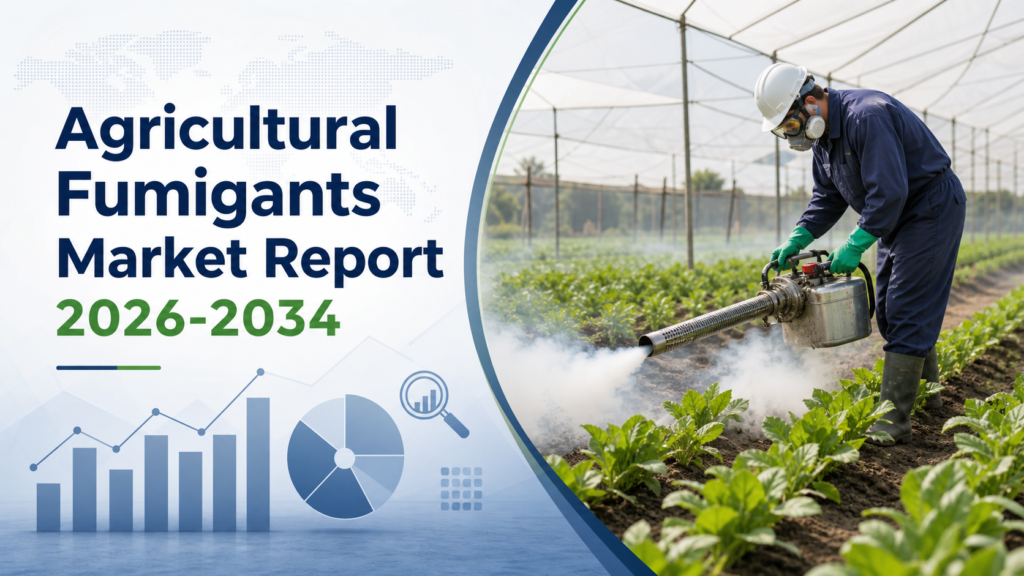
Agricultural Fumigants Market
Market Overview:
According to IMARC Group’s latest research publication, “Agricultural Fumigants Market Size, Share, Trends and Forecast by Type, Form, Crop Type, Application, Pest Control Method, and Region,” the global agricultural fumigants market size was valued at USD 2.6 Billion in 2025. Looking forward, IMARC Group estimates the market to reach USD 3.5 Billion by 2034, exhibiting a CAGR of 3.39% during 2026-2034, driven by rising food demand, pest infestations, increased crop protection needs, and post-harvest loss prevention. Asia Pacific currently dominates the market, holding a significant share of over 40.0%, driven by rapid population growth, rising food demand, and the need for effective post-harvest protection.
The market for agricultural fumigants is driven by several key factors, including rising global food demand, the need for higher crop yields, and the increasing prevalence of pest infestations. The growth of commercial storage facilities as well as warehouses has generated increased demand for fumigants because they protect stored items from spoilage and contamination. Technological advancements in fumigation techniques, including eco-friendly and bio-based alternatives, are further driving market growth.
Grab a sample copy of this report: https://www.imarcgroup.com/agricultural-fumigants-market/requestsample
How AI is Reshaping the Future of the Global Agricultural Fumigants Market
- Innovations in controlled-release fumigants, sensor-based application systems, and AI-driven pest monitoring are improving efficiency and reducing chemical usage across large-scale storage and soil fumigation operations.
- Digital fumigation monitoring platforms are helping producers comply with evolving environmental regulations while tracking gas concentration and exposure levels in real time.
- Improved aeration and containment technologies in grain storage are enhancing fumigation efficiency, reducing chemical wastage through data-driven process control.
- INTRESO’s eFUME, registered by the EPA as a methyl bromide alternative, uses ethyl formate as an active ingredient, offering fast-acting pest elimination typically within one to 24 hours.
- AI-driven precision application techniques are helping farmers optimize soil fumigation methods, enhancing fumigant efficacy while reducing chemical exposure and environmental impact.
Key Trends in the Global Agricultural Fumigants Market
- Growing Demand for Food Security and Post-Harvest Protection: With the increasing global population, protecting stored grains, fruits, and vegetables from pest infestations is crucial in reducing post-harvest losses, with fumigants widely used in warehouses, silos, and shipping containers.
- Regulatory and Environmental Factors: Stringent government regulations on chemical pesticide use have driven innovation, with many traditional fumigants such as methyl bromide banned or restricted due to ozone-depleting properties, leading to the development of eco-friendly and bio-based alternatives.
- Technological Advancements and Adoption of Bio-Based Fumigants: The rise of biological and precision fumigation technologies is creating a positive market outlook, with the demand for organic farming solutions driving development of biofumigants using plant-based compounds and microbial solutions.
- Methyl Bromide Alternative Registration Milestones: INTRESO Group received EPA registration for eFUME, a direct, cost-effective drop-in replacement for methyl bromide, marking an important step for the U.S. agricultural sector in safeguarding supply chains and biosecurity.
- State-Level Research Into Fumigant Alternatives: California’s Department of Pesticide Regulation released findings from an independent study on pre-plant fumigant alternatives, concluding that no existing alternative can yet serve as a direct substitute for methyl bromide.
Growth Factors in the Global Agricultural Fumigants Market
- Rising Global Food Insecurity: The United Nations projects the worldwide population to increase substantially over the coming decades, intensifying the need for effective post-harvest protection and food preservation techniques worldwide.
- Chemical Pollution Reduction Initiatives: Multiple governments united to initiate a large multi-country project to address pollution caused by plastics and pesticides in agriculture, encouraging safer and more sustainable fumigation practices.
- Large-Scale Grain Storage and Export Requirements: Countries with substantial grain storage and export industries require effective fumigation to prevent spoilage and contamination, with stringent food safety regulations further promoting advanced fumigation techniques.
- High-Value Crop Cultivation Expansion: Growing cultivation areas for high-value crops such as tomatoes and blueberries in regions like Europe are driving demand for effective pest management strategies to preserve crop quality and meet export regulations.
- Sustainable Crop Protection Research Investment: Multi-year research partnerships focused on sustainable crop protection are working to cut chemical pesticide usage significantly in key crop cultivation, reflecting growing institutional investment in fumigant alternatives.
Leading Companies Operating in the Global Agricultural Fumigants Industry:
- AMVAC Chemical Corporation
- Arkema
- BASF SE
- Corteva Inc.
- Detia Degesch GmbH
- FMC Corporation
- Lanxess AG
- Nippon Chemical Industrial Co. Ltd.
- Nufarm
- SGS SA
- Syngenta AG (China National Chemical Corporation)
- Trinity Manufacturing Inc.
- UPL Limited
Global Agricultural Fumigants Market Report Segmentation:
Breakup By Type:
- Methyl Bromide
- Chloropicrin
- Phosphine
- Metam Sodium
- 1,3-Dichloropropene
- Others
Phosphine is the leading fumigant for stored grain protection, widely used in warehouses, silos, and bulk commodities, with its lower environmental impact and regulatory acceptance compared to Methyl Bromide driving continued dominance in post-harvest pest control.
Breakup By Form:
- Solid
- Liquid
- Gas
Liquid agricultural fumigants hold the largest market share due to their high efficacy, ease of application, and deep penetration into soil and storage structures, with compatibility across drip irrigation and chemigation application methods.
Breakup By Crop Type:
- Cereals and Grains
- Oilseeds and Pulses
- Fruits and Vegetables
- Others
Fruits and Vegetables lead the market with around 47.8% of the market share, owing to high susceptibility to pests, fungi, and soil-borne diseases that require pre-plant soil fumigation and post-harvest treatment.
Breakup By Application:
- Soil
- Warehouse
Warehouses lead the market with around 55.0% of market share, driven by the need for post-harvest pest control in stored grains, seeds, and commodities vulnerable to insect infestations, mold, and decay.
Breakup By Pest Control Method:
- Tarpaulin Fumigation
- Non-Tarp Fumigation by Injection
- Structural Fumigation
- Vacuum Chamber Fumigation
- Others
Tarpaulin Fumigation leads the market with around 38.2% of the market share, owing to its cost-effectiveness, efficiency, and versatility in pest control for stored grains, seeds, and commodities.
Breakup By Region:
- North America (United States, Canada)
- Asia Pacific (China, Japan, India, South Korea, Australia, Indonesia, Others)
- Europe (Germany, France, United Kingdom, Italy, Spain, Russia, Others)
- Latin America (Brazil, Mexico, Others)
- Middle East and Africa
Asia Pacific accounted for the largest market share of over 40.0%, driven by rapid population growth, rising food demand, and large-scale grain production and export-oriented industries in China, India, Japan, and Australia. The United States accounted for over 86.50% of the agricultural fumigants market in North America.
Recent News and Developments in the Global Agricultural Fumigants Market
- July 2026: California’s Department of Pesticide Regulation released the final component of a multi-part study on fumigant alternatives, finding that no existing alternative can yet serve as a direct substitute for methyl bromide or MITC generators.
- October 2025: INTRESO Group received EPA registration for eFUME, a methyl bromide alternative fumigation treatment using ethyl formate as its active ingredient, suited to a wide variety of fruits, vegetables, grains, and cut flowers.
- February 2025: The Miller Research Potato Pest Management Seminar in Idaho focused on alternatives to Metam sodium fumigation, compost and green manure trials, and disease management strategies.
- September 2024: Australia announced an updated Methyl Bromide Fumigation Methodology, effective May 2025, clarifying requirements to reduce ozone depletion while ensuring biosecurity compliance as a Montreal Protocol signatory.
Note: If you require specific details, data, or insights that are not currently included in the scope of this report, we are happy to accommodate your request. As part of our customization service, we will gather and provide the additional information you need, tailored to your specific requirements. Please let us know your exact needs, and we will ensure the report is updated accordingly to meet your expectations.
About Us:
IMARC Group is a global management consulting firm that helps the world’s most ambitious changemakers to create a lasting impact. The company provides a comprehensive suite of market entry and expansion services. IMARC offerings include thorough market assessment, feasibility studies, company incorporation assistance, factory setup support, regulatory approvals and licensing navigation, branding, marketing and sales strategies, competitive landscape and benchmarking analyses, pricing and cost research, and procurement research.
Contact Us:
IMARC Group
134 N 4th St. Brooklyn, NY 11249, USA
Email: sales@imarcgroup.com
Tel No: (D) +91 120 433 0800
United States: +1-201-971-6302