Generative AI is transforming how businesses create content, automate workflows, analyze information, and deliver personalized customer experiences. From AI-powered chatbots to intelligent business applications, companies are increasingly adopting generative AI to improve productivity and accelerate digital transformation.
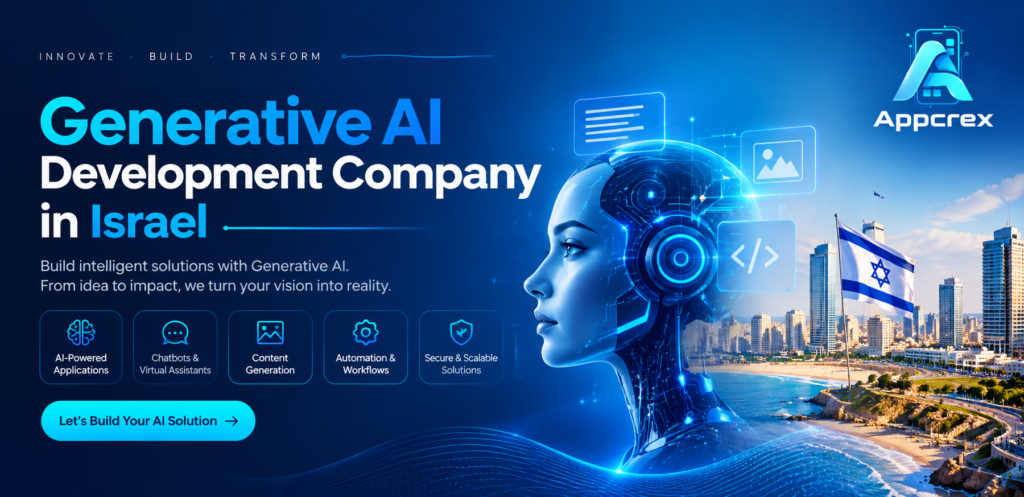
If you are looking for a Generative AI Development Company in Israel, Appcrex offers customized AI development solutions designed to help businesses integrate intelligent technologies into their operations. Our solutions can include AI chatbots, large language model (LLM) applications, AI agents, content generation systems, workflow automation, and custom generative AI software.
Whether you are a startup, an established enterprise, or a growing technology company, generative AI can help you develop innovative products, streamline business processes, and create new opportunities for growth.
What Is Generative AI Development?
Generative AI development involves building software applications that use artificial intelligence models to generate new content, understand natural-language requests, summarize information, answer questions, and assist with complex tasks.
Depending on business requirements, generative AI solutions can generate text, images, code, summaries, recommendations, and other forms of digital content.
A generative AI development company helps businesses identify suitable use cases, select AI models, integrate business data, develop applications, and deploy secure and scalable AI-powered systems.
Why Do Businesses in Israel Need Generative AI Solutions?
Israel has an active technology and startup ecosystem, making AI-powered solutions relevant to businesses seeking innovation and operational efficiency. Organizations across different industries can explore generative AI to improve customer service, automate repetitive work, and develop new digital products.
Here are some potential benefits of adopting generative AI solutions.
1. Business Process Automation
Generative AI can assist with repetitive tasks such as document processing, email drafting, report generation, and internal knowledge searches. Automation can help employees focus on higher-value activities.
2. AI-Powered Customer Support
AI chatbots and virtual assistants can answer frequently asked questions, guide customers through common processes, and provide support outside regular business hours.
3. Personalized Customer Experiences
Generative AI can help businesses deliver personalized recommendations, responses, and content based on customer preferences and relevant business information.
4. Faster Content Creation
Businesses can use AI tools to generate initial drafts of marketing content, product descriptions, summaries, and other materials. Human review remains important for quality, accuracy, and brand consistency.
5. Improved Data Accessibility
AI-powered knowledge assistants can help employees search company documents, retrieve relevant information, and summarize large volumes of text.
6. Product and Service Innovation
Startups and enterprises can integrate generative AI into websites, mobile applications, SaaS platforms, and internal business tools to create new digital experiences.
Generative AI Development Services Offered by Appcrex
Appcrex can develop customized generative AI solutions based on your business goals, technical requirements, and target users.
1. Custom Generative AI Development
Custom generative AI development focuses on creating AI-powered applications tailored to specific business needs. These applications can support content generation, knowledge retrieval, customer interactions, and workflow automation.
2. AI Chatbot Development
AI chatbots can understand natural-language questions and provide relevant responses using configured instructions, approved knowledge sources, and connected business systems.
Common applications include customer support, lead qualification, product assistance, and internal employee support.
3. Large Language Model (LLM) Development
LLM-powered applications can process natural-language inputs, summarize documents, generate text, and assist users with information-intensive tasks.
Businesses can use existing models, customize model behavior, or integrate models with their own data, depending on their requirements.
4. Retrieval-Augmented Generation (RAG)
RAG combines a generative AI model with a retrieval system that searches relevant information from selected documents or databases before generating an answer.
This approach can help businesses build AI assistants that answer questions using company policies, product documentation, technical manuals, and internal knowledge bases.
5. AI Agent Development
AI agents can be designed to perform defined tasks, use approved tools, retrieve information, and coordinate workflows with appropriate permissions and oversight.
Examples include research assistants, customer service agents, document-processing assistants, and internal workflow automation tools.
6. AI Content Generation Solutions
AI content generation software can help businesses create first drafts of articles, product descriptions, advertising copy, email campaigns, and social media content.
Content workflows should include human review and fact-checking before publication.
7. Generative AI Integration
Businesses that already use CRM systems, websites, mobile applications, or enterprise software can integrate generative AI capabilities into their existing platforms.
Integration may include AI-powered search, automated summaries, conversational interfaces, and intelligent recommendations.
Industries That Can Benefit from Generative AI in Israel
Generative AI can support different industries when its applications are matched to practical business needs.
Healthcare
Healthcare organizations can explore AI for administrative document summaries, patient information assistance, and internal knowledge retrieval. Medical applications require appropriate privacy safeguards, clinical oversight, and validation.
Fintech and Financial Services
Financial businesses can use generative AI to summarize documents, assist customer support teams, search internal policies, and automate selected administrative workflows. Sensitive financial decisions require suitable controls and human oversight.
Retail and E-Commerce
Retailers can use AI to generate product descriptions, assist online shoppers, improve product discovery, and personalize customer interactions.
Education and EdTech
Educational platforms can incorporate AI tutors, learning assistants, content summaries, and personalized learning support, with safeguards against inaccurate information.
Real Estate
Real estate businesses can use generative AI to draft property descriptions, summarize listings, respond to common inquiries, and support lead management.
SaaS and Technology
Technology companies can integrate generative AI into SaaS products, developer tools, support systems, knowledge platforms, and workflow automation solutions.
Manufacturing and Logistics
Manufacturing and logistics businesses can explore AI for document processing, operational knowledge retrieval, technical support, and summarizing reports.
Key Features of Generative AI Applications
A successful generative AI application should be designed around its intended users and business objectives.
Important features may include:
- Natural-language conversations
- Context-aware responses
- AI-powered search
- Document summarization
- Knowledge-base integration
- Multilingual capabilities
- Workflow automation
- API integrations
- User authentication
- Role-based access controls
- Usage analytics and monitoring
- Human review and escalation
- Feedback collection
- Error handling and response validation
Not every application needs every feature. The right combination depends on the intended use case, risk level, available data, and business requirements.
Generative AI Development Process
A structured development process helps businesses build useful, reliable, and maintainable AI applications.
Step 1: Business Requirement Analysis
Identify the business problem, target users, expected outcomes, available data, and tasks the AI application should perform.
Step 2: Use Case and Model Selection
Evaluate suitable AI models and approaches based on performance, cost, latency, privacy, language requirements, and integration needs.
Step 3: Data Preparation
Organize and validate the information that the AI application will use. This may involve document processing, data cleaning, access controls, and preparing a searchable knowledge base.
Step 4: UI/UX Design
Create an intuitive interface that makes AI functionality easy to understand and use. Include feedback mechanisms and clear options for human assistance when needed.
Step 5: AI Application Development
Develop the application, integrate the selected AI models, and implement features such as prompting, retrieval, tool use, and workflow automation.
Step 6: Testing and Evaluation
Evaluate response quality, factual accuracy, security, latency, reliability, and performance across representative use cases.
Step 7: Deployment and Integration
Deploy the solution and connect it to the required websites, mobile apps, enterprise systems, or cloud infrastructure.
Step 8: Monitoring and Optimization
Monitor performance, operating costs, user feedback, and emerging risks. Update prompts, retrieval systems, model configurations, and application logic as needed.
How Much Does Generative AI Development Cost in Israel?
The cost of developing a generative AI application depends on its complexity, features, integrations, data requirements, and deployment environment. There is no single price that applies to every project.
| Development Factor | Potential Cost Impact |
|---|---|
| Basic AI chatbot | Low to medium |
| Custom AI application | Medium |
| LLM integration | Depends on model and architecture |
| RAG-based knowledge assistant | Medium to high |
| AI agent with tool integrations | Medium to high |
| Enterprise system integration | Medium to high |
| Custom model training or fine-tuning | High, depending on scope |
| Security and compliance requirements | Depends on requirements |
| Cloud infrastructure and model usage | Ongoing operational cost |
| Maintenance and optimization | Ongoing cost |
A focused AI chatbot using an existing model is generally less complex than an enterprise-grade AI platform with custom integrations, extensive data processing, advanced access controls, and multiple AI agents.
Businesses should evaluate both initial development costs and ongoing expenses, including model usage, infrastructure, monitoring, maintenance, and human review.
Data Privacy, Security, and Responsible AI
Security and privacy should be considered from the beginning of every generative AI project, particularly when an application processes confidential business information or personal data.
Important considerations include:
- Protecting sensitive information
- Applying role-based access controls
- Encrypting data where appropriate
- Reviewing model and service-provider data policies
- Limiting access to approved knowledge sources
- Testing for prompt injection and unauthorized data disclosure
- Monitoring application outputs
- Maintaining audit logs where appropriate
- Establishing human review for high-impact decisions
- Evaluating relevant Israeli and international legal requirements
Businesses operating in Israel should assess applicable privacy, data-protection, sector-specific, and contractual obligations based on their activities and the information they process.
Why Choose Appcrex as Your Generative AI Development Company in Israel?
Appcrex focuses on building customized digital solutions that align with business objectives and user needs. Our generative AI development approach can help businesses explore practical AI applications without treating every business problem as a reason to build a complex AI system.
With Appcrex, your project can include:
- Custom generative AI application development
- AI chatbot and virtual assistant development
- LLM integration
- RAG-based knowledge assistants
- AI agent and workflow development
- Web and mobile application integration
- API and third-party integrations
- User-friendly UI/UX design
- Security-focused development
- Testing, maintenance, and optimization
We can help define a suitable technical approach based on your goals, available data, expected usage, and operational requirements.
Conclusion
Generative AI is creating new opportunities for businesses to automate workflows, improve customer interactions, access information more efficiently, and develop innovative digital products.
Choosing the right Generative AI Development Company in Israel means finding a development partner that understands your business requirements, selects appropriate AI technologies, and prioritizes reliability, privacy, and measurable value.
Appcrex can help businesses explore customized generative AI solutions, from intelligent chatbots and knowledge assistants to AI-powered applications and workflow automation systems.
Looking to build a generative AI solution for your business in Israel? Connect with Appcrex to discuss your project requirements and development goals.