Market Overview
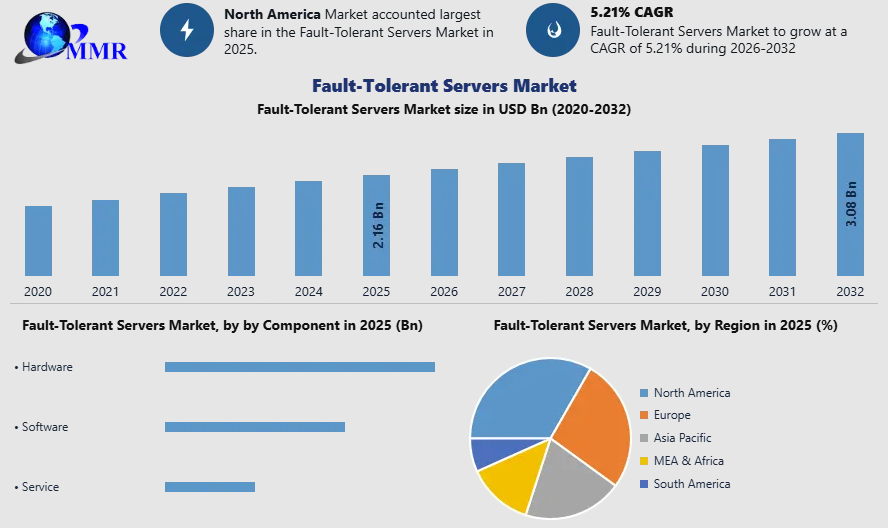
The Fault-Tolerant Servers Market is experiencing steady expansion as organizations increasingly prioritize uninterrupted digital operations, reliable data processing, and business continuity. The global market was valued at approximately USD 2.16 billion in 2025 and is expected to reach nearly USD 3.08 billion by 2032, registering a compound annual growth rate (CAGR) of 5.21% during the forecast period.
Intrigued to explore the contents? Secure your hands-on sample copy of the report: https://www.maximizemarketresearch.com/request-sample/91953/
Fault-tolerant servers are designed to maintain continuous system availability even when individual hardware or software components experience failures. These systems commonly incorporate redundant processors, memory, storage, power supplies, networking components, and other critical infrastructure to reduce the risk of downtime. Unlike conventional server architectures, fault-tolerant platforms can automatically switch to redundant components or operating configurations when a failure occurs.
The increasing dependence on digital platforms has made server availability a critical business requirement across industries. E-commerce platforms, financial institutions, healthcare providers, telecommunications companies, and large enterprises increasingly require infrastructure capable of supporting continuous transactions and real-time applications. As workloads become more data-intensive and organizations expand their digital operations, demand for resilient computing infrastructure is expected to continue increasing.
The market analysis covers major components, deployment models, organization sizes, end-user industries, and geographic regions. Historical market developments and changing industry dynamics provide a basis for understanding the evolution of fault-tolerant server technologies and their future growth prospects.
Market Drivers and Trends
Increasing Adoption of Cloud Computing
The rapid adoption of cloud computing is one of the important factors supporting demand for fault-tolerant servers. Organizations are moving workloads, applications, databases, and business processes to cloud environments to improve scalability, accessibility, and operational flexibility.
Intrigued to explore the contents? Secure your hands-on sample copy of the report: https://www.maximizemarketresearch.com/request-sample/91953/
As enterprises become increasingly dependent on hosted applications and cloud infrastructure, downtime can directly affect productivity, customer experience, and revenue generation. Fault-tolerant server architectures provide additional resilience by reducing the impact of component failures and supporting continuous service availability.
The expansion of hybrid and multi-cloud environments is also encouraging organizations to invest in reliable server infrastructure capable of supporting complex workloads and continuous data operations.
Growth of Business Automation
Business automation is another significant market trend. Enterprises are deploying automated systems for customer management, financial processing, inventory management, logistics, production, and other business functions.
Because automated processes frequently operate continuously and depend on real-time data, infrastructure interruptions can affect multiple interconnected processes. Fault-tolerant servers help organizations maintain availability by providing redundancy and minimizing disruptions caused by individual component failures.
Increasing Data-Centric Applications
The growth of data-intensive applications, analytics, artificial intelligence workloads, enterprise databases, and digital platforms is increasing demand for dependable computing infrastructure. Organizations require servers that can process large volumes of information while maintaining availability.
As businesses increasingly rely on digital services, fault tolerance is becoming an important consideration when organizations design or upgrade their IT infrastructure.
Emphasis on Business Continuity and High Availability
Business continuity has become a major consideration for organizations operating mission-critical applications. Even short periods of downtime can disrupt transactions, customer services, communication systems, and internal operations.
Fault-tolerant servers support high availability through redundant components and automated failover capabilities. This makes them particularly relevant to sectors where continuous operation is a fundamental infrastructure requirement.
Primary Market Constraints
High Installation and Infrastructure Costs
The relatively high cost associated with fault-tolerant server deployment remains a key market constraint. Fault-tolerant architectures generally require duplicate or redundant components, specialized configurations, additional storage capacity, and supporting infrastructure.
These requirements can increase the initial investment compared with conventional server systems. Small and medium-sized businesses with limited IT budgets may therefore hesitate to adopt dedicated fault-tolerant platforms.
Lack of Awareness and Technical Expertise
Limited awareness of advanced fault-tolerance technologies can also restrict adoption, particularly among smaller organizations. Implementing and managing highly resilient server environments may require specialized technical expertise.
Organizations without experienced IT teams may face additional costs associated with deployment, maintenance, monitoring, and system management.
Complex Infrastructure Management
Fault-tolerant environments can involve sophisticated hardware and software configurations. Maintaining redundant components, monitoring system health, and ensuring compatibility between infrastructure elements can add operational complexity.
Consequently, organizations must evaluate not only the initial investment but also long-term maintenance, technical support, and management requirements when implementing fault-tolerant server infrastructure.
Key Market Segments
By Component
The market is segmented into Hardware, Software, and Service.
Among these, the Hardware segment is expected to account for a significant market share during the forecast period. Fault-tolerant servers depend heavily on redundant physical components, including processors, memory modules, storage systems, power supplies, and networking equipment.
Hardware redundancy enables systems to continue operating when a primary component fails. Growing investments in robust enterprise infrastructure and the increasing adoption of data-intensive applications are supporting demand for specialized fault-tolerant hardware.
Software and services also play important roles by enabling monitoring, system management, automated failover, maintenance, configuration, and infrastructure support.
By End User
Based on end user, the market is categorized into IT & Telecom, BFSI, E-commerce, Healthcare, and Others.
The E-commerce segment is expected to hold a prominent position in the market, supported by the sector’s dependence on uninterrupted online platforms, transaction processing, inventory systems, and customer-facing applications.
E-commerce businesses operate in highly digital environments where server downtime can interrupt transactions and customer access. Fault-tolerant infrastructure therefore provides an important mechanism for improving system availability.
The BFSI sector is another important end user because banking and financial applications require reliable processing of transactions and access to critical data. Healthcare organizations similarly require dependable infrastructure for digital records, applications, medical systems, and administrative operations.
By Organization Size
The market is divided into Small and Medium-sized Enterprises (SMEs) and Large Enterprises.
Large enterprises are expected to represent an important share because they generally operate complex IT environments, large databases, enterprise applications, and mission-critical digital systems. Their greater IT infrastructure investments can support the deployment of redundant and high-availability server architectures.
At the same time, cloud-based infrastructure and managed services could make fault-tolerant capabilities increasingly accessible to SMEs by reducing the need for extensive in-house infrastructure.
By Deployment
Based on deployment, the market is categorized into On-premises and Cloud-based solutions.
On-premises deployment continues to serve organizations that require direct control over infrastructure, data, and system configurations. Meanwhile, cloud-based deployments are gaining importance as organizations increasingly adopt flexible infrastructure models.
The combination of cloud computing, hybrid infrastructure, and business automation is expected to create additional opportunities for fault-tolerant server technologies.
Intrigued to explore the contents? Secure your hands-on sample copy of the report: https://www.maximizemarketresearch.com/request-sample/91953/
Regional Insights
North America represents an important market for fault-tolerant servers, supported by the presence of major technology companies, established data center infrastructure, high cloud adoption, and significant enterprise IT spending. The region’s mature digital ecosystem creates demand for reliable infrastructure capable of supporting mission-critical applications.
Europe also represents a significant market, supported by established enterprises, expanding data center infrastructure, digital transformation initiatives, and continued technological development. Demand for reliable infrastructure is particularly relevant to industries that depend on continuous digital operations.
Asia Pacific is expected to offer substantial growth opportunities as countries across the region continue investing in digital transformation, cloud computing, enterprise automation, and data infrastructure. The expansion of technology-intensive industries and increasing enterprise digitization can contribute to demand for resilient server platforms.
Markets across the Middle East and Africa and South America are also developing as organizations modernize their IT environments and increase adoption of digital services.
Major Industry Players
The competitive landscape includes established technology companies, server manufacturers, infrastructure providers, and specialized fault-tolerance technology companies. Major companies identified in the market include:
- NEC Corp.
- Texas Instruments
- Cirrus Logic
- National Semiconductor
- Micrel
- Intersil
- IBM
- Fujitsu
- Hewlett Packard Enterprise Development
- Oracle
- Microsoft Technology
- Lenovo
- NetApp
- One-Net Communications
- Stratus Technologies
- Unisys Corporation
- Dell
- Cisco
- Sun Microsystems
- Hitachi Ltd.
- Toshiba Corporation
- Siemens AG
- AT&T Technology Services
- Schneider Electric
- NEC Solutions
Competition within the market is influenced by technology development, infrastructure capabilities, product portfolios, reliability, service offerings, enterprise relationships, and geographic presence. Companies are positioned across different portions of the value chain, including server hardware, software, networking, infrastructure management, and technology services.
Frequently Asked Questions
1. What is the size of the Fault-Tolerant Servers Market?
The global Fault-Tolerant Servers Market was valued at approximately USD 2.16 billion in 2025.
2. What will be the Fault-Tolerant Servers Market size by 2032?
The market is expected to reach approximately USD 3.08 billion by 2032.
3. What is the expected CAGR of the Fault-Tolerant Servers Market?
The market is projected to expand at a CAGR of 5.21% during the forecast period.
4. Which component segment is expected to hold a significant market share?
The Hardware segment is expected to hold a significant share because fault-tolerant systems rely on redundant physical components to maintain system availability.
5. Which end-user segment is expected to contribute significantly to market demand?
The E-commerce segment is expected to hold a prominent position due to its dependence on uninterrupted digital operations, transaction processing, and continuous customer access.
Conclusion
The Fault-Tolerant Servers Market is positioned for steady growth as enterprises increasingly depend on continuous digital operations, cloud services, automated business processes, and data-intensive applications. The market is projected to grow from USD 2.16 billion in 2025 to USD 3.08 billion by 2032, at a 5.21% CAGR.
Connect With Us:
MAXIMIZE MARKET RESEARCH PVT. LTD.
2nd Floor, Navale IT park Phase 3,
Pune Banglore Highway, Narhe
Pune, Maharashtra 411041, India.
+91 9607365656
sales@maximizemarketresearch.com
About Maximize Market Research:
Maximize Market Research is one of the fastest-growing market research and business consulting firms serving clients globally. Our revenue impact and focused growth-driven research initiatives make us a proud partner of majority of the Fortune 500 companies. We have a diversified portfolio and serve a variety of industries such as IT & telecom, chemical, food & beverage, aerospace & defense, healthcare and others.