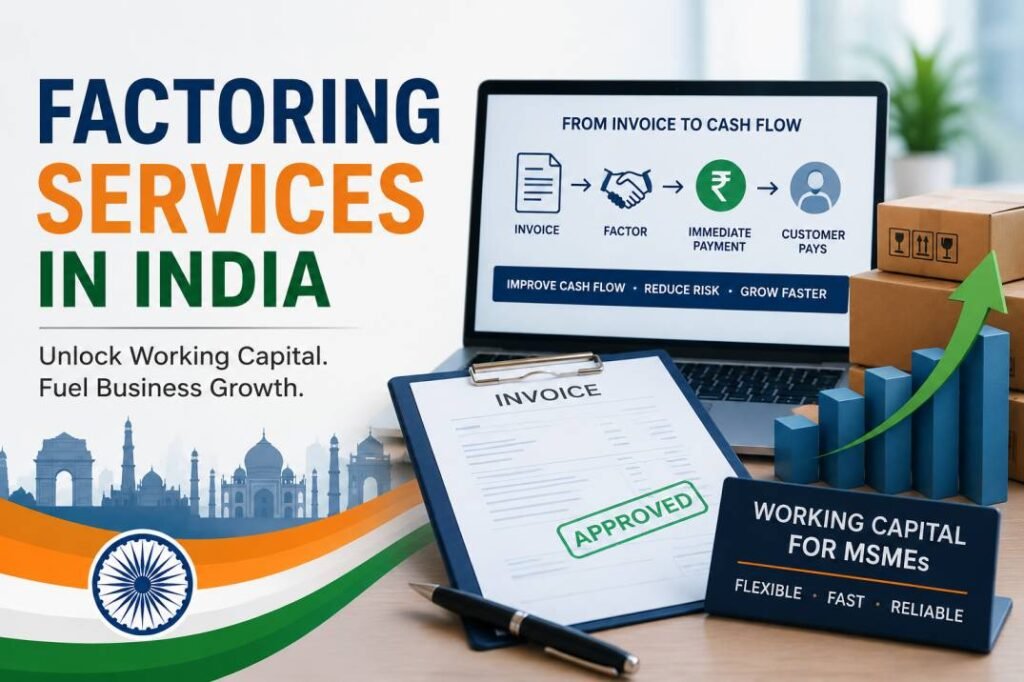
For Micro, Small and Medium Enterprises (MSMEs), maintaining consistent cash flow can be one of the biggest challenges of running and growing a business. An MSME may generate strong sales and have reliable customers, yet still face a shortage of cash because customers often take 30, 60, or 90 days to pay their invoices.
This gap between raising an invoice and receiving payment can restrict a company’s ability to purchase inventory, pay suppliers, manage payroll, accept new orders, and invest in growth.
This is where factoring services in India can provide an important working-capital solution.
Factoring allows a business to use eligible trade receivables to obtain funds before customers make their payments. Depending on the structure, a factor may purchase or finance receivables and may also provide collection-related services.
India has a regulated framework for factoring. The Factoring Regulation Act, 2011 governs factoring and assignment of receivables, while the Reserve Bank of India regulates applicable financial entities and has issued regulations covering factors and registration of assignments.
For MSMEs, factoring can therefore be more than a short-term funding mechanism. When structured appropriately, it can become part of a broader strategy for managing receivables, improving liquidity, and supporting sustainable business growth.
What Are Factoring Services in India?
Factoring services in India are financial services through which a business can obtain funding against eligible accounts receivable arising from genuine trade transactions.
In a typical factoring arrangement:
- The MSME sells products or provides services.
- The MSME raises an invoice against the customer.
- The invoice becomes an account receivable.
- The factor evaluates the receivable and underlying customer.
- The factor provides funding according to the agreed terms.
- The customer pays the receivable according to the arrangement.
- The transaction is settled after applicable fees, charges, and reserves.
The exact legal structure can differ between factoring arrangements.
The RBI’s regulatory framework recognizes NBFC-Factors and provides conditions for entities undertaking factoring business. RBI regulations state that an NBFC-Factor must meet prescribed requirements and conduct factoring business in accordance with the Factoring Regulation Act and applicable RBI directions.
Why MSMEs Need Factoring Services
MSMEs frequently sell to larger companies on credit terms.
For example, an MSME supplier may deliver goods today but receive payment after 60 days.
During those 60 days, the business still needs to:
- Purchase raw materials
- Pay employees
- Pay suppliers
- Maintain inventory
- Pay rent and utilities
- Manage transportation
- Fulfill additional orders
- Fund marketing and expansion
The company’s sales ledger may show substantial revenue, but its bank account may not reflect those sales yet.
This creates a working capital gap.
Factoring services can potentially help convert eligible receivables into earlier access to funds.
How Factoring Services in India Work
The process generally involves several parties and stages.
Step 1: The MSME Makes a Sale
The business supplies products or services to a customer under agreed credit terms.
For example:
Invoice Value: ₹10,00,000
Payment Terms: 60 days
The MSME has earned revenue, but the cash is not expected immediately.
Step 2: The Invoice Becomes a Receivable
The customer now owes ₹10 lakh to the MSME.
This amount becomes part of the company’s accounts receivable.
Step 3: The Factor Evaluates the Invoice
The factor may examine:
- Customer creditworthiness
- Invoice amount
- Payment terms
- Customer payment history
- Invoice age
- Customer concentration
- Existing financing
- Invoice disputes
- Returns and credit notes
- Underlying trade transaction
The factor may also conduct due diligence on the MSME and its customers.
Step 4: Funding Is Provided
If the receivable qualifies, the factor provides financing according to the agreed advance rate and terms.
For illustration, suppose an eligible invoice is ₹10 lakh and the advance rate is 80%.
Potential initial funding:
₹10,00,000 × 80% = ₹8,00,000
The actual advance rate and financing structure depend on the provider and agreement.
Step 5: Customer Payment
The customer pays the invoice according to the factoring arrangement.
Depending on the structure, payment may be directed to the factor.
Step 6: Settlement
After receiving the customer payment, the factor settles the remaining amount with the MSME after deducting applicable fees, charges, interest, and other contractual amounts.
Simple Example of Factoring Services in India
Consider an MSME manufacturer with ₹50 lakh of outstanding invoices.
The company has already delivered products but expects customers to pay over the next 60 days.
At the same time, the manufacturer needs ₹25 lakh to:
- Purchase raw materials
- Pay suppliers
- Maintain production
- Fund payroll
- Accept new customer orders
Instead of waiting two months for all customers to pay, the business may use eligible receivables through a factoring arrangement to obtain earlier liquidity.
This can potentially allow the company to continue its operations without allowing unpaid invoices to completely restrict cash flow.
The example is illustrative. Actual funding depends on invoice eligibility, customer credit quality, advance rates, fees, reserves, and contractual terms.
Read also: How to Choose the Best Mobile App Development Company in Dubai: A Complete Buyer’s Guide
Key Benefits of Factoring Services in India for MSMEs
1. Faster Access to Working Capital
The most important benefit is improved liquidity.
Instead of waiting until an invoice reaches its due date, an MSME may obtain funds earlier against eligible receivables.
This can make it easier to manage day-to-day expenses.
2. Better Cash-Flow Management
Predictable access to working capital can help businesses plan:
- Payroll
- Supplier payments
- Inventory purchases
- Transportation
- Operating expenses
- Business expansion
3. Supports Business Growth
A business may have sufficient customer demand but insufficient working capital to fulfill additional orders.
Factoring can potentially provide liquidity to support production and sales growth.
4. Reduces the Impact of Long Credit Terms
Large customers may require 45-, 60-, or 90-day payment terms.
Factoring can help reduce the pressure caused by these extended collection periods.
5. Helps Fund Larger Orders
An MSME may receive a large purchase order but need significant funds before it can deliver the order.
Access to receivables-based funding can help bridge this operational gap.
6. May Reduce Dependence on Traditional Borrowing
Factoring can provide an alternative or complementary source of working capital.
Instead of relying entirely on a conventional term loan, a business may use its receivables to obtain liquidity.
7. Can Scale With Sales
When a business grows, its receivables may also increase.
A receivables-based financing arrangement can potentially grow alongside eligible sales, subject to the facility’s limits and eligibility rules.
Factoring Services in India vs. Traditional Business Loans
Factoring and traditional loans are different financial products.
| Factor | Factoring | Traditional Business Loan |
|---|---|---|
| Primary basis | Eligible receivables | Business financial profile |
| Funding source | Invoices/receivables | Loan facility |
| Repayment | Linked to receivable collection and agreement | Scheduled repayment |
| Customer involvement | May be involved | Usually limited |
| Funding capacity | Can relate to eligible receivables | Generally predetermined |
| Main purpose | Working capital | Working capital or longer-term needs |
| Credit assessment | Business and customer/debtor | Primarily business/borrower |
The right solution depends on the MSME’s cash-flow cycle, customer profile, funding needs, and cost of capital.
Recourse and Non-Recourse Factoring
One of the most important considerations when evaluating factoring services in India is whether the arrangement is with recourse or without recourse.
With-Recourse Factoring
Under a recourse arrangement, the MSME may remain responsible for certain unpaid receivables if the customer fails to pay under specified circumstances.
This means the business retains some of the credit risk.
Without-Recourse Factoring
Under a genuine non-recourse arrangement, the factor may assume specified customer credit risk.
However, businesses should carefully examine the agreement.
Non-recourse does not necessarily cover every possible reason for non-payment.
For example, the contract may treat the following differently:
- Customer insolvency
- Commercial disputes
- Product returns
- Fraud
- Incorrect documentation
- Quality disputes
- Contractual offsets
The exact risk transfer should always be confirmed in writing.
Factoring Services Through TReDS
One of the most important developments for MSMEs in India is the Trade Receivables Discounting System (TReDS).
TReDS is an electronic platform designed to facilitate the financing or discounting of MSME trade receivables from buyers, including large corporates.
SIDBI describes TReDS as an electronic platform for online discounting of MSME bills for supplies to large corporates and states that it can help MSMEs secure financial assistance digitally against invoices or bills.
RBI also states that factoring transactions involving MSMEs through TReDS can qualify for priority-sector classification under applicable rules.
How TReDS Can Help MSMEs
A simplified TReDS process is:
MSME Supplies Goods → Invoice Raised → Buyer Accepts Invoice → Receivable Listed → Financiers Bid/Finance → MSME Receives Funds → Buyer Pays on Due Date
This can potentially help MSMEs obtain competitive financing against accepted trade receivables.
RBI’s FAQ explains that TReDS can handle both factoring and reverse factoring and states that transactions processed through TReDS are without recourse to the MSME seller.
The actual eligibility and transaction terms depend on the platform, buyer, financier, invoice, and applicable rules.
Factoring vs. TReDS
TReDS is not simply another name for factoring.
Factoring is a financial transaction or service involving receivables.
TReDS is an electronic institutional platform through which eligible MSME receivables can be discounted or financed.
A business can therefore encounter factoring-related transactions both within and outside TReDS.
Who Can Benefit From Factoring Services in India?
Factoring may be particularly useful for MSMEs that:
- Sell products or services to established businesses
- Offer credit terms
- Have regular invoicing
- Experience delayed customer payments
- Have strong commercial customers
- Need additional working capital
- Are growing quickly
- Receive large purchase orders
- Have a predictable receivables cycle
Potential users can include:
Manufacturing MSMEs
Manufacturers often need to purchase raw materials and pay production costs before customers settle invoices.
Wholesale Businesses
Wholesalers may sell inventory on credit and face long payment cycles.
Distributors
Distributors can use receivables financing to manage the gap between purchasing products and collecting customer payments.
Staffing Companies
Staffing companies may pay employees before receiving customer payments.
IT and Professional Services
IT companies, consultants, engineers, and service providers often invoice business customers after delivering work.
Logistics Businesses
Transportation and logistics companies can face significant operating expenses before customer invoices are paid.
Construction Businesses
Construction-related businesses may experience long billing and collection cycles.
Eligibility for Factoring Services in India
Eligibility varies between factors and financing platforms.
A provider may assess:
MSME Status
The business may need to meet the applicable MSME definition and provide relevant registration details.
Customer Quality
The financial strength of the customer or debtor can be particularly important because the receivable represents the source of repayment.
Invoice Quality
Invoices should generally represent genuine trade transactions and contain accurate documentation.
RBI guidance for bank factoring has emphasized that factoring should involve invoices representing genuine trade transactions.
Payment History
Customers with a consistent record of timely payments may be viewed more favorably.
Invoice Aging
Fresh invoices are generally more attractive than substantially overdue receivables.
Customer Concentration
A business that depends heavily on one customer may face additional concentration risk.
Existing Financing
The provider needs to establish that the receivables are not already financed or pledged elsewhere.
Documents Required for Factoring
The exact requirements depend on the provider, but an MSME may need:
- Business registration documents
- Udyam registration details
- PAN
- GST registration
- GST returns
- Income tax returns
- Bank statements
- Financial statements
- Accounts receivable aging reports
- Customer invoices
- Purchase orders
- Customer contracts
- Delivery documents
- Existing financing details
- KYC documents
Strong documentation can help make the evaluation process more efficient.
Costs of Factoring Services in India
Factoring is not free financing.
Potential costs can include:
- Discount charges
- Interest
- Processing fees
- Service fees
- Administration charges
- Collection charges
- Platform charges
- Legal or documentation costs
- Other contractual fees
The cost depends on factors such as:
- Customer creditworthiness
- Invoice amount
- Payment period
- MSME risk profile
- Recourse structure
- Financing provider
- Industry
- Transaction volume
Businesses should compare the total effective cost rather than focusing only on the advertised advance rate.
Advance Rate in Factoring
An advance rate determines how much of an eligible invoice the MSME can receive before the customer pays.
For example:
Invoice Value: ₹20 lakh
Illustrative Advance Rate: 80%
Initial Funding: ₹16 lakh
The remaining amount may be held as a reserve and settled after the customer payment, after deducting applicable charges.
Advance rates are not universal.
The factor may determine the percentage based on:
- Customer credit quality
- Invoice risk
- Industry
- Payment terms
- Historical collections
- Concentration
- Recourse structure
How to Calculate the Cost of Factoring
Suppose an MSME factors an invoice worth ₹10 lakh.
Assume, for illustration:
- Advance: ₹8 lakh
- Total factoring cost: ₹30,000
The simple cost relative to the funded amount is:
₹30,000 ÷ ₹8,00,000 = 3.75%
However, businesses should consider the actual financing period, all fees, reserve mechanics, taxes where applicable, and other charges.
The effective annualized cost can be materially different depending on how long the financing remains outstanding.
How Factoring Can Improve the Cash Conversion Cycle
The cash conversion cycle measures how long money remains tied up in business operations.
A simplified formula is:
Cash Conversion Cycle = Inventory Days + Receivable Days − Payable Days
Suppose an MSME has:
Inventory Days: 40
Receivable Days: 60
Payable Days: 30
The simplified cycle is:
40 + 60 − 30 = 70 days
This means the company may have cash tied up for approximately 70 days during its operating cycle.
Factoring can provide earlier access to receivables, potentially reducing the practical cash-flow pressure associated with those 60 receivable days.
However, factoring does not automatically improve the underlying collection cycle. Better invoicing and collections remain important.
Factoring and Business Growth
One of the biggest advantages of factoring is its potential to connect revenue growth with working capital.
Imagine an MSME growing from ₹5 crore to ₹10 crore in annual sales.
Revenue has doubled.
But the company may also need:
- More inventory
- More raw materials
- More employees
- More transportation
- More supplier payments
- More receivables
Growth can therefore consume cash before it produces additional collected cash.
Factoring services can potentially provide liquidity against eligible receivables, allowing the business to continue funding operations while customers follow their normal payment schedules.
How Factoring Supports Large Purchase Orders
A large order can create a working-capital challenge.
For example:
Purchase Order: ₹1 crore
The MSME may need ₹50 lakh to purchase materials and produce the order.
If the customer pays only 60 days after delivery, the business needs sufficient liquidity to survive the entire cycle.
If eligible receivables are already available, factoring may provide working capital that helps the business fulfill additional orders.
This can be particularly useful for companies experiencing rapid growth.
Factoring and Supplier Payments
Supplier relationships are critical for MSMEs.
Delayed supplier payments can result in:
- Reduced credit limits
- Lost discounts
- Supply interruptions
- Reduced trust
- Higher procurement costs
Factoring can potentially provide liquidity that allows an MSME to pay suppliers on time even when customers have not yet paid.
This can strengthen the overall working-capital cycle.
Factoring Services in India for Exporters
Export-oriented MSMEs can also face extended payment cycles.
An exporter may ship products today and receive payment weeks or months later.
Export factoring can potentially provide earlier liquidity against eligible export receivables.
However, international transactions introduce additional considerations, including:
- Foreign exchange
- Country risk
- Buyer credit risk
- Documentation
- International trade terms
- Cross-border regulations
Exporters should use a provider experienced in the relevant international transaction structure.
Important Legal and Regulatory Framework in India
The factoring industry in India operates within a defined regulatory framework.
The Factoring Regulation Act, 2011 provides the legal framework for factoring and assignment of receivables. RBI has issued regulations concerning registration of factors and registration of assignments of receivables.
RBI’s 2022 Registration of Factors Regulations specify requirements for companies seeking registration as NBFC-Factors. The regulations also recognize certain eligible NBFC-ICCs that may undertake factoring subject to prescribed requirements.
RBI’s broader regulatory material continues to recognize the Factoring Regulation Act as part of the regulatory framework applicable to relevant NBFCs.
For an MSME, this means it is important to understand who the financing provider is and under what legal structure the transaction is being conducted.
What MSMEs Should Check Before Choosing a Factor
Before entering into a factoring arrangement, businesses should evaluate:
1. Regulatory Status
Confirm that the provider is legally permitted to conduct the relevant factoring activity.
2. Total Cost
Ask for a complete breakdown of interest, discount charges, processing fees, service fees, and other costs.
3. Recourse Conditions
Understand exactly what happens if a customer does not pay.
4. Advance Rate
Find out how much of each eligible invoice can be funded.
5. Reserve
Understand how much money is held back and when it will be released.
6. Customer Notification
Determine whether the customer will be informed about the factoring arrangement.
7. Collection Responsibility
Clarify who will follow up with customers and manage collections.
8. Contract Period
Check whether there is a minimum commitment.
9. Exit Charges
Look for early termination fees or other exit conditions.
10. Reporting Requirements
Understand what financial and receivables information must be submitted regularly.
Red Flags When Choosing Factoring Services in India
Businesses should be cautious when a provider:
- Does not clearly disclose its legal status
- Avoids providing a written fee structure
- Promises guaranteed approval without financial assessment
- Offers unusually high funding without explaining conditions
- Uses unclear contractual language
- Does not explain recourse obligations
- Requests unexplained upfront payments
- Does not clearly explain how customer payments are handled
Always review the agreement carefully before transferring or financing receivables.
How MSMEs Can Improve Factoring Eligibility
Maintain Accurate Invoices
Invoices should contain correct customer names, GST details, amounts, dates, purchase-order references, and payment terms.
Invoice Promptly
The sooner a valid invoice is issued, the sooner it can potentially enter the financing cycle.
Maintain Strong Customer Relationships
Reliable customers can improve the quality of the receivables portfolio.
Reduce Invoice Disputes
Clear contracts and accurate deliveries can minimize disputes.
Track Receivables
Maintain updated aging reports.
Avoid Double Financing
Businesses should clearly track which invoices have been pledged, financed, or assigned.
RBI’s regulatory framework includes mechanisms around registration of assignments and measures intended to prevent issues such as duplicate financing.
Common Mistakes MSMEs Make With Factoring
Mistake 1: Looking Only at the Advance Rate
An 85% advance rate may look better than 80%, but the overall cost could be higher.
Mistake 2: Ignoring the Recourse Clause
Businesses should understand their responsibility if customers fail to pay.
Mistake 3: Financing Poor-Quality Invoices
Disputed or overdue invoices may not qualify or may carry unfavorable terms.
Mistake 4: Ignoring Customer Concentration
Relying heavily on one debtor can increase risk.
Mistake 5: Not Tracking Financing Assignments
Poor records can create duplicate-financing problems.
Mistake 6: Using Factoring to Cover Permanent Losses
Factoring can address timing-related liquidity problems, but it should not be used indefinitely to cover an unprofitable business model.
Factoring vs. Invoice Discounting
These terms are often confused.
Factoring
The factor may purchase receivables and may also provide collection and administration services.
Invoice Discounting
The business typically uses eligible invoices to obtain funding while retaining greater control over customer collections.
The exact legal and operational structure depends on the provider.
Factoring vs. Receivables Financing
Receivables financing is a broad term.
It can include several structures where outstanding receivables support funding.
Factoring is a specific type of receivables transaction involving the purchase or financing of receivables.
Therefore:
Receivables Financing = Broad Category
Factoring = Specific Financing/Receivables Structure
Understanding the legal agreement is more important than relying on the product label.
Factoring Services in India Through TReDS: A Practical Example
Consider an MSME that supplies ₹25 lakh of goods to a large corporate buyer.
The invoice is accepted by the buyer but is payable after 60 days.
Instead of waiting for 60 days, the eligible receivable can potentially be offered through a TReDS platform.
Financiers may provide funding against the accepted receivable.
The MSME receives liquidity earlier, while the buyer pays according to the agreed due date.
SIDBI describes TReDS as a digital mechanism designed to address delayed payments to MSMEs and improve liquidity and cash-flow management.
Frequently Asked Questions About Factoring Services in India
What are factoring services in India?
Factoring services in India involve financing or purchasing eligible business receivables so that companies can obtain funds before customers pay their invoices.
Is factoring legal in India?
Yes. Factoring operates under India’s legal and regulatory framework, including the Factoring Regulation Act, 2011 and applicable RBI regulations.
Is factoring suitable for MSMEs?
Factoring can be suitable for MSMEs that sell to established business customers on credit terms and need working capital before invoices are paid.
What is TReDS?
TReDS is an electronic platform that facilitates discounting or financing of eligible MSME trade receivables. SIDBI describes it as a mechanism for online discounting of MSME bills for supplies to large corporates.
Is TReDS factoring without recourse?
RBI’s FAQ states that transactions processed under TReDS are without recourse to MSMEs.
How much funding can an MSME receive through factoring?
The amount depends on invoice value, eligibility, customer credit quality, advance rate, concentration, payment terms, and the financing provider.
Does factoring require collateral?
Factoring is generally based on eligible receivables rather than traditional property collateral, but the exact transaction structure and security requirements can vary.
How much does factoring cost in India?
Costs vary depending on the factor, customer creditworthiness, invoice duration, recourse structure, transaction size, and other factors.
Can startups use factoring?
A startup may qualify if it has genuine eligible B2B receivables and meets the provider’s requirements. However, businesses with limited trading history may face additional eligibility requirements.
Does the customer need to know about factoring?
It depends on the arrangement. Some factoring transactions involve notification and direct payment to the factor, while other structures may operate differently.
What happens if a customer does not pay?
The outcome depends on whether the factoring arrangement is with recourse, without recourse, or subject to specific contractual protections and exclusions.
Can exporters use factoring?
Export factoring can be available for eligible international receivables, subject to the provider’s product, country risk assessment, foreign-exchange requirements, and applicable regulations.
Best Practices for MSMEs Using Factoring Services
To maximize the benefits of factoring, businesses should:
- Maintain accurate accounting records.
- Invoice customers promptly.
- Monitor receivable aging.
- Work with financially reliable customers.
- Minimize billing disputes.
- Track every financed invoice.
- Understand all financing costs.
- Review recourse provisions carefully.
- Avoid double financing.
- Compare multiple providers.
- Maintain healthy profit margins.
- Use factoring as part of an overall working-capital strategy.
How Factoring Fits Into an MSME Working Capital Strategy
Factoring should not be considered in isolation.
An effective working-capital strategy can combine:
Efficient Inventory Management
Fast and Accurate Invoicing
Strong Receivables Collection
Negotiated Supplier Terms
Appropriate Factoring
Cash-Flow Forecasting
This approach can reduce unnecessary dependence on external financing while ensuring that adequate liquidity remains available for growth.
Final Thoughts
Factoring services in India can provide MSMEs with an important way to unlock working capital from unpaid business invoices.
Instead of waiting weeks or months for customers to pay, an eligible MSME may be able to obtain earlier liquidity against its receivables.
This can help businesses:
- Improve cash flow
- Pay suppliers on time
- Maintain inventory
- Manage payroll
- Fulfill larger orders
- Handle long customer payment terms
- Support expansion
- Reduce short-term liquidity pressure
India’s factoring ecosystem is supported by a formal legal and regulatory framework, while platforms such as TReDS provide an additional digital route for eligible MSME receivables. RBI and SIDBI materials confirm the role of factoring and TReDS in facilitating MSME receivables financing.
However, factoring is not automatically the cheapest form of financing.
MSMEs should carefully compare the total cost, advance rate, reserve, recourse provisions, customer notification requirements, collection responsibilities, and contract terms before selecting a provider.
The most effective use of factoring services in India is as part of a disciplined working-capital strategy. When combined with efficient invoicing, strong collections, healthy customer relationships, accurate accounting, and careful financial planning, factoring can help an MSME turn outstanding receivables into usable liquidity and create greater financial flexibility for sustainable growth.