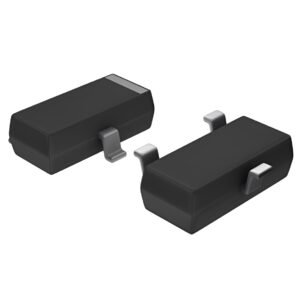
Digital Transistors
Digital Transistors have become increasingly important in modern electronics because they offer a compact and efficient way to manage switching functions within digital and embedded circuits. Unlike standard bipolar transistors that often require several external resistors, Digital Transistors include built-in biasing resistors within the semiconductor package. This integrated structure simplifies circuit design, reduces component count, and helps manufacturers create smaller, cleaner, and more cost-efficient electronic systems.
As electronics move towards greater miniaturisation, automation, connectivity, and energy efficiency, designers need components that provide reliable operation without adding unnecessary complexity. Digital Transistors meet this demand by combining familiar transistor functionality with internal resistive networks that make them easier to connect to logic-level signals.
They are widely used in consumer electronics, industrial systems, automotive modules, smart devices, robotics, sensors, and embedded platforms. Their ability to reduce the number of separate components on a circuit board makes them particularly valuable in high-density designs where every millimetre of PCB space matters.
What Exactly Is a Digital Transistor?
A Digital Transistor is essentially a bipolar junction transistor combined with one or more internal resistors.
Traditional bipolar junction transistors usually require external resistors around the base terminal to control current and establish the correct operating condition. These resistors must be selected separately, placed on the PCB, and connected through additional tracks.
Digital Transistors integrate these resistor functions directly into the device.
A typical Digital Transistor may include:
- A resistor connected between the input and transistor base
- A second resistor connected between the base and emitter
- An NPN or PNP transistor structure
- A compact surface-mount package
This internal arrangement allows the device to be controlled more easily by digital signals.
Because the resistor network is already built in, circuit designers can often connect the transistor directly to a microcontroller or logic output without adding a separate bias resistor.
Why Were Digital Transistors Developed?
The development of Digital Transistors reflects a broader trend in electronics: reducing complexity through integration.
As electronic products became smaller and more sophisticated, designers needed ways to decrease the number of components used on printed circuit boards.
A traditional transistor switching stage may require:
- One transistor
- One base resistor
- One base-to-emitter resistor
- Several PCB connections
Using a Digital Transistor can consolidate much of this circuitry into one component.
This offers important advantages for manufacturers producing large quantities of electronics.
Fewer components can mean:
- Lower placement costs
- Less board space
- Fewer solder joints
- Reduced inventory
- Faster assembly
- Simpler quality inspection
Even a small reduction in parts can have a major effect when a product is manufactured in quantities of thousands or millions.
How Do Digital Transistors Operate?
Digital Transistors operate according to the same fundamental principles as bipolar transistors.
A small electrical signal applied to the input controls a larger current between the collector and emitter terminals.
When the input reaches the required level, the transistor turns on and allows current to flow through the connected load.
When the input signal is removed or lowered, the transistor switches off.
The integrated resistor network controls the current entering the transistor base and helps establish the appropriate switching behaviour.
This makes Digital Transistors particularly useful for simple on/off control.
For example, a microcontroller may output a logic signal that activates a Digital Transistor. The transistor can then control an LED, relay, alarm, or another external device.
The microcontroller handles the decision-making, while the transistor manages the switching action.
How Do Digital Transistors Differ from Standard Bipolar Transistors?
The most important difference is resistor integration.
A conventional bipolar transistor typically requires the designer to calculate and install the correct external base resistor.
Digital Transistors provide this resistor internally.
This difference may seem small, but it has a significant effect on circuit design.
With a standard transistor, engineers must consider:
- Resistor calculations
- Additional components
- Extra PCB routing
- More assembly operations
With a Digital Transistor, these steps are simplified because the biasing elements are already included.
This makes Digital Transistors particularly useful where switching circuits are repeated many times across the same board.
What Is the Purpose of the Internal Resistor Network?
The internal resistor network controls how the transistor responds to the input signal.
The input resistor limits base current to a safe level.
A second resistor, when included, may connect the base to the emitter. This resistor helps ensure that the transistor remains switched off when the input signal is floating or inactive.
Different Digital Transistors use different resistor values.
The selected resistance affects:
- Required input voltage
- Input current
- Switching speed
- Collector current capability
- Logic compatibility
Engineers should therefore choose a transistor whose internal resistor values match the expected control signal and load conditions.
Why Are Digital Transistors Ideal for Microcontroller Interfaces?
Microcontrollers are at the heart of many modern electronic systems.
They control sensors, displays, motors, communication modules, indicators, and other devices. However, microcontroller output pins are generally designed for low-current logic signals.
They may not be able to directly drive certain external loads.
Digital Transistors provide a convenient interface.
The microcontroller supplies a small control signal to the transistor. The transistor then switches the current required by the external load.
This arrangement can be useful for:
- Relay activation
- Indicator control
- Buzzer switching
- Small actuator control
- Sensor power management
- Module enable signals
- Alarm outputs
- Peripheral switching
By reducing the need for external resistors, Digital Transistors make these interfaces easier to implement.
What Is the Difference Between NPN and PNP Digital Transistors?
Digital Transistors are available in both NPN and PNP configurations.
NPN Digital Transistors are commonly used for low-side switching.
In a low-side arrangement, the load is connected to the positive supply while the transistor completes the connection to ground.
When the transistor turns on, current flows through the load.
PNP Digital Transistors are commonly used for high-side switching.
In this arrangement, the transistor controls the connection between the positive supply and the load.
The correct choice depends on:
- Circuit architecture
- Supply voltage
- Load position
- Control polarity
- Required switching behaviour
Both configurations provide the same fundamental advantage of integrated biasing resistors.
Where Are Digital Transistors Used in Consumer Electronics?
Consumer electronics are one of the most common application areas.
Modern devices contain many control signals and switching functions, but manufacturers must keep the products compact and affordable.
Digital Transistors can help meet both requirements.
Typical consumer applications include:
- Televisions
- Audio equipment
- Smart home products
- Remote controls
- Charging devices
- Household appliances
- Gaming equipment
- Portable electronics
- Display control circuits
A single consumer product may contain numerous small switching circuits. Replacing traditional transistor-and-resistor combinations with Digital Transistors can simplify the entire board.
How Are Digital Transistors Used in Automotive Electronics?
Vehicles increasingly depend on electronic control systems.
Modern cars contain modules that manage lighting, displays, sensors, comfort features, communication systems, and safety-related functions.
Many of these systems require low-current switching.
Digital Transistors can support functions such as:
- Dashboard indicator control
- Lighting interfaces
- Sensor signal switching
- Actuator control signals
- Warning circuits
- Control module outputs
- Power enable functions
Automotive applications can expose electronics to temperature extremes, electrical noise, vibration, and voltage fluctuations.
For this reason, designers should select appropriately rated and qualified devices for automotive environments.
What Role Do Digital Transistors Play in Industrial Automation?
Industrial systems rely heavily on reliable switching.
Machines and automated processes often contain controllers that must interact with sensors, alarms, indicators, actuators, and communication circuits.
Digital Transistors can provide an efficient connection between control logic and these external functions.
Common industrial uses include:
- Programmable control boards
- Machine interfaces
- Alarm systems
- Motor control signals
- Sensor interfaces
- Process monitoring equipment
- Automation modules
- Status indicators
Their compact size also makes it possible to integrate many switching channels onto a single control board.
Why Are Digital Transistors Valuable in IoT Devices?
Internet of Things devices often operate under strict size and power constraints.
They may combine:
- Wireless communication
- Sensors
- Processing hardware
- Power-management circuits
- User indicators
- Control outputs
All of these functions must fit inside compact enclosures.
Digital Transistors help reduce PCB component count, making it easier to design smaller connected devices.
They can be used to control:
- Status LEDs
- Sensor power
- Wireless modules
- Alarm outputs
- Small relays
- Peripheral enable lines
This is particularly useful in battery-powered IoT products where efficient use of space is essential.
How Do Digital Transistors Help Reduce PCB Size?
Every discrete component takes up physical space.
A traditional transistor stage may need a transistor plus multiple resistors.
Each part requires:
- Component footprint
- Copper tracks
- Placement clearance
- Solder pads
Digital Transistors combine several functions into one package.
This reduces the space required for each switching channel.
For products containing dozens of switching circuits, the total space savings can become considerable.
Smaller PCBs can support:
- More compact products
- Lower board material costs
- Higher feature density
- Easier enclosure design
How Can Digital Transistors Improve Manufacturing Efficiency?
Manufacturing electronic products involves numerous operations.
Each component must be purchased, stored, tracked, positioned, soldered, and inspected.
Reducing component count can simplify every part of this process.
Digital Transistors can help manufacturers reduce:
- Pick-and-place operations
- Number of unique parts
- Inventory requirements
- Assembly time
- Inspection points
- Potential placement errors
For high-volume production, these efficiency gains can be significant.
A design that saves two components per switching channel could eliminate hundreds or thousands of placements across a large production batch.
What Electrical Specifications Matter Most?
Selecting the correct Digital Transistor requires careful attention to electrical specifications.
Important parameters include:
- Collector-emitter voltage
- Maximum collector current
- Power dissipation
- Input resistance
- Base-emitter resistance
- DC current gain
- Saturation voltage
- Switching speed
- Leakage current
- Operating temperature
The transistor should always be selected with suitable margins.
Operating a device continuously close to its absolute maximum ratings can increase electrical and thermal stress.
Engineers should consider both normal operating conditions and possible worst-case scenarios.
Why Is Collector Current Important?
Collector current determines how much current the transistor can safely control.
A Digital Transistor selected for an LED circuit may only need to handle a relatively small current.
A transistor controlling a relay coil or actuator may require a higher current rating.
If the load requires more current than the transistor can safely manage, the device may overheat or fail.
Designers should therefore calculate the maximum expected load current and select a device with appropriate headroom.
Why Does Collector-Emitter Voltage Matter?
Collector-emitter voltage indicates the maximum voltage that can safely appear across the transistor.
The transistor should have a voltage rating comfortably above the circuit supply voltage.
This is particularly important in systems where voltage spikes or transient conditions may occur.
Industrial and automotive applications can experience electrical disturbances that exceed normal supply levels.
Selecting a transistor with adequate voltage margin can improve robustness.
Why Should Designers Consider Power Dissipation?
Even when used as a switch, a transistor dissipates some power.
This energy is converted into heat.
Power dissipation depends on factors such as:
- Collector current
- Voltage across the transistor
- Switching frequency
- Duty cycle
- Package thermal characteristics
If too much heat is generated, the transistor temperature can rise beyond safe limits.
Designers should review thermal resistance, ambient temperature, and PCB layout when evaluating power dissipation.
How Does Package Type Affect Selection?
Digital Transistors are available in many compact package styles.
Surface-mount packages are particularly common because they support automated PCB assembly and high component density.
The right package depends on:
- Available PCB space
- Required current
- Heat dissipation
- Manufacturing process
- Mechanical constraints
Very small packages are useful for compact designs, but they may have lower thermal capability than larger devices.
Engineers must balance physical size with electrical performance.
How Do Digital Transistors Support Reliable Circuit Operation?
Reliability is influenced by both component selection and system design.
Digital Transistors can help improve consistency because their resistive elements are integrated into the same package.
This reduces the number of external components that could be incorrectly selected or placed.
Potential reliability benefits include:
- Fewer solder joints
- Reduced assembly variation
- Consistent resistor ratios
- Simpler PCB routing
- Lower component count
- Easier quality control
However, proper electrical and thermal design remains essential.
Are Digital Transistors Suitable for Fast Switching?
Digital Transistors can support many switching applications, but their switching speed varies between devices.
For basic control functions such as indicators, relays, and enable signals, extremely high speed is usually unnecessary.
Other applications may require faster switching.
Engineers should examine parameters such as:
- Turn-on time
- Turn-off time
- Storage time
- Transition frequency
If extremely high-speed switching is required, another semiconductor technology may be more appropriate.
Digital Transistors are primarily valued for convenience, integration, and logic compatibility.
How Do Digital Transistors Contribute to Energy-Efficient Electronics?
Energy efficiency is increasingly important across electronics.
Although Digital Transistors are small devices, optimising their operation can still contribute to lower system power consumption.
Appropriate device selection can help reduce:
- Excessive base current
- Unnecessary switching losses
- Heat generation
- Standby power usage
Battery-powered devices benefit particularly from careful switching design.
Efficient transistor operation can contribute to longer battery life and improved thermal performance.
What Should Engineers Consider Before Choosing a Digital Transistor?
Before selecting a device, designers should evaluate the complete application.
Important questions include:
- Is an NPN or PNP device required?
- What is the supply voltage?
- What current must be switched?
- Which logic voltage controls the transistor?
- What internal resistance is appropriate?
- How much power will be dissipated?
- What operating temperature is expected?
- Which package size fits the PCB?
A well-selected Digital Transistor can simplify the final circuit significantly.
A poorly selected device may create switching, thermal, or reliability problems.
Why Are Digital Transistors Important for Modern Product Development?
Modern electronic product development is driven by several major goals:
- Smaller size
- Lower manufacturing cost
- Faster production
- Greater reliability
- Increased functionality
- Improved power efficiency
Digital Transistors support many of these goals simultaneously.
They reduce external component requirements, simplify logic interfaces, and help engineers create more compact switching stages.
This makes them a practical choice across a wide range of products.
How Will Digital Transistors Fit into Future Electronics?
Future electronic systems are expected to contain even more embedded intelligence, connectivity, automation, and sensor functionality.
This will create increasing demand for compact switching components that integrate easily with digital control systems.
Digital Transistors are well suited to this environment because they provide:
- Simple logic-level control
- Integrated resistor networks
- Small package options
- Low component count
- Efficient PCB usage
- Manufacturing advantages
They will continue to complement other semiconductor technologies rather than replacing them.
Applications requiring very high power, extremely fast switching, or specialised analogue performance may use MOSFETs or other devices. However, for straightforward logic-controlled switching, Digital Transistors remain highly effective.
Why Do Digital Transistors Remain a Smart Design Choice?
Digital Transistors demonstrate how relatively simple component integration can provide meaningful benefits in modern electronic design.
By combining a transistor and biasing resistors within a single package, these devices reduce the need for additional parts while preserving the switching functionality required in countless applications.
They support cleaner PCB layouts, simplified manufacturing, reliable logic interfacing, and compact product design.
From smart appliances and embedded devices to industrial automation and vehicle electronics, Digital Transistors provide an efficient way to connect digital control signals with real-world electrical loads.
Their versatility is one of their greatest strengths. They can be used in simple indicator circuits, complex control modules, connected IoT devices, and many other electronic systems.
As designers continue to pursue smaller, smarter, and more efficient products, Digital Transistors will remain a valuable component for practical switching applications.
Their combination of integration, convenience, compact size, and reliable performance makes them an important building block in the continuing evolution of modern electronics.