A garage door opener makes daily access to a residential or commercial property more convenient. With a functioning opener, the garage door can open and close through a wall control, remote, keypad, or compatible smart device. However, when the system begins to malfunction, the problem can affect convenience, security, and the door’s normal operation.
Understanding common garage door opener problems helps property owners recognize warning signs and determine when professional inspection may be necessary. Some issues have simple causes, while others involve electrical components, safety sensors, or mechanical parts that require qualified attention.
1. Garage Door Opener Does Not Respond
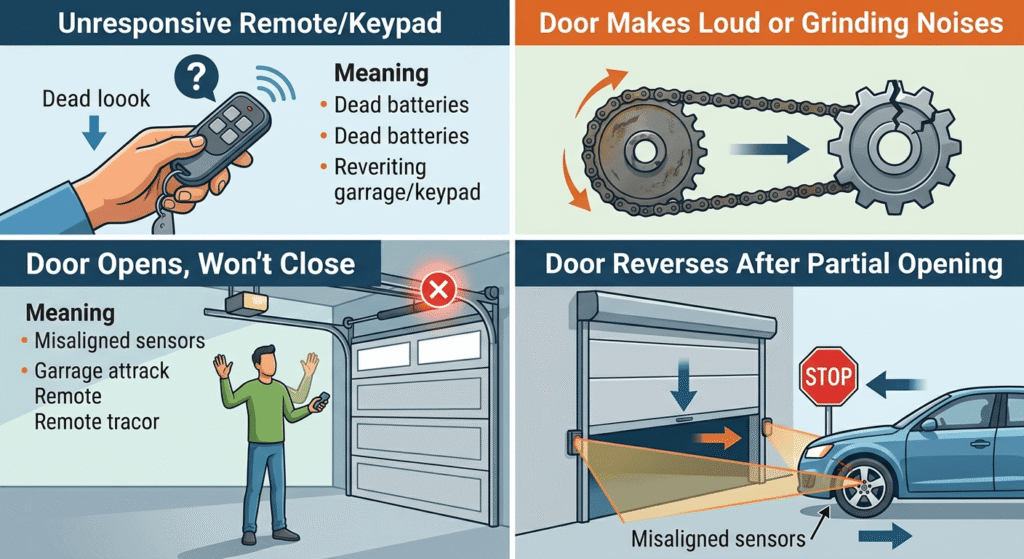
One common problem occurs when the opener fails to respond to a remote control or wall switch. Before assuming that the motor has failed, check whether the opener has power and whether the remote batteries need replacing. A disconnected power supply or an activated lock feature may also prevent normal operation.
If the wall switch works but the remote does not, the issue may involve the remote, its batteries, or its programming. If neither control works despite a functioning power supply, the opener may require further diagnosis.
2. Garage Door Starts Moving but Reverses
A garage door that begins closing and then reverses direction may have a safety sensor issue. Many modern systems use photoelectric sensors near the bottom of the door tracks to detect obstructions. If the sensors are blocked, misaligned, or affected by damaged wiring, the opener may prevent the door from closing fully.
Property owners can check whether objects are blocking the sensor path and whether the sensor lenses appear dirty. The area around the door should remain clear during operation. If the problem continues, a technician can inspect the sensors and related components.
Never bypass a safety sensor to force the door to close. These devices help protect people, pets, and property from potential injury or damage.
3. Unusual Noises During Operation
Grinding, clicking, humming, or rattling sounds may indicate that the opener or another part of the garage door system needs attention. Loose mounting hardware, worn internal gears, chain-drive tension issues, and mechanical resistance can all contribute to unusual sounds.
The source of the noise matters. A problem that appears to come from the opener may actually originate from the door’s rollers, tracks, springs, or hinges. A professional inspection can help identify the cause rather than replacing parts unnecessarily.
4. Garage Door Opens Slowly or Struggles to Lift
An opener that struggles to raise the door may be experiencing mechanical resistance or a problem with its motor or drive system. Worn components, an improperly balanced door, and damaged hardware can place additional strain on the opener.
The opener should not be expected to compensate for a door that is difficult to move. Continuing to operate a malfunctioning system may increase wear or lead to further damage. Stop using the door if it becomes unusually heavy, moves unevenly, or appears to be coming off its tracks.
Springs and lifting cables operate under significant tension. Do not attempt to adjust them yourself. A qualified technician can evaluate the complete system and determine whether the problem involves the opener or the door’s counterbalance mechanism.
5. Remote Control or Keypad Problems
Remote controls and wireless keypads can develop problems because of depleted batteries, programming changes, signal interference, or compatibility issues. If a remote stops working, replacing its batteries and following the manufacturer’s instructions for reprogramming may resolve the issue.
For systems with smart connectivity, check the manufacturer’s app for connection messages and confirm that the opener’s power and network connections are working as expected. Avoid sharing access credentials with unauthorized users, and review remote access settings when changing occupants or property access arrangements.
If the controls remain unresponsive after basic checks, the opener’s receiver, wiring, or control board may need professional evaluation.
6. Choosing the Right Garage Door Opener
Selecting an appropriate opener depends on the door’s weight, usage frequency, noise requirements, and available features. Chain-drive models are commonly used for their practical design, while belt-drive models are often preferred where quieter operation is important. Wall-mounted options may suit certain garage layouts when the door and hardware are compatible.
Smart connectivity, battery backup, security features, and remote access may also influence the decision. Before replacing an older unit, property owners should confirm that the new opener is suitable for their door and installed according to the manufacturer’s requirements.
7. When to Seek Professional Garage Door Opener Repair
Professional assistance is appropriate when the opener repeatedly fails, produces persistent unusual noises, reverses without an obvious obstruction, or struggles to operate a properly maintained door. A technician can inspect the motor, drive mechanism, wiring, safety sensors, remote controls, and connected door hardware.
For persistent operating issues, professional garage door opener repair and installation can help identify the cause and determine whether repair, adjustment, or replacement is appropriate. The correct solution depends on the opener’s condition, compatibility, and the source of the malfunction.
Property owners can also learn about programming a LiftMaster garage door opener to understand basic remote and keypad setup. Always follow the instructions for the specific model, and seek professional help if programming does not resolve the problem or the system shows signs of mechanical failure.
Conclusion
Garage door opener problems can result from power interruptions, remote control faults, sensor issues, worn components, or mechanical resistance. Recognizing these warning signs can help property owners respond promptly and avoid putting unnecessary strain on the system.
Basic checks, such as replacing remote batteries and clearing sensor obstructions, may resolve minor issues. Persistent malfunctions and problems involving wiring, motors, springs, or lifting hardware should be evaluated by a qualified technician. Regular maintenance and timely repairs help support safe, dependable garage door operation.
About Power Lift Garage Doors
Power Lift Garage Doors provides residential and commercial garage door repair, installation, replacement, and maintenance services in Pearland, Texas, and surrounding communities. Services include garage door opener repair and installation, spring repair, cable replacement, roller replacement, and off-track repair.