Cockpit lighting is one of the most underestimated elements of flight deck design. Pilots move from blinding sunlight above a cloud deck to complete darkness within minutes, and in military operations they may fly with night vision goggles for an entire mission. Throughout these transitions, every legend, indicator, and screen in the cockpit display system must remain readable without creating glare, reflections, or distraction. Achieving that balance requires careful engineering across optics, electronics, and human factors.
The Lighting Challenge in Modern Cockpits
Modern flight decks combine several light sources: integrally lit control panels, annunciators, push button switches, flood and utility lights, and large-format displays. Each element has its own luminance characteristics, color, and dimming behavior. If they are not engineered as a coherent system, pilots may face a panel where one legend glows brightly while another is barely visible, or where a display reflects off the canopy at night.
Key challenges include:
- Sunlight readability: In bright ambient conditions, displays and legends must provide enough luminance and contrast to remain legible, often aided by anti-reflective coatings and optical bonding.
- Dark adaptation: At night, excessive light impairs the pilot’s ability to see outside the aircraft. Lighting must dim smoothly to very low levels without flicker or color shift.
- Uniformity: Legends and backlit panels should appear evenly lit across the entire panel, so no area draws attention unnecessarily.
- Color discipline: Warning, caution, and advisory colors must remain distinguishable at every brightness level.
Integrally Lit Panels and Light Balancing
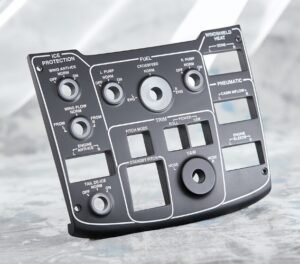
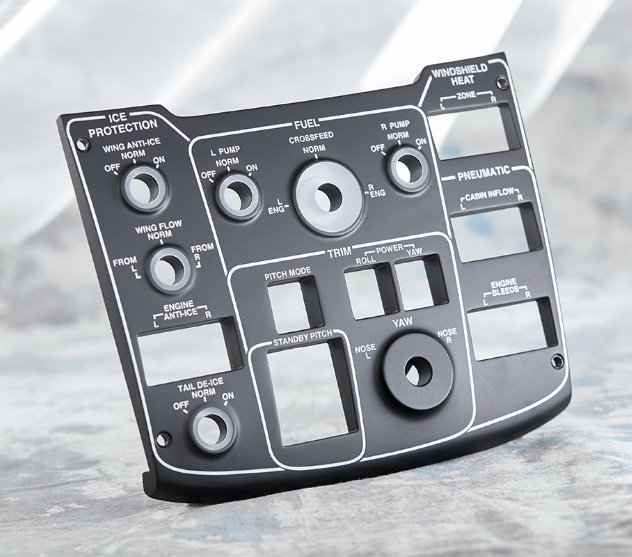
Integrally lit panels are a cornerstone of cockpit lighting. Light is guided through the panel structure to illuminate legends from within, producing a clean, uniform appearance. Achieving uniformity across dozens of legends, each with a different size and shape, requires precise control of LED placement, light guide geometry, diffusers, and paint layers.
Light balancing between panels is equally important. When a pilot dims the cockpit, every panel should follow the same dimming curve. Mismatched curves create an uneven cockpit where some panels disappear while others remain too bright. Manufacturers address this with calibrated electronics and careful component selection, verified through luminance and chromaticity measurements.
NVIS Compatibility
For military and many special-mission aircraft, lighting must also be compatible with Night Vision Imaging Systems. Night vision goggles amplify light in the red and near-infrared portion of the spectrum, so cockpit lighting that emits in this range can saturate the goggles and effectively blind the pilot. NVIS-compatible lighting, defined by standards such as MIL-STD-3009 and MIL-L-85762A, uses filtered light sources and specific color definitions, including NVIS Green A, Green B, Yellow, Red, and White, so cockpit lighting remains visible to the naked eye without interfering with the goggles. Learn more about NVIS lighting solutions.
Displays as Part of the Lighting System
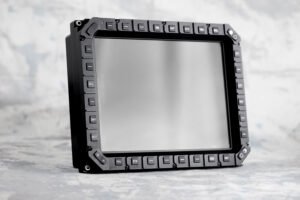
Displays are often treated separately from panel lighting, but pilots experience the cockpit as one visual environment. A well-integrated cockpit display system matches display dimming with the surrounding panel lighting, controls reflections on bezels and glass, and ensures that line key legends around the display remain readable in every mode. Leading rugged display manufacturers design bezels and displays together for this reason, treating lighting as a system-level requirement rather than a component specification.
Operational Needs Drive Lighting Decisions
Lighting requirements differ by mission. A commercial airliner prioritizes long-duration comfort and consistency across a fleet. A military helicopter flying low-level night missions prioritizes NVIS performance and a minimal external light signature. A training simulator must reproduce real aircraft lighting faithfully. Defining these operational needs early helps engineering teams make the right trade-offs among brightness, power consumption, heat, weight, and cost.
About AEROMAOZ
AEROMAOZ has more than 45 years of experience designing and manufacturing rugged HMI solutions for mission-critical environments. Its portfolio includes integrally lit panels, bezels and displays, NVIS-compatible solutions, and external and cockpit lighting for commercial and military aircraft, helicopters, UAV ground stations, armored vehicles, and naval platforms.
Conclusion
Effective cockpit lighting is a balancing act among visibility, readability, and the realities of each mission. By treating panels, displays, and lighting as one integrated system, designers give pilots a cockpit that stays clear and comfortable from bright daylight to the darkest night.