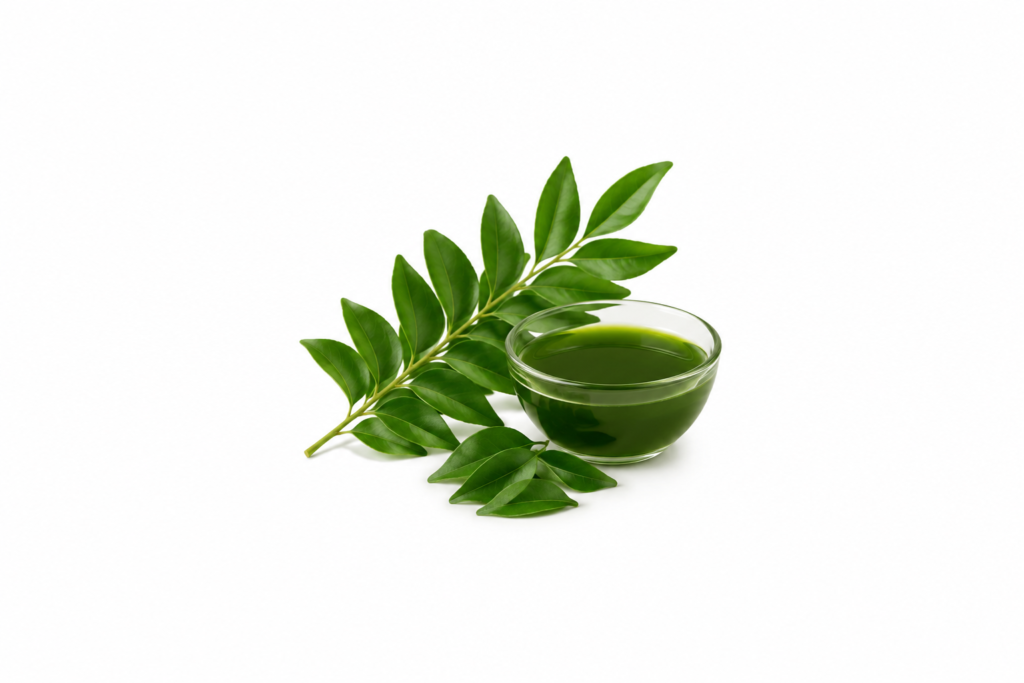
Curry Leaf Extract displayed with fresh curry leaves, highlighting its natural botanical origin and potential applications in nutraceutical and herbal formulations.
Curry Leaf Extract is gaining attention in the botanical ingredients industry because curry leaves have a long history of use in traditional food and wellness practices. Derived from the leaves of Murraya koenigii, the extract contains naturally occurring plant compounds that interest researchers and product developers. As consumer demand for plant-based ingredients grows, Curry Leaf Extract offers opportunities for developing innovative nutritional supplements, functional foods and wellness products.
Botanical ingredients are valued for their diverse natural compositions and their potential applications in different product categories. Manufacturers are exploring ways to incorporate traditional plant ingredients into modern formulations while maintaining quality consistency, and product safety. Alongside Curry Leaf Extract ingredients such as Amla Extract and Alpha Lipoic Acid can contribute different characteristics to carefully designed nutritional products.
Understanding the Benefits of Curry Leaf Extract
Curry leaves are commonly used in South Asian cooking to add aroma and flavor. Beyond their culinary role they contain plant compounds including carbazole alkaloids and various phenolic compounds. These substances have attracted scientific interest because of their antioxidant properties observed in laboratory research.
Curry Leaf Extract provides a concentrated form of selected compounds from curry leaves. Its composition depends on the plant material extraction process and manufacturing specifications. Understanding these differences is important for businesses seeking reliable botanical ingredients for their products.
Researchers continue to investigate the biological activities of curry leaf compounds. However laboratory findings do not automatically demonstrate health benefits in humans. Product developers should therefore evaluate available scientific evidence carefully before making health-related claims.
Applications in Nutritional Supplement Development
The growing interest in botanical nutrition has encouraged manufacturers to explore a wide range of plant-derived ingredients. Curry Leaf Extract can be considered for suitable supplement formulations depending on the intended application ingredient specifications and regulatory requirements.
Potential product formats may include capsules tablets powders and selected functional nutrition products. The choice of format depends on the extract’s properties its compatibility with other ingredients and the desired characteristics of the finished product.
For successful formulation development manufacturers should consider several important factors:
- Ingredient identity and botanical authentication.
- Standardization of relevant plant compounds where appropriate.
- Stability and compatibility with other formulation ingredients.
- Microbiological quality and contaminant testing.
- Compliance with applicable food and supplement regulations.
These considerations help businesses develop products with consistent specifications and dependable quality.
Exploring the Role of Amla Extract
Amla Extract is obtained from the fruit of Phyllanthus emblica which is also known as Indian gooseberry. The fruit is traditionally valued in Indian food practices and is known for containing vitamin C and various polyphenolic compounds. Its composition varies according to the raw material processing and extraction method.
In nutritional product development Amla Extract may be selected for formulations focused on botanical nutrition and antioxidant-related product concepts. Manufacturers should confirm the actual nutrient and phytochemical profile of the ingredient rather than assuming every extract has the same composition.
Combining different botanical ingredients requires careful formulation planning. When Amla Extract is considered alongside Curry Leaf Extract developers should assess the intended purpose of each ingredient and ensure that the combined formulation meets suitable quality and safety standards.
The final product should be supported by appropriate evidence and accurate labeling. Any claims about antioxidant activity or other health effects must comply with the regulations applicable to the product’s market.
Understanding Alpha Lipoic Acid in Modern Formulations
Alpha Lipoic Acid is a naturally occurring compound involved in mitochondrial energy metabolism. It participates in biochemical processes that help the body convert nutrients into usable energy. It is also studied for its antioxidant properties and its potential applications in nutritional supplements.
Unlike plant extracts Alpha Lipoic Acid is a distinct chemical compound with its own formulation and quality considerations. Its stability dosage requirements and compatibility with other ingredients should be evaluated during product development.
Manufacturers considering Alpha Lipoic Acid for nutritional formulations should review scientific evidence and regulatory guidance relevant to the intended product. Evidence for a particular application should not be generalized to every supplement or combination of ingredients.
When developing products that feature Curry Leaf Extract and Alpha Lipoic Acid it is important to assess ingredient interactions stability and appropriate serving levels. Qualified formulation professionals can help determine whether a proposed combination is suitable for its intended purpose.
Quality Standards for Botanical Ingredients
Quality assurance is essential when sourcing Curry Leaf Extract for commercial applications. Natural ingredients can vary because of differences in growing conditions harvesting practices storage and processing methods. Reliable specifications help reduce uncertainty and support consistent product manufacturing.
Businesses should consider the following quality measures when evaluating a supplier:
Raw material authentication: Confirm the botanical identity and source of the plant material.
Manufacturing controls: Review the extraction process and procedures used to maintain batch consistency.
Analytical testing: Evaluate appropriate tests for identity potency microbial quality heavy metals pesticides and other relevant contaminants.
Documentation: Request applicable certificates of analysis specifications and supporting technical information.
Regulatory compliance: Confirm that the ingredient is suitable for the intended product category and destination market.
A structured supplier evaluation process helps manufacturers make informed sourcing decisions and maintain quality throughout product development.
Sustainability and Responsible Ingredient Sourcing
Sustainable sourcing is becoming increasingly important in the botanical ingredient industry. Responsible purchasing practices can support traceability and encourage better management of agricultural resources. Businesses sourcing Curry Leaf Extract should consider the origin of the raw material and the supplier’s approach to responsible procurement.
Traceability documentation can help manufacturers understand where plant materials originate and how they move through the supply chain. Consistent processing and appropriate storage also help preserve the quality of botanical ingredients.
Responsible sourcing should be supported by documented procedures rather than broad environmental claims. Manufacturers can strengthen their procurement practices by reviewing supplier records and establishing clear ingredient acceptance criteria.
Choosing Ingredients for Innovative Products
Selecting the right ingredients requires a balance between product objectives scientific evidence safety quality and consumer expectations. Curry Leaf Extract may suit certain botanical product concepts while Amla Extract can offer a different phytochemical profile. Alpha Lipoic Acid may be considered where its specific biochemical role aligns with the formulation objectives.
Before selecting any ingredient businesses should define the intended product category target market and desired technical specifications. They should also assess stability and compatibility and review the regulatory requirements that apply to the finished product.
Clear communication between ingredient suppliers formulation specialists and quality teams can make development more efficient. It also helps ensure that product descriptions remain accurate and that finished products meet their established specifications.
Conclusion
The botanical ingredients industry continues to explore traditional plants and scientifically studied compounds for modern nutritional product development. Curry Leaf Extract offers an ingredient option for suitable formulations while Amla Extract and Alpha Lipoic Acid provide distinct characteristics that may serve different product objectives.
Careful sourcing scientific evaluation and quality control are essential for responsible ingredient selection. Businesses that prioritize documented specifications and regulatory compliance can build a stronger foundation for consistent product development. Botanic Healthcare supports the botanical ingredient sector through its focus on ingredient quality and the development of plant-based solutions for diverse industries.