What Makes a Temporary Control Input Useful?
A Momentary Push Button Switch gives an operator direct control without leaving the command active after the button is released. The APEM 1213C WHITE belongs to a broad family of Push Button Switches used in control panels, test equipment and machine interfaces. Its simple action suits commands that should last only for the duration of a deliberate press.
Unlike a maintained switch, which stays in its selected state, a momentary model returns automatically when pressure is removed. That behaviour is valuable for start pulses, reset commands, counters, test inputs and acknowledgement functions. The connected control circuit determines what happens after the electrical pulse ends.
What Are the Main Features of the APEM 1213C WHITE?
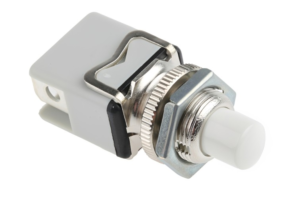
The APEM 1213C WHITE is a non-illuminated, panel-mounted switch from the 1200 Series. It has a white plunger actuator, momentary action and a compact 12.2 mm panel cut-out requirement. The product is listed with an SPST contact configuration and a normally open switching function.
Its electrical ratings include operation at up to 250 V AC and 24 V DC, subject to the permitted load and installation conditions in the manufacturer’s documentation. The minimum listed operating temperature is −20°C, and the product is RoHS compliant. Designers should still verify current ratings, load type, environmental limits and switching life before selection.
How Does a Normally Open Momentary Contact Work?
In its resting state, a normally open contact does not provide a conducting path. Pressing the actuator closes the contact, allowing the connected control signal to pass. Releasing the actuator opens the contact again and ends the command.
This arrangement is commonly used as an input to a relay, timer, controller or electronic circuit. The push button should generally control an appropriately designed input rather than directly switching a large motor or other demanding load. If equipment must continue running after release, a separate holding circuit or programmed function provides that behaviour.
Why Does Actuator Colour Matter?
Colour helps operators recognise controls quickly, especially when several buttons share one panel. The white actuator can represent reset, acknowledgement, selection or general-purpose control, provided its meaning is documented and used consistently.
Colour alone should not carry the entire instruction. Suitable Push Button Labels & Legends can make the intended action explicit. In assemblies using removable interface components, correctly matched Push Button Caps can support colour coding and tactile identification, but compatibility must be confirmed for the selected switch series.
Where Can the Switch Be Used?
The compact panel-mount format makes MPN 1213C WHITE useful in industrial control panels, laboratory equipment, test benches, access systems and purpose-built electronic assemblies. It may also support manual inputs on packaging equipment, small machinery and maintenance tools.
Suitability depends on the complete circuit rather than the application name. Engineers must consider contact load, switching frequency, panel depth, conductor termination and exposure to vibration or contamination. A switch installed in clean indoor equipment faces different conditions from one exposed to dust, moisture, oils or mechanical impact.
How Should the Panel Opening Be Prepared?
Accurate panel work supports secure mounting and consistent actuator movement. The specified 12.2 mm cut-out should be created with a suitable tool, with burrs removed before the switch is inserted. The mounting surface must resist flexing during repeated operation.
For a separate operator station, compatible Push Button & Control Station Enclosures can provide a structured housing solution. Enclosure material, cable entries and ingress protection must match the environment, with sufficient internal clearance for terminals and wiring.
How Can Accidental Operation Be Reduced?
Positioning is the first defence against unintended activation. The button should be easy to reach deliberately but separated from handles, moving workpieces and areas where tools or clothing may make contact. Crowded layouts should provide enough spacing for gloved operation without pressing an adjacent control.
Appropriately matched Push Button Guards & Covers may reduce accidental presses in higher-risk locations. A guard must not obstruct normal operation or create a new hazard, and its dimensions must be checked against the selected switch.
Is This Switch Suitable as an Emergency Stop?
No. A standard white momentary push button should not be treated as an emergency-stop device. Emergency stopping requires purpose-designed components, recognisable colouring, suitable contact behaviour and integration into a safety circuit that meets the machinery risk assessment and applicable standards.
Dedicated Emergency Stop Push Buttons are built for that distinct role. The APEM 1213C WHITE is better suited to ordinary commands such as start, test, acknowledge or reset where its temporary action matches the control logic.
What Should Be Checked During Wiring and Commissioning?
Installation should be performed with the supply isolated by a competent person. Wiring must follow the correct terminal identification, and connected conductors should not place mechanical stress on the switch body. Insulation, conductor size and circuit protection must suit the applied voltage and load.
After assembly, technicians should confirm that the plunger moves freely, the contact changes state only when pressed and the control system responds as intended. Repeated testing can reveal loose connections, panel movement or incorrect logic before the equipment enters service.
Why Is the APEM 1213C WHITE a Practical Choice?
The APEM 1213C WHITE combines a compact footprint, clear white actuator and straightforward momentary operation. Its normally open contact supports short control commands without leaving a maintained electrical state at the operator interface.
Reliable performance depends on correct circuit design, accurate panel preparation and an environment compatible with the switch’s limits. When these details are addressed, this Momentary Push Button Switch can provide a simple, recognisable and dependable input for professional control and signalling equipment.