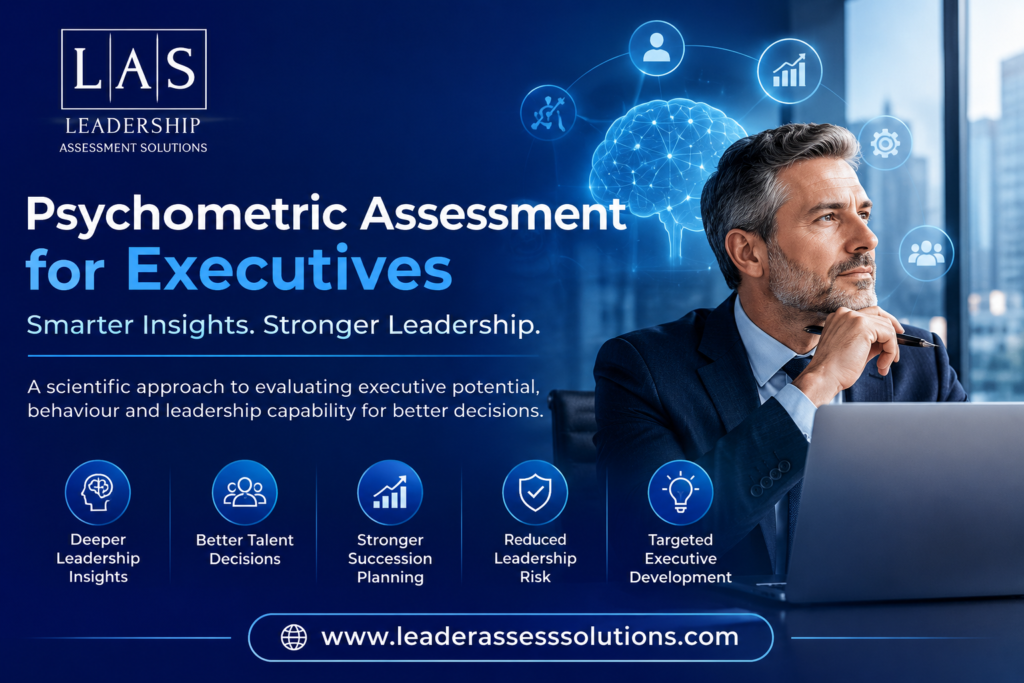
Hiring an executive is one of the most consequential decisions an organization can make. A candidate may have an impressive résumé, extensive industry experience, and a strong interview performance, but these factors alone may not reveal how that person will actually behave when faced with pressure, uncertainty, conflict, rapid change, or complex strategic decisions. This is why psychometric assessment for executives has become an important component of modern leadership evaluation. Psychometric assessment provides structured insight into personality, cognitive abilities, motivations, leadership behaviors, decision-making tendencies, and potential risks. When these insights are combined with interviews, references, career history, and role-specific evaluation, organizations can develop a more complete picture of an executive candidate and make more informed leadership decisions.
What Is Psychometric Assessment for Executives?
Psychometric assessment for executives refers to scientifically developed assessment methods used to understand characteristics that can influence workplace behavior and leadership performance. Rather than relying only on what an executive says during an interview, these assessments provide structured information about behavioral tendencies, reasoning ability, motivations, interpersonal style, and other relevant characteristics. The purpose is not to determine whether a candidate is simply “good” or “bad.” Instead, the goal is to understand how an individual’s strengths, limitations, motivations, and behavioral patterns may align with the requirements of a particular executive role. For example, a highly decisive leader may be an excellent fit for an organization going through a major transformation, while the same level of assertiveness could create challenges in a company where collaboration and consensus are essential.
Why Psychometric Assessment Matters in Executive Hiring
Executive hiring involves significantly greater organizational risk than most hiring decisions because senior leaders influence strategy, culture, financial performance, employee engagement, customer relationships, and long-term business direction. A poor executive appointment can have consequences that extend across an entire organization. Psychometric assessment cannot eliminate hiring risk, but it can provide additional evidence that helps boards, CEOs, CHROs, and hiring committees evaluate candidates more objectively. It can also highlight areas that deserve deeper investigation during interviews and reference checks.
Traditional executive interviews are valuable, but they have limitations. Experienced executives are often highly skilled communicators who know how to present their accomplishments and respond confidently to challenging questions. A structured executive personality assessment can provide additional insight into consistent behavioral patterns that may not become obvious during a few hours of conversation. This does not mean psychometric testing should replace interviews. Instead, the most effective approach is to use assessment as one part of a broader executive evaluation process.
What Does an Executive Psychometric Assessment Measure?
There is no single psychometric assessment that is appropriate for every executive. The right assessment depends on the position, business environment, organizational culture, and leadership challenges. Personality is one important area that can be evaluated. Personality assessments may explore characteristics such as ambition, sociability, emotional stability, curiosity, interpersonal approach, adaptability, and willingness to take risks. For an executive appointment, this information can help organizations understand how a candidate may typically influence others, respond to criticism, deal with uncertainty, or approach collaboration.
Cognitive ability is another important area. Executives regularly have to process complex information, evaluate competing priorities, recognize patterns, solve problems, and make decisions when complete information is unavailable. Depending on the role, cognitive assessments may examine areas such as critical reasoning, verbal reasoning, numerical reasoning, abstract thinking, and problem-solving ability. These assessments should always be selected according to the actual demands of the executive position rather than being used simply because they are available.
Motivation and values can also provide valuable insight. Two executives with similar experience and capabilities may be motivated by very different factors. One leader may be primarily motivated by achievement and growth, while another may place greater importance on innovation, influence, stability, purpose, or developing people. Understanding these drivers can help organizations evaluate whether a candidate’s motivations are compatible with the organization’s strategy and culture.
Another valuable component of leadership assessment tools for executives is the identification of potential derailers. A derailer is a behavioral tendency that may become problematic under pressure or in certain situations. For example, confidence can become overconfidence, decisiveness can become impatience, attention to detail can become micromanagement, and ambition can become excessive competitiveness. Identifying these possibilities does not mean predicting that an executive will fail. Instead, it creates an opportunity to investigate potential risks more carefully before making a final decision.
How Psychometric Assessment Fits Into the Executive Assessment Process
An effective executive assessment process begins with understanding the leadership challenge. Organizations should first identify what they actually need from the person entering the role. A company preparing for rapid international growth may need an executive who is highly adaptable and commercially focused, while an organization undergoing restructuring may require stronger change leadership, resilience, and operational discipline. Establishing these requirements before assessing candidates helps prevent organizations from judging executives against vague or subjective ideas of what a “great leader” should look like.
The next step is creating an executive assessment framework. This framework should define the competencies, behaviors, experiences, and characteristics associated with success in the specific role. Instead of simply asking whether a candidate has “strong leadership,” the organization can define what leadership means in that environment. It might include strategic thinking, stakeholder management, team leadership, commercial judgment, adaptability, decision-making, communication, and the ability to execute change.
Psychometric assessment can then be combined with other sources of evidence. A comprehensive executive assessment may include behavioral interviews, cognitive assessments, personality assessments, leadership simulations, business-case exercises, structured reference interviews, career-history analysis, and stakeholder feedback. Using several sources creates a more balanced view of the candidate and reduces the likelihood that one test result or interview impression will dominate the final decision.
The interpretation stage is particularly important. Assessment results should always be considered in relation to the specific executive role. A particular characteristic does not automatically represent a strength or weakness. For example, high risk tolerance may be valuable for an entrepreneurially focused company but could create concerns in a highly regulated environment. Similarly, a strong preference for collaboration may be beneficial in a consensus-driven culture but could become challenging if the role requires rapid unilateral decision-making.
Psychometric Assessment and Executive Succession Planning
Psychometric assessment can also play an important role in executive succession planning. Many organizations have talented internal leaders who appear ready for promotion, but being successful in a functional position does not necessarily mean an individual is prepared to lead an entire organization. Moving from a departmental leadership position to the C-suite often requires broader strategic thinking, stronger stakeholder management, greater tolerance for ambiguity, and the ability to influence across the enterprise.
Assessment can help organizations understand the strengths and development needs of potential successors. It may reveal whether an internal candidate demonstrates the capabilities required for greater responsibility, which areas require development, and what potential risks should be monitored. This information can support more targeted executive development programs and help organizations make succession decisions based on evidence rather than tenure, personal relationships, or assumptions about readiness.
For example, an organization may have three potential successors for a senior leadership position. One candidate may demonstrate exceptional analytical ability but struggle with influencing senior stakeholders. Another may have excellent interpersonal skills but need greater exposure to strategic decision-making. A third may demonstrate strong strategic thinking but have limited experience managing large-scale transformation. Psychometric assessment, combined with interviews and performance evidence, can help the organization determine which candidate is best prepared and what development each person may require.
Example of Psychometric Assessment in Executive Selection
Consider a technology company searching for a new Chief Operating Officer. Three candidates have similar professional backgrounds and extensive operational experience. The first candidate is highly analytical, disciplined, and detail-oriented but may become cautious when facing uncertainty. The second candidate is highly decisive, commercially ambitious, and comfortable taking risks but may sometimes dominate discussions. The third candidate is collaborative, adaptable, and relationship-focused but may need greater structure when making high-stakes decisions.
There is no universally correct profile. The right choice depends on the company’s current needs. If the organization is entering an aggressive growth period, the second candidate’s decisiveness and commercial drive could be valuable, provided the potential interpersonal risks can be effectively managed. If the business is focused on operational stability and process improvement, the first candidate may be a stronger fit. If the company is trying to rebuild relationships and improve cross-functional collaboration, the third candidate could have significant advantages. The assessment does not make the decision by itself; instead, it gives decision-makers better evidence for discussing the relative strengths, risks, and potential of each candidate.
How to Select the Right Executive Psychometric Assessment
Organizations should carefully evaluate assessment tools and providers before using them for executive decisions. First, they should consider the scientific foundation of the assessment and whether there is appropriate evidence supporting its reliability and validity for the intended purpose. Second, the assessment should be relevant to the actual requirements of the position. A generic personality questionnaire may provide interesting information, but executive selection requires a more focused understanding of leadership capability and role fit.
Professional interpretation is equally important. Even a high-quality assessment can be misunderstood if results are interpreted without appropriate expertise. Organizations should also consider fairness and consistency throughout the assessment process. Candidates should be evaluated against clearly defined and job-relevant criteria rather than subjective impressions. Finally, assessment should ideally produce useful feedback. When executives understand their strengths and development opportunities, assessment can support not only selection but also leadership development and succession planning.
Common Mistakes Organizations Should Avoid
One of the most common mistakes is treating a single assessment score as the final hiring decision. Psychometric assessments should contribute to a broader evidence base rather than replacing professional judgment. Another mistake is ignoring the organizational context. A characteristic that is beneficial in one company may be less valuable or even problematic in another. Organizations should also avoid overinterpreting assessment results. Psychometric assessments provide structured evidence about likely patterns and tendencies; they do not guarantee future performance.
Another important mistake is choosing an assessment simply because it is popular. Organizations should examine whether the tool is appropriate for executive selection, whether it has a strong evidence base, and whether it measures characteristics relevant to the role. Finally, companies should avoid reducing executives to personality labels. Effective assessment is about understanding how different characteristics may interact with the demands of a particular role and business environment.
The Future of Executive Assessment
Executive assessment is becoming increasingly evidence-driven. Organizations are combining psychometric data with structured interviews, leadership simulations, references, competency frameworks, career history, and other sources of information to develop a more complete understanding of leadership potential. This approach is particularly valuable as organizations face increasingly complex challenges involving transformation, globalization, technology, changing workforce expectations, and uncertain markets.
The future of executive assessment is therefore unlikely to depend on one test or one score. Instead, organizations will increasingly focus on integrating multiple forms of evidence and interpreting them within the context of the organization’s strategy, culture, leadership requirements, and future challenges. This approach can help boards and senior HR leaders make decisions that are more structured, transparent, and defensible.
Conclusion
Psychometric assessment for executives can provide valuable insight into the qualities that are difficult to evaluate through résumés and interviews alone. Personality, cognitive ability, motivation, behavioral tendencies, and potential derailers can all contribute to a deeper understanding of executive candidates when assessed appropriately. However, psychometric assessment should not be treated as a standalone hiring solution. Its greatest value comes when it is integrated with structured interviews, references, career evidence, role-specific competency frameworks, and professional interpretation.
For organizations hiring, promoting, or developing senior leaders, the objective should be to replace assumptions with evidence and evaluate leadership potential against the real demands of the position. A carefully designed executive assessment process can support better hiring decisions, stronger succession planning, and more targeted leadership development.
If your organization is preparing to make an important executive appointment or succession decision, Leadership Assessment Solutions can help provide an independent, evidence-based perspective on executive capability, potential, and risk. Visit www.leaderassesssolutions.com to learn more and explore how a structured executive assessment can support your next leadership decision.