How Can Scheduled Control Reduce Unnecessary Equipment Runtime?
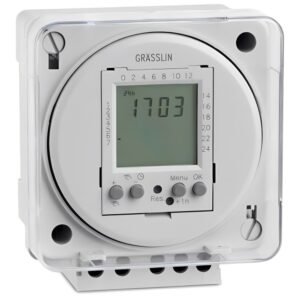
Reliable scheduling starts with the Grasslin Digital Time Switch providing automatic control over when connected equipment operates. Identified by manufacturer part number 03.62.0010.1 and the tactic 371.1 plus model designation, this single-channel digital timer supports daily and weekly programmes. It is particularly useful where lighting, ventilation, heating or suitable machinery must follow a predictable operating routine without depending on manual switching.
Using a defined timetable can reduce avoidable runtime when programmed operating periods accurately match demand. Existing Lighting Controllers may handle functions such as sensing or dimming, while Multi Function Panel Meters can help operators observe important electrical parameters. The timer adds another layer by controlling when an appropriate circuit is permitted to operate.
What Makes the Grasslin Digital Time Switch Practical?
The Grasslin Digital Time Switch operates from a 230 V AC supply with a stated tolerance of ±10% and a frequency range of 50 to 60 Hz. Its potential-free changeover contact allows the switching output to be integrated into a suitably designed control circuit without electrically tying the contact to the timer’s internal supply.
Twenty memory spaces provide room for multiple switching events across a working day or week. Users can create individual daily programmes, repeat instructions across selected blocks of days or establish different schedules for weekdays and weekends. The shortest programmable switching interval is one minute, making the timer suitable for routine building and equipment control rather than extremely fast process sequencing.
How Should a Weekly Programme Be Planned?
An effective programme should begin with a clear operating schedule rather than a collection of isolated switching times. Facility teams should identify when the controlled load is genuinely required, account for preparation and shutdown periods, and then group days that follow the same routine. This approach uses the available memory efficiently and makes later adjustments easier to understand.
For example, lighting could be activated shortly before personnel arrive and switched off after the building closes. A ventilation system might start before an occupied period and stop once air movement is no longer required. Weekend operation can be programmed separately, helping prevent equipment from following weekday routines when a site is empty.
The Grasslin Digital Time Switch also supports 12-hour or 24-hour time display and manual summer-to-winter time adjustment. Seasonal clock changes should therefore be included in the site’s maintenance schedule. Recording the final programme beside the control panel can also help future technicians understand why each event was created.
Which Electrical Loads Can the Timer Control?
Load compatibility must be assessed before connecting equipment. The switching contact is rated up to 16 A at 250 V AC for a resistive load and 4 A at 250 V AC for an inductive load at a power factor of 0.6. The published incandescent-lamp rating is 1,000 W. These values are not interchangeable because motors, transformers, LED drivers and other inductive or capacitive devices may produce substantial starting current.
If the actual load or its inrush current exceeds the timer’s switching capability, the Grasslin Digital Time Switch should operate a correctly selected external switching device instead of carrying the full load directly. Cable capacity, protective-device coordination, ambient conditions and the characteristics of the connected equipment must all be considered during system design.
What Happens If the Mains Supply Fails?
A three-year power reserve helps the timer retain its clock and programmed information during a supply interruption. This feature reduces the likelihood of routine schedules being lost after an outage and supports faster restoration of automatic operation when power returns.
The reserve does not power the connected load during a blackout. It maintains the timer’s internal timekeeping and programme data only. Once the mains supply is restored, the switching output resumes according to the stored schedule and current time. Periodic inspections should still confirm that the displayed time and programmed events remain correct.
How Should the Installation Be Protected?
Safe installation requires suitable isolation and overcurrent protection. Properly selected Non-Fused Switch Disconnectors can provide a means of circuit isolation, while correctly rated Fuses may protect associated wiring and equipment where the circuit design calls for them. Protective components must be chosen according to the load, cable specification, fault level and applicable electrical regulations.
The timer uses screw terminals, so conductors should be prepared and tightened in accordance with the installation instructions. The supply must be isolated before wiring or maintenance begins. Installation should be completed by a competent person who can confirm the terminal arrangement, protective measures and suitability of the connected load.
How Is the Grasslin Digital Time Switch Commissioned?
Commissioning involves more than entering switching times. Suitable Multimeters can assist qualified technicians with permitted electrical measurements, while Voltage Indicator Proving Units support recognised procedures for confirming that compatible voltage indicators function correctly. Test instruments must have an appropriate measurement category and be used by trained personnel.
After electrical checks are complete, the installer should confirm the date and time format, enter the required programme, and test every switching event. Manual automatic, fixed-ON and fixed-OFF modes can help verify the control response, but the timer should be returned to the intended operating mode before handover. The stated timekeeping accuracy is ±1 second per day at 20°C, although periodic clock checks remain good maintenance practice.
Where Can This Digital Timer Add Value?
The Grasslin Digital Time Switch is well suited to repeatable control tasks in commercial buildings, workshops, plant areas and similar facilities. Potential applications include scheduled lighting, ventilation fans, heating control circuits, signage, pumps and suitable small equipment. Each application must remain within the published electrical ratings or use an appropriate external interface.
With one channel, 20 memory spaces, daily and weekly programming, manual overrides and a substantial power reserve, the timer provides focused control without unnecessary complexity. When it is correctly specified, installed and programmed, the Grasslin Digital Time Switch can create dependable operating routines while helping organisations reduce avoidable equipment use outside required periods.