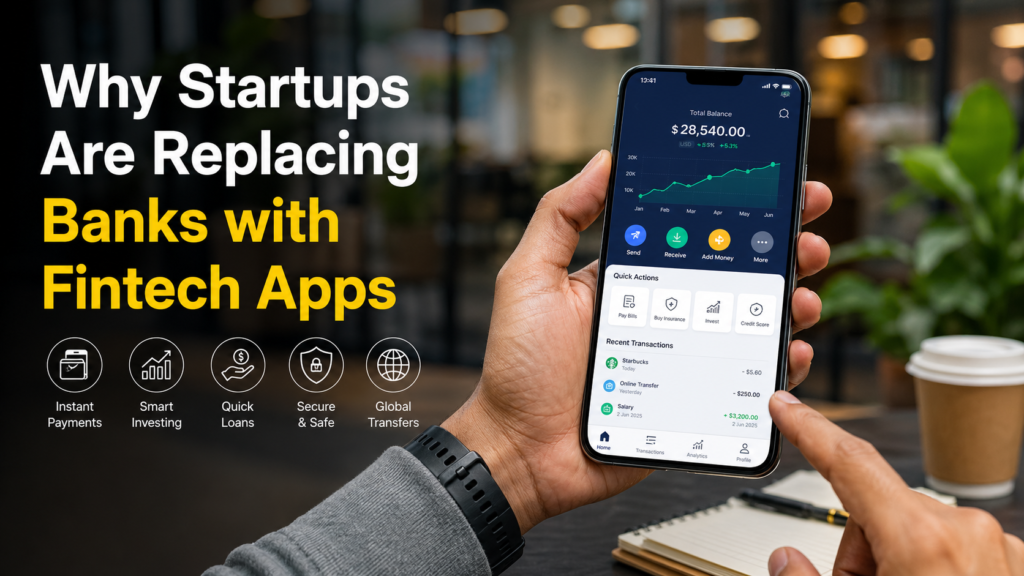
Let’s Be Honest — Nobody Hates Their Bank. They Just Love Convenience More.
Think about the last time you walked into a bank branch. Standing in line. Filling out forms. Waiting for approvals that take days — sometimes weeks. Compare that to opening a digital wallet in under 3 minutes, getting a loan approved through an AI-powered app, or sending money internationally for a fraction of what your bank would charge. That gap? That’s exactly why fintech startups are eating the banking industry’s lunch.
And here’s the thing — this isn’t just happening in Silicon Valley or London. Fintech is exploding across Asia, the Middle East, and markets like India and the UAE. If you’re a founder, product manager, or investor thinking about mobile app development right now, this is the single most important industry trend you need to understand.
Global fintech transaction volume is expected to cross multi-trillion dollars in 2026. Mobile wallet users, neobank sign-ups, and digital lending are all growing faster than traditional banks can respond.
What Exactly Is a Fintech App? (And Why Should You Care?)
Fintech — short for Financial Technology — uses software to make money management faster, cheaper, and smarter. It’s not a new concept, but the pace of adoption in 2026 has become genuinely jaw-dropping.
Here’s a quick look at the major types of fintech apps dominating the market right now:
- Digital Payment Apps — Think PhonePe, Paytm, Stripe
- Lending & Loan Apps — KreditBee, LendingClub, and dozens of regional players
- Investment Platforms — Groww, Zerodha, Robinhood
- Neobanks — Revolut, Mercury, Brex (bank accounts with zero branch), bold_part=None
- Buy Now Pay Later (BNPL) Apps
- SME & Business Banking Apps
- Insurance & Insuretech Platforms
- AI Budgeting & Expense Trackers
- Cross-Border Payment & Forex Apps — Wise, Revolut
Each of these solves one very specific financial pain point — and solves it 10x better than a traditional bank. That’s the secret formula.
ALDO READ – What is the Best Digital Mobile App Development in the UAE?
Why Customers Are Ditching Banks for Fintech Apps
Let’s stop talking in abstractions. Here’s what real users actually want — and what banks consistently fail to deliver:
Speed That Feels Like a Superpower
Instant KYC. Real-time transfers. Loan approvals in minutes. When your fintech app can do in 4 minutes what a bank takes 4 days to do, the choice becomes obvious. For millennials and Gen Z who grew up with one-click Amazon deliveries, banking slowness isn’t just frustrating — it feels broken.
A User Experience That Doesn’t Make You Want to Cry
Modern fintech apps invest heavily in UI/UX design. Clean dashboards. Smart spending insights. Push notifications that actually help. Compare this to most bank apps — which often feel like they were designed in 2008 and never updated. Mobile app development in fintech is not just about features. It’s about creating an experience users genuinely enjoy.
Lower Costs. Fewer Surprises.
No hidden charges. Better foreign exchange rates. Zero minimum balance requirements. Free onboarding. When your fintech startup removes every little fee that banks have normalized, users notice — and they stay.
24/7 Availability. No Queues. No Drama.
Fintech apps don’t have branch hours. They don’t close for public holidays. You can send ₹50,000 or $5,000 at 2 AM on a Sunday and it goes through. That kind of freedom is something traditional banking infrastructure genuinely cannot replicate overnight.
Banks vs Fintech Apps: The Honest Comparison
| Traditional Banks | Fintech Apps |
| Slow account opening (days/weeks) | Instant signup & KYC (minutes) |
| Heavy paperwork | Fully digital, paperless |
| Outdated mobile apps | Modern, beautiful UX |
| Often higher fees | Lower or zero fees |
| Branch hours only | 24/7 access |
| Slow product launches | Rapid iteration & updates |
| Manual credit scoring | AI-powered credit decisions |
| Limited personalization | Hyper-personalized offers |
digital banking disruption, neobank vs traditional bank, online lending platforms, AI credit scoring, embedded finance ecosystem, open banking APIs, BaaS (Banking-as-a-Service)
Why Traditional Banks Are Struggling to Catch Up
To be fair, banks aren’t sitting still. JPMorgan Chase, HDFC, ICICI, DBS — they’re all pouring billions into digital transformation. But there are structural reasons why they can’t move as fast as a scrappy 20-person startup:
- Legacy Tech Debt: Old mainframe systems that take months to update, not days
- Regulatory Bureaucracy: New products require compliance reviews that take quarters, not weeks
- Expensive Physical Infrastructure: Thousands of branches and ATMs to maintain
- Risk-Averse Culture: Banks are structurally incentivized to avoid failure, not pursue innovation
- Poor Mobile-First Thinking: Most bank apps are afterthoughts, not core products
A fintech startup, on the other hand, can update its app 3 times a week, run A/B tests on onboarding flows, and ship a completely new feature in 10 days. That speed difference is lethal for incumbents.
READ MORE – Mobile App Development Cost in UAE (Detailed Pricing Guide 2026)
How Fintech Startups Are Actually Winning
There’s a pattern behind every successful fintech startup. It’s not magic. It’s a deliberate strategy that any founder or product team can learn from:
1. Master One Problem First
The best fintech apps don’t try to do everything. Stripe focused only on payments. Wise focused only on international transfers. Groww focused only on mutual funds. This laser focus lets them build a genuinely superior product instead of a mediocre one that does everything.
2. Mobile-First Is Not Optional
In 2026, if your financial product isn’t mobile-first, you don’t have a product. Especially in markets like India and the UAE, where smartphone penetration is sky-high and users often access the internet exclusively through their phones. This is why mobile app development companies in Dubai and across the Gulf are seeing unprecedented demand from fintech founders.
3. Use Data Like a Weapon
Fintech apps collect behavioral data that banks can only dream of. How often you spend, what you buy, when you transfer money, how you invest. This feeds AI models that offer personalized products, detect fraud in milliseconds, and underwrite loans more accurately than any human loan officer.
4. Growth Hacking That Actually Works
Cashback. Referral bonuses. Free signup. Zero-fee first transfer. These aren’t gimmicks — they’re engineered acquisition funnels. When a fintech startup removes every barrier to trying their product, conversion rates skyrocket.
The Tech Stack Powering Fintech in 2026
Want to understand why fintech apps feel so different from banking apps? Look at the technologies underneath the hood:
- AI & Machine Learning: Fraud detection, credit scoring, and personalized financial advice
- Open Banking APIs: Real-time data sharing between financial institutions
- Blockchain & Smart Contracts: Faster, cheaper cross-border settlements
- Cloud-Native Infrastructure: Scale from 100 users to 10 million without breaking
- Biometric Authentication: Face ID, fingerprint — no more forgotten passwords
- Embedded Finance Tools: Financial services built directly into non-financial apps
- Voice Banking: Natural language financial commands via AI assistants
- Predictive Analytics: Know what a user needs before they ask
If you’re building custom fintech solutions today, these aren’t nice-to-haves. They’re table stakes.
App Development in Dubai: Why the UAE Is a Fintech Goldmine
Let’s talk specifically about app development in Dubai and the broader UAE market — because if you’re reading this and thinking about launching a fintech product, this region deserves your full attention.
The UAE has one of the highest smartphone penetration rates in the world. Dubai’s DIFC (Dubai International Financial Centre) has become one of the top three global fintech hubs. The government actively supports fintech innovation through regulatory sandboxes, ADGM licensing, and initiatives from the Central Bank of the UAE.
Why Dubai Is Different
- High disposable income + tech-savvy population = perfect fintech adoption environment
- Large expat community = massive demand for international transfers and multi-currency wallets
- SME sector = underserved by traditional banks, desperate for better financial tools
- Tourism economy = demand for seamless payment experiences across currencies and countries
- Vision 2031 & Dubai Economic Agenda = government funding and infrastructure for tech startups
Mobile app development in Dubai has evolved dramatically. Mobile app development companies in Dubai now offer end-to-end fintech solutions — from regulatory compliance consulting to AI integration to multi-language (Arabic + English) interfaces.
If you’re looking to launch a fintech product in this region, working with an experienced mobile app development dubai team that understands both the technical and regulatory landscape is non-negotiable.
ALSO READ – How to Choose the Right App Development Company in UAE
Real Fintech Startups That Replaced Bank Functions
| Banking Function Replaced | Fintech Apps Doing It Better |
| Payments & Transfers | PhonePe, Paytm, Stripe, Wise |
| Consumer Lending | KreditBee, LendingClub, PaySense |
| Investing & Wealth | Groww, Zerodha, Robinhood |
| Business Banking | Brex, Mercury, Cashfree |
| International FX | Wise, Revolut, Airwallex |
| Insurance | PolicyBazaar, Acko, Lemonade |
| BNPL & Credit | LazyPay, Simpl, Klarna |
| SME Loans | Credibly, Lendio, NeoGrowth |
Gen Z & Millennials: The Generation That Chose Fintech Over Banks
Here’s a truth that keeps bank executives up at night: younger generations have almost no loyalty to traditional financial institutions.
- They grew up with apps, not branches
- They expect instant everything — from food delivery to loan approval
- They trust an app with good UX more than a brand with 200 years of history
- They want rewards, cashback, and personalization — not brochures
- They prefer automation over human interaction for routine financial tasks
- They switch apps freely if a better one appears
This generational shift isn’t just a trend — it’s a fundamental restructuring of how financial services get distributed. Building an AI financial platform that speaks this generation’s language is one of the biggest opportunities in tech right now.
Thinking About Building a Fintech App? Here’s What Founders Need to Know
Fintech isn’t just a hot sector — it’s one of the most attractive startup verticals in 2026. Here’s why founders love it:
- Massive addressable market — literally everyone who uses money (so, everyone)
- Recurring revenue — users transact daily, not once a year
- Strong investor appetite — fintech consistently tops VC funding charts
- Global scalability — financial pain points are universal
- Defensible moats — once users trust you with their money, they rarely switch
Hottest Fintech Startup Opportunities in 2026
- SME Lending Platforms — Small businesses are chronically underserved by banks
- Creator Economy Finance Apps — Helping influencers and freelancers manage irregular income
- Cross-Border Payment Tools — Still painful, still expensive, still ripe for disruption
- AI Budgeting & Financial Planning Apps for Gen Z
- Rural & Tier-2/3 City Fintech — Massive untapped market in India, Southeast Asia, Africa
- Invoice Financing Apps for Freelancers & Small Businesses
- Embedded Finance for E-Commerce & SaaS Platforms
If you have a strong fintech idea, partnering with an expert mobile phone app development team that has fintech experience — not just generic app development experience — will be the difference between launch and failure.
READ MORE – How to Compare Mobile App Development Companies in UAE (Features, Pricing & Value)
How Fintech Apps Actually Make Money (Business Models That Work)
One thing that confuses first-time founders: ‘If fees are low or zero, how does a fintech app make money?’ Great question. Here are the real revenue engines:
- Transaction Fees: Small cuts on every payment processed (Stripe’s core model)
- Subscription Plans: Premium tiers with better rates, higher limits, more features
- Premium Cards: Metal or virtual cards with travel perks and cashback
- Lending Interest: Net interest margin on loans originated through the platform
- Interchange Revenue: Fee earned every time a user swipes their debit/credit card
- SaaS Tools for Businesses: Charging SMEs for payroll, invoicing, or treasury tools
- Wealth Management Commissions: Taking a % of AUM (assets under management)
- Data & API Monetization: Selling anonymized insights to banks and enterprises (with consent)
How Much Does It Cost to Build a Fintech App in 2026?
This is the question every founder eventually asks. And honestly, the answer depends on a lot of factors — but here’s a realistic ballpark based on current market rates for mobile app development:
| App Type | Estimated Development Cost |
| Basic Digital Wallet App | $20,000 – $50,000 |
| Loan / Lending App | $40,000 – $90,000 |
| Investment Platform | $60,000 – $150,000 |
| Full Neobank / Multi-feature App | $100,000 – $300,000+ |
| Enterprise Fintech Platform | Custom Pricing |
The final number depends on:
- Number of features and integrations
- Security & compliance requirements (KYC, AML, PCI DSS)
- Country-specific regulatory frameworks (RBI, UAE Central Bank, FCA, etc.)
- Development team location (offshore vs. onshore)
- AI and ML feature complexity
Working with specialized mobile app development companies in Dubai or other regional hubs often delivers better value than generic outsourcing — because they bring fintech domain knowledge, not just coding ability.
Compliance & Regulations: The Part Nobody Wants to Talk About (But Must)
Here’s the blunt truth: regulatory compliance is where most fintech startups make their most expensive mistakes. Getting this wrong doesn’t just mean fines — it can mean shutting down entirely. Every serious fintech app needs to account for:
- KYC (Know Your Customer): Identity verification for every user onboarded
- AML (Anti-Money Laundering): Monitoring and reporting suspicious transactions
- PCI DSS: Data security standards for handling card payments
- RBI Guidelines: Mandatory for any fintech operating in India
- UAE Central Bank & ADGM Regulations: For fintech development services in the Gulf region
- GDPR / Data Privacy Laws: Especially critical for apps serving European users
- Real-time Fraud Monitoring Systems: Non-negotiable for any transaction platform
If you’re working with a fintech development services partner, make sure they have experience navigating these frameworks — not just writing code.
The Risks of Fintech Disruption (Let’s Be Honest About Both Sides)
No article about fintech disruption should pretend it’s all upside. There are real risks — both for users and for startups building in this space:
- Data Privacy Breaches: Fintech apps hold extremely sensitive financial data. A breach is catastrophic.
- Startup Shutdown Risk: Unlike banks, fintech startups can (and do) shut down. User funds can be at risk.
- Regulatory Gaps: In some markets, fintech is operating in a regulatory grey zone.
- Cybersecurity Attacks: Digital-only platforms are primary targets for sophisticated hackers.
- Poor Customer Support: Many fintech apps rely on chatbots — which fail users in complex situations.
- Hidden Lending Risks: Some BNPL and lending apps obscure true interest costs.
The bottom line? Fintech is powerful — but users should spread their financial exposure, and founders should treat compliance as a product feature, not an afterthought.
The Future of Finance: Collaboration, Not Just Competition
Here’s the nuanced take that most people miss: the future of finance isn’t ‘fintechs kill banks.’ It’s ‘whoever owns the customer experience wins.’
And increasingly, that means:
- Bank + Fintech Partnerships: Banks providing the license and capital, fintechs providing the UX
- Banking-as-a-Service (BaaS): Fintechs using bank rails as infrastructure to build on
- AI Financial Assistants: Personal finance management that proactively guides your decisions
- Embedded Finance: Financial services built invisibly into every major platform (e-commerce, SaaS, logistics)
- Borderless Payments: True global payment infrastructure without FX friction
Whoever builds the most seamless, intelligent, and trustworthy financial experience — whether that’s a 150-year-old bank or a 2-year-old startup — will win the next decade of finance.
Why Choose SISGAIN
When startups and enterprises need secure, scalable, and future-ready fintech solutions, they choose SISGAIN. From custom fintech app development to AI-powered automation, payment systems, lending platforms, and seamless user experiences, SISGAIN delivers trusted innovation with proven expertise. Ready to modernize your financial business and stay ahead of competitors? Contact Us today and build your fintech success story with SISGAIN.
FAQ:
Are fintech apps safer than traditional banks?
It depends on the specific app’s security infrastructure and which regulations they operate under. Licensed fintech apps with strong encryption, biometric authentication, and regulatory oversight can be very safe. However, unlike banks, fintech startups generally don’t offer the same government-backed deposit insurance. Always check the licensing before trusting an app with significant funds.
Will fintech completely replace traditional banks?
Not entirely — at least not soon. Banks still hold irreplaceable advantages: established trust, government licenses, deposit insurance, and massive capital reserves. What fintechs will replace — and are already replacing — are the everyday touchpoints: payments, savings, transfers, and lending. The institutional backbone of banking will persist, but the customer interface will increasingly be fintech-built.
Why are so many users switching to fintech apps?
Three words: speed, price, and experience. Users get onboarded faster, pay less in fees, and enjoy far superior mobile experiences. For younger users especially, the brand loyalty that kept previous generations at the same bank for 30 years simply doesn’t exist.
Is fintech a profitable sector to build in for 2026?
Yes — consistently one of the top-funded and highest-growth tech sectors globally. The combination of high transaction volumes, recurring revenue models, and strong consumer adoption makes it attractive for both founders and investors. That said, regulatory compliance costs and customer acquisition costs are real challenges that require careful financial planning.
What’s the best approach for app development in Dubai for a fintech product?
Work with mobile app development companies in Dubai that have direct fintech experience — not just general app development portfolios. Look for teams that understand DIFC and ADGM regulatory frameworks, have experience integrating payment gateways approved for the UAE market, and can build Arabic-English bilingual interfaces. The technical work and the regulatory strategy need to be developed together from day one.