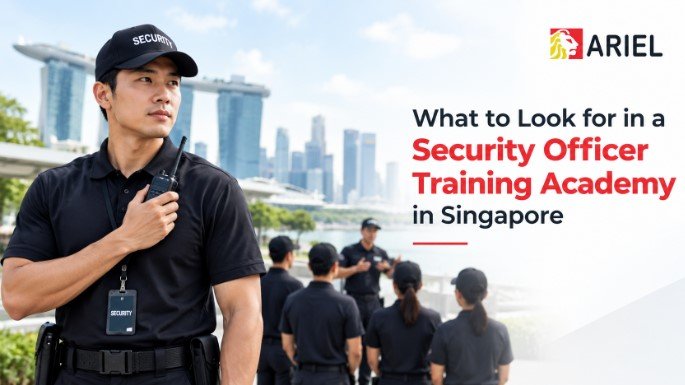
Choosing the right security officer training academy in Singapore is an important step for anyone planning to enter the security industry or build the skills needed for security-related roles. A training provider should offer more than a course title that sounds relevant. You should look at the training pathway, required certifications, practical learning, instructor support, course structure, and how well the training matches the requirements of the role you want to perform.
In Singapore, security officers are subject to licensing and training requirements. The Singapore Police Force (SPF) states that licensed security officers must meet the applicable training requirements under the Security Progressive Wage Model (PWM), including relevant Workforce Skills Qualifications (WSQ) certifications or other prescribed training before performing corresponding job functions.
That makes choosing an appropriate academy an important decision—not simply a matter of finding the nearest or cheapest course.
Key Takeaway: Look for a training academy that provides a clear, relevant training pathway, explains the certifications and requirements associated with the role, develops practical security officer skills, and helps you understand what comes next after training.
For learners considering their options in Singapore, Ariel Security Academy can be one of the training providers to research when comparing suitable learning options.
What Should You Look for in a Security Officer Training Academy?
The right academy should make it easy for you to understand what you are learning, why the training matters, and how it relates to your intended security role.
Before registering, consider these key areas:
- Relevant training and certification
- Alignment with current Singapore requirements
- Practical security officer skills training
- Qualified and experienced trainers
- Clear course structure
- Assessment and learner support
- Training that supports your career goals
- Transparent fees and schedules
- Convenient learning arrangements
- Clear information about the next steps
These factors can help you compare academies based on what actually matters for your training rather than relying on advertising claims alone.
1. Check Whether the Training Matches Your Intended Role
One of the first questions to ask is: What job do I want to perform after completing my training?
Security work can involve different responsibilities. A person beginning a career as a security officer may need a different training pathway from someone planning to progress into supervisory responsibilities or perform specialised functions.
Singapore’s licensing framework links security officer grades and job functions with prescribed training requirements. Security officers must have the relevant training certifications before they can perform certain job functions.
This means you should not select a course simply because its name contains words such as “security” or “security officer.”
Instead, ask:
- What job function does this training prepare me for?
- Is the training relevant to my intended grade or role?
- What certification or Statement of Attainment will I receive?
- Are additional modules required?
- Will I need further training for specific duties later?
- Does the academy explain the progression pathway?
A good training provider should be able to give you clear answers.
Why this matters
Imagine two courses have similar names. One may provide training relevant to entry-level duties, while another may be intended for people who already have experience.
Without checking the actual training pathway, you could enrol in a course that does not match your immediate career objective.
2. Understand Singapore’s Security Training Requirements
Anyone researching security industry training Singapore should understand that training is connected to the regulatory framework.
The Singapore Police Force states that a Security Officer licence is required for specified functions such as guarding or patrolling property, surveillance, acting as a bodyguard or bouncer, screening individuals entering premises, and certain traffic-regulation functions.
The licensing conditions also state that, unless exempted, a licensed security officer must attain the relevant mandatory WSQ certification and/or other required training before being deployed for corresponding job functions.
Therefore, when comparing academies, look beyond statements such as “professional training” or “career-focused course.”
Ask for specific information about:
- The relevant training modules
- Certification requirements
- Applicable job functions
- Assessment arrangements
- Licensing-related requirements
- Any additional training needed for specialised duties
Requirements can change, so it is also sensible to verify current licensing information through official Singapore authorities before enrolling.
3. Look for Practical Security Officer Skills Training
Security work is not only about remembering information for an examination.
A good security officer skills training programme should help learners understand how knowledge applies in realistic workplace situations.
Depending on the training pathway, useful areas may include understanding procedures, identifying potential risks, communicating clearly, responding appropriately to incidents, and following established protocols.
Practical learning can help answer questions such as:
- What should I do when I notice something unusual?
- How should an incident be reported?
- How can I communicate effectively with members of the public?
- What information should be recorded?
- How should procedures be followed during an emergency?
- What responsibilities apply to my particular role?
The purpose of practical training is not to turn every situation into a scripted exercise. It is to help learners understand the principles behind their responsibilities so they can apply them appropriately.
Ask about practical learning before enrolling
You can ask the academy:
“How much of the training focuses on practical application?”
Also ask whether learners receive opportunities to work through scenarios, demonstrations, exercises, or other forms of applied learning where relevant.
This can tell you more about the learning experience than a long list of course features.
4. Evaluate the Trainers, Not Just the Course Name
The quality of instruction can influence how effectively you understand a course.
When comparing providers for professional security training, look for clear information about the trainers and their role in the learning process.
Useful questions include:
- Who conducts the training?
- What relevant experience do the trainers have?
- How do trainers explain difficult concepts?
- Can learners ask questions during the course?
- Is feedback provided during assessments?
- How does the trainer connect classroom learning with workplace situations?
A trainer does not need to turn every lesson into an elaborate presentation. What matters is whether the trainer can explain the subject clearly, answer relevant questions, and help learners understand how the knowledge applies to their responsibilities.
5. Review the Course Structure Before Paying
A well-organised course should make its learning pathway reasonably easy to understand.
Before enrolling, check:
Course duration
Find out how long the training takes and whether the schedule suits your availability.
Delivery format
Understand whether the course is delivered in person, online, or through a combination of formats. For practical subjects, also find out how applied learning is handled.
Assessment
Ask how learners are assessed and whether there are specific assessment requirements.
Attendance
Check whether attendance requirements apply and what happens if you cannot attend a scheduled session.
Certification
Find out what certification or training record you receive after successfully completing the relevant requirements.
Taking a few minutes to check these details can prevent misunderstandings later.
6. Do Not Choose an Academy Based Only on Course Fees
Price is an important consideration, but it should not be the only one.
A lower course fee does not automatically mean better value, just as a higher fee does not automatically mean better training.
Instead, compare what you receive for the stated fee.
For example:
| Factor | Questions to Ask |
| Course content | What exactly is covered? |
| Training pathway | Does it match my intended role? |
| Certification | What qualification or certification is provided? |
| Assessment | How will I be assessed? |
| Trainer support | Can I ask questions and receive guidance? |
| Schedule | Does the timing fit my availability? |
| Practical learning | How is knowledge applied? |
| Additional costs | Are there separate fees I should know about? |
| Career relevance | Does the training support my intended career path? |
This approach gives you a more useful comparison than looking at price alone.
7. Check Whether the Academy Explains the Next Step
A common mistake is to think that completing a training course automatically answers every question about starting work.
Training and licensing are related, but they are not necessarily the same thing.
For example, the SPF has a separate process for applying for a Security Officer licence. Its current guidance states that applicants must meet specified eligibility criteria and submit the required documents.
The SPF also states that licensed Security Officers must carry a Security Officer Identification Card while on duty, and that applicants for the ID card need a valid Security Officer licence and the prescribed training status.
Therefore, ask your academy:
- What happens after I complete training?
- What documentation will I receive?
- What should I do regarding licensing?
- Are there additional requirements I should be aware of?
- Where can I verify the latest official requirements?
A responsible training provider should help you understand the boundaries of what the course does and does not cover.
8. Consider Your Long-Term Security Officer Career Training Goals
If you are considering security officer career training, do not only think about your first course.
Think about where you want your career to go.
You may initially want an entry-level security role. Later, you might consider supervisory responsibilities or specialised functions.
Singapore’s Security Progressive Wage Model includes different grades and corresponding job functions and training requirements.
This makes progression an important part of your long-term planning.
Ask yourself:
Short-term goal:
What training do I need to begin my intended role?
Medium-term goal:
What additional skills could help me take on more responsibility?
Long-term goal:
Do I want to progress toward supervisory or other specialised responsibilities?
You do not need to complete every possible course immediately. A better approach is to understand the pathway and take relevant training as your career develops.
9. Look for an Academy That Makes Requirements Easy to Understand
Training information can sometimes become confusing because learners encounter course names, abbreviations, certifications, licensing terminology and job grades at the same time.
A useful academy should communicate these details clearly.
For example, instead of simply stating that a programme provides “complete security training,” the course information should help learners understand:
- Who the course is intended for
- What they will learn
- What assessment is involved
- What certification is associated with the course
- Whether prerequisites apply
- What the learner should do after completion
This clarity is especially useful for people who are entering the industry for the first time.
For learners comparing providers, Ariel Security Academy is another option they can review alongside other Singapore training providers, using factors such as course relevance, structure, requirements and learner support.
10. Consider Communication and Learner Support
Training does not begin when you walk into a classroom. It starts when you contact the academy.
Pay attention to how the provider handles basic questions.
For example:
- Are course requirements explained clearly?
- Is the schedule easy to understand?
- Are registration steps straightforward?
- Can you ask questions before enrolling?
- Are important conditions communicated upfront?
- Do you receive clear instructions about assessments?
Good communication can make the entire training process easier to navigate.
If you cannot get a clear answer to a basic question before enrolling, it is reasonable to ask additional questions before making a commitment.
Basic Security Officer Training: What Beginners Should Check
If you are looking for basic security officer training, you may be starting with little or no experience in the industry.
In that situation, focus on clarity rather than trying to choose the most advanced programme available.
Look for training that helps you understand:
Your responsibilities
You should know what a security officer is expected to do within the scope of the relevant role.
Workplace procedures
Understanding procedures is essential because security work often involves following established processes rather than improvising.
Communication
Security officers may interact with colleagues, visitors, customers, contractors and members of the public. Clear and professional communication is therefore an important part of workplace readiness.
Incident response
Training should help you understand how to respond appropriately to incidents within your responsibilities and when to escalate matters.
Professional conduct
A security role involves responsibility, observation, communication and adherence to procedures. Professional conduct should therefore be treated as part of the learning process rather than an afterthought.
How to Compare Two Security Training Academies
Suppose you have shortlisted two training providers.
Instead of asking, “Which one is better?” create a simple comparison.
| Question | Academy A | Academy B |
| Is the course relevant to my intended role? | ✓ / ? | ✓ / ? |
| Are requirements clearly explained? | ✓ / ? | ✓ / ? |
| Is the certification clearly stated? | ✓ / ? | ✓ / ? |
| Does the schedule suit me? | ✓ / ? | ✓ / ? |
| Is practical learning included where relevant? | ✓ / ? | ✓ / ? |
| Are assessment details clear? | ✓ / ? | ✓ / ? |
| Are fees and additional costs explained? | ✓ / ? | ✓ / ? |
| Is learner support available? | ✓ / ? | ✓ / ? |
| Do I understand the next step after completion? | ✓ / ? | ✓ / ? |
This method helps you make a decision based on your own circumstances rather than marketing language.
Mistakes to Avoid When Choosing a Training Academy
Choosing only because it is cheap
Cost matters, but training relevance, certification, schedule and support also matter.
Assuming every security course leads to the same outcome
Different training may relate to different job functions or career stages.
Ignoring official requirements
Always check current requirements from the relevant Singapore authorities. Training requirements and licensing procedures can change.
Focusing only on the certificate
A certificate is useful, but your ability to understand and apply what you learned also matters.
Not checking assessment requirements
Find out how you will be assessed before enrolling.
Waiting until the end to ask about licensing
Understand the relationship between training and licensing from the beginning.
Selecting an academy without considering your schedule
A course that conflicts with your work or personal commitments may become difficult to complete.
Taking advanced training without a clear reason
More training is not necessarily more useful if it does not match your current career objective.
Questions to Ask Before Enrolling
Before choosing a security officer training academy, keep this checklist handy:
- What course is appropriate for someone at my current experience level?
- What job functions does the training relate to?
- What certification or training record will I receive?
- Are there prerequisites?
- How is the course assessed?
- How long does the training take?
- What are the available schedules?
- Are there practical components?
- Are there additional costs?
- What should I do after completing the training?
- Where can I verify the current licensing requirements?
- Are additional modules required for the role I want?
You do not need to ask every question if the academy already provides the information clearly. The purpose is to make sure there are no important gaps before you register.
What Makes a Training Academy a Practical Choice?
There is no single factor that determines whether a training academy is suitable for every learner.
Someone starting a new career may prioritise clear beginner guidance and convenient schedules. Another learner may already have industry experience and be more interested in progressing toward a higher grade or specialised responsibility.
The most useful approach is therefore to match the academy to your training needs.
Consider:
- Your current experiencenew
- Your intended job function
- Your required training
- Your preferred schedule
- Your learning preferences
- Your career goals
- Your budget
- The official licensing requirements that apply to you
For example, the SPF notes that people with certain prior supervisory security experience or uniformed-services backgrounds may be eligible for exemptions or emplacement to a higher Security PWM grade, subject to the applicable framework and case-by-case assessment.
That is another reason not to assume that every learner needs exactly the same training pathway.
FAQs About Choosing a Security Officer Training Academy in Singapore
1. How do I choose a security officer training academy in Singapore?
Start by identifying the security role you want to perform. Then compare academies based on relevant training, certification requirements, practical learning, assessment, trainer support, schedule, fees and the next steps after completion.
2. Is security officer training required in Singapore?
Security officers are subject to prescribed licensing and training requirements. The SPF states that relevant mandatory WSQ certifications and/or other required training must generally be completed before licensed officers are deployed for corresponding job functions, unless an exemption applies.
3. What should beginners look for in basic security officer training?
Beginners should look for clear course information, relevant training modules, understandable instruction, appropriate assessment, practical application and guidance on what happens after training.
4. Does completing a training course automatically give me a Security Officer licence?
Training and licensing are separate parts of the process. The SPF has a specific application process and eligibility criteria for a Security Officer licence. Applicants should verify the latest requirements directly with the relevant authority.
5. Why are practical skills important for security officers?
Security officers may need to apply procedures, communicate with people, observe situations and respond appropriately to incidents. Practical learning helps connect classroom knowledge with workplace responsibilities.
6. Should I choose an academy based on the lowest course fee?
Not necessarily. Compare the complete training offering, including course content, certification, assessment, schedule, learner support and any additional costs. A lower fee does not by itself establish that a course is more suitable.
7. Can experienced security personnel have different training requirements?
In some circumstances, prior supervisory security experience or experience in uniformed services may be considered for exemptions or emplacement to a higher Security PWM grade. The SPF states that such applications are assessed under the applicable framework on a case-by-case basis.
8. How can I check whether the information given by an academy is current?
Compare the academy’s course information with current information published by relevant Singapore authorities, particularly the Singapore Police Force. This is useful because licensing, training and administrative requirements can be updated over time.
9. What should I do after completing my training?
Keep your training documentation and check the applicable licensing and employment requirements for your intended role. If you need a Security Officer licence, follow the current official application process and make sure the required documents and training records are available.
Conclusion
Choosing the right security officer training academy in Singapore starts with understanding what you actually need from the training. Do not select a provider based only on course price, location or a broad course title.
Instead, check whether the training matches your intended job function, understand the relevant certification and licensing requirements, evaluate practical learning, review assessment arrangements, and consider how the course fits into your longer-term career plans.
Most importantly, verify current regulatory requirements rather than relying solely on information from course advertisements. The Singapore Police Force provides official information on Security Officer licensing, training requirements and related processes.
If you are comparing training options in Singapore, you can also explore Ariel Security Academy and review its available training information alongside other providers. The goal is to choose a learning pathway that fits your current needs and helps you prepare for the responsibilities of your intended security role.