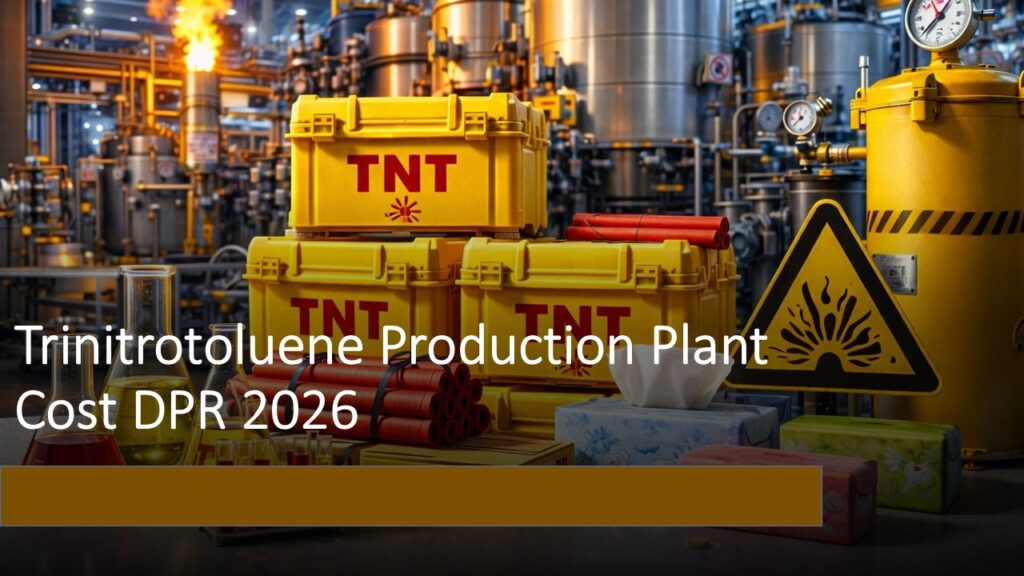
IMARC Group’s “Trinitrotoluene Production Cost Analysis Report 2026: Industry Trends, Plant Setup, Machinery, Raw Materials, Investment Opportunities, Cost and Revenue” report provides a comprehensive guide on how to set up a trinitrotoluene production plant. The report offers clarifications on various aspects, such as unit operations, raw material requirements, utility supply, infrastructural needs, machinery models, labour necessities, transportation timelines, packaging costs, etc.
In addition to the operational aspects, the report also provides in-depth insights into trinitrotoluene production process, project economics, encompassing vital aspects such as capital investments, project funding, operating expenses, income and expenditure projections, fixed and variable costs, direct and indirect expenses, expected ROI, net present value (NPV), profit and loss account, and thorough financial analysis, among other crucial metrics. With this comprehensive roadmap, entrepreneurs and stakeholders can make informed decisions and venture into a successful trinitrotoluene production unit.
What is Trinitrotoluene?
Trinitrotoluene (TNT) is a widely used high explosive chemical compound derived from toluene through a multi-step nitration process. It is valued for its stability, ease of handling, and powerful explosive properties, making it a key material in military and industrial applications. TNT is commonly used as a bursting charge in munitions, demolition activities, mining operations, and seismic exploration. Additionally, it serves as an intermediate in chemical synthesis and dye manufacturing. Its ability to remain stable under normal conditions while delivering controlled explosive energy makes it one of the most important compounds in defense and heavy industries worldwide.
Is Trinitrotoluene Production Profitable?
Trinitrotoluene production offers strong profitability due to its consistent demand across defense, mining, and construction sectors. A typical plant can achieve gross profit margins of around 30-50% and net profit margins of 15-25%, supported by large-scale industrial applications. Raw material costs account for nearly 50-60% of operating expenses, while utilities contribute 20-25%. With stable demand and high entry barriers due to safety and regulatory requirements, TNT manufacturing presents a lucrative long-term investment opportunity.
Request a Sample Report: https://www.imarcgroup.com/trinitrotoluene-manufacturing-plant-project-report/requestsample
How to Setup a Trinitrotoluene Production Plant?
Setting up a trinitrotoluene production plant involves selecting an appropriate location, securing regulatory approvals, and installing specialized equipment such as nitration reactors, crystallization units, and filtration systems. The process includes nitration, washing, neutralization, and drying stages to ensure product purity and safety. Proper plant layout, quality control systems, and safety measures are critical due to the hazardous nature of the product. Additionally, reliable sourcing of raw materials like toluene and nitric acid is essential for efficient operations.
Market Trend and Drivers of Trinitrotoluene:
The trinitrotoluene market is driven by its extensive use in defense, mining, and construction industries. The global market reached approximately 117 kg tons in 2025 and is projected to grow to 188.63 kg tons by 2034, exhibiting a CAGR of around 5.45%. Growth is primarily supported by rising military expenditures, increasing mining activities, and expanding infrastructure and demolition projects worldwide. Additionally, TNT’s role in industrial explosives and seismic exploration continues to drive demand. The presence of high entry barriers, including strict safety regulations and capital requirements, further stabilizes the market by limiting new entrants. Continuous investments in production facilities and technological advancements are also contributing to steady market expansion.
Key Aspects to Setup a Trinitrotoluene Plant:
- Location to Setup Plant
- Market Research
- Plant Layout
- Construction and Infrastructure
- Equipment/Machinery Procurement
- Documentation and Licenses
- Cost Analysis
Requirements to Setup a Facility:
- Funds
- Machinery
- Lands
Types of Costs to Setup a Factory:
- Land, Location and Site Development Cost
- Plant Layout Cost
- Machinery Requirements and Costs
- Raw Material Requirements and Costs
- Packaging Requirements and Costs
- Transportation Requirements and Costs
- Utility Requirements and Costs
- Human Resource Requirements and Costs
Project Economics:
- Capital Investments
- Operating Costs
- Expenditure Projections
- Revenue Projections
- Taxation and Depreciation
- Profit Projections
- Financial Analysis
Capital Expenditure (CapEx)
Capital expenditure in a trinitrotoluene production plant includes costs related to land acquisition, site development, civil construction, and installation of specialized machinery such as nitration reactors, separation units, and drying systems. Machinery and equipment form the largest portion of total investment, along with infrastructure for safety and compliance. The overall CapEx varies based on plant capacity (e.g., ~20,000 MT/year), technology used, and location-specific factors.
Operating Expenditure (OpEx)
Operating expenditure primarily consists of raw material costs, utilities, labor, maintenance, and logistics. Raw materials such as toluene and nitrating acids account for approximately 50–60% of total OpEx, while utilities contribute 20–25%. Additional costs include packaging, transportation, wages, and regulatory compliance. Efficient supply chain management and process optimization are essential to control operational costs and maintain profitability over time.
Key Questions Answered in the Report:
- How has the trinitrotoluene market performed so far and how will it perform in the coming years?
- What is the market segmentation of the global trinitrotoluene market?
- What is the regional breakup of the global trinitrotoluene market?
- What are the price trends of various feedstocks in the trinitrotoluene industry?
- What is the structure of the trinitrotoluene industry and who are the key players?
- What are the various unit operations involved in a trinitrotoluene production plant?
- What is the total size of land required for setting up a trinitrotoluene production plant?
- What is the layout of a trinitrotoluene production plant?
- What are the machinery requirements for setting up a trinitrotoluene production plant?
- What are the raw material requirements for setting up a trinitrotoluene production plant?
- And more…
Ask Analyst for Customized Report: https://www.imarcgroup.com/request?type=report&id=10061&flag=C
How IMARC Can Help?
IMARC Group is a global management consulting firm that helps the world’s most ambitious changemakers to create a lasting impact. The company provide a comprehensive suite of market entry and expansion services. IMARC offerings include thorough market assessment, feasibility studies, company incorporation assistance, factory setup support, regulatory approvals and licensing navigation, branding, marketing and sales strategies, competitive landscape and benchmarking analyses, pricing and cost research, and procurement research.
Services:
- Plant Setup
- Factoring Auditing
- Regulatory Approvals, and Licensing
- Company Incorporation
- Incubation Services
- Recruitment Services
- Marketing and Sales
Contact Us:
IMARC Group
134 N 4th St. Brooklyn, NY 11249, USA
Email: sales@imarcgroup.com
Tel No:(D) +91 120 433 0800
United States: (+1-201971-6302)