Market Overview
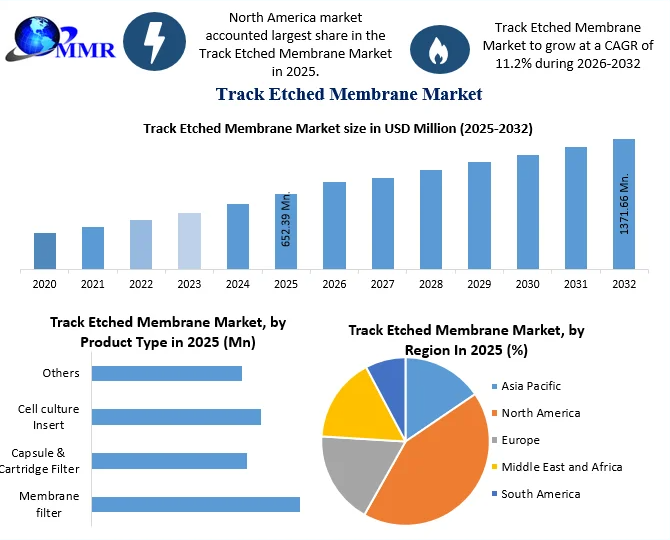
The Global Track Etched Membrane Market was valued at USD 652.39 million in 2025 and is projected to reach nearly USD 1,371.66 million by 2032, growing at a compound annual growth rate (CAGR) of 11.2% during the forecast period from 2026 to 2032. The market is witnessing strong growth as pharmaceutical manufacturing, biotechnology research, clinical diagnostics, environmental monitoring, and water purification increasingly require high-precision filtration technologies.
Download Sample Pages of Research Overview: https://www.maximizemarketresearch.com/request-sample/16637/
Track-etched membranes (TEMs) are specialized filtration materials manufactured by exposing polymer films to energetic ions and subsequently applying chemical etching to create uniform, cylindrical pores. Unlike conventional membranes that contain irregular pore pathways, track-etched membranes offer controlled pore dimensions, consistent particle retention, and reliable separation performance. These characteristics make them suitable for applications in which filtration accuracy, reproducibility, and contamination control are essential.
The growing development of biologics, vaccines, advanced diagnostic systems, and cell-based therapies is strengthening demand for high-quality membrane filtration products. Pharmaceutical and biopharmaceutical companies use precision filtration technologies to support sample preparation, analytical testing, and selected process-control applications. Similarly, academic institutions and research laboratories rely on track-etched membranes for cell migration studies, microscopy, particle analysis, and microfluidic applications.
Environmental monitoring represents another important area of market development. Track-etched membranes can support the collection and analysis of microorganisms and particulate matter in water, air, and industrial samples. Their controlled pore structures help researchers obtain consistent results when evaluating contamination levels and studying environmental quality.
The market is also benefiting from advances in membrane materials, surface modification, and specialized product formats. Manufacturers are focusing on improving chemical compatibility, mechanical stability, pore uniformity, and product traceability to meet the requirements of regulated industries. However, specialized production equipment, manufacturing complexity, and relatively high production costs remain important barriers to broader adoption.
North America dominated the market in 2025, supported by its established pharmaceutical and biotechnology industries, strong research infrastructure, and demand for advanced analytical and filtration products. Europe remains an important market because of its established life sciences and laboratory equipment industries, while Asia Pacific presents growth opportunities through expanding pharmaceutical manufacturing, biotechnology investment, and environmental testing requirements.
Market Drivers and Trends
Increasing Demand for High-Precision Filtration
The growing requirement for precise and reproducible filtration is a major driver of the Track Etched Membrane Market. Pharmaceutical laboratories, biotechnology companies, food and beverage manufacturers, and environmental testing organizations require filtration products that can separate particles according to defined size ranges while maintaining consistent performance.
Download Sample Pages of Research Overview: https://www.maximizemarketresearch.com/request-sample/16637/
Track-etched membranes offer uniform pore structures that support controlled particle retention and reliable analytical results. These characteristics are particularly useful in microscopy, cell analysis, microbial testing, and specialized sample preparation. Their predictable filtration properties can also help laboratories improve the repeatability of testing procedures and reduce variability between experiments.
As regulatory and quality-assurance requirements become increasingly important across pharmaceutical production and laboratory testing, demand for dependable filtration products is expected to increase. The expansion of research facilities and quality-control laboratories across emerging economies further supports the market’s long-term growth prospects.
Expansion of Biomedical Research and Diagnostic Applications
The increasing importance of biomedical research is creating additional opportunities for track-etched membrane manufacturers. Applications include cell culture inserts, cell migration studies, tissue engineering research, microfluidic devices, and specialized diagnostic workflows. The membranes’ controlled pore dimensions allow researchers to select products suited to particular experimental requirements.
The development of personalized medicine, advanced drug discovery, and cell-based research is encouraging laboratories to adopt specialized consumables that improve experimental consistency. Track-etched membranes can also support sample preparation and particle separation in selected diagnostic applications.
Growing investment in biotechnology and pharmaceutical research is expected to increase demand for membrane products that combine precise filtration characteristics with compatibility across established laboratory procedures.
Growth in Biopharmaceutical Manufacturing and Single-Use Systems
The expansion of biologics and vaccine manufacturing is supporting demand for filtration products used in bioprocessing and quality-control environments. Pharmaceutical companies are increasingly adopting modular manufacturing systems and single-use technologies to improve operational flexibility and reduce cleaning requirements.
Track-etched membranes may be incorporated into selected filtration assemblies, analytical systems, and specialized process applications where controlled pore geometry is valuable. The increasing need for documented product specifications, reproducible performance, and dependable supply chains is encouraging manufacturers to strengthen product quality systems and expand their product portfolios.
However, track-etched membranes are not interchangeable with every sterilizing-grade or virus-retentive filtration technology. Their suitability depends on the application, validated performance requirements, material compatibility, and applicable regulatory standards.
Technological Advancements and Product Customization
Technological innovation is influencing competition across the Track Etched Membrane Market. Manufacturers are working to improve pore-size consistency, surface characteristics, chemical resistance, and membrane durability. Advances in irradiation control and etching processes can support the production of membranes with more precisely defined structures.
Customization is another emerging trend. Buyers may require particular membrane diameters, pore sizes, thicknesses, surface treatments, or integrated product formats. Suppliers capable of providing specialized membrane discs, sheets, cell culture inserts, and application-specific assemblies can address a wider range of customer requirements.
These developments are creating opportunities for manufacturers to differentiate their products through technical performance, documentation, and application support rather than competing solely on price.
Increasing Focus on Environmental Monitoring
Growing attention to water quality, industrial wastewater, air pollution, and microbial contamination is expanding the use of specialized membrane filtration products in environmental testing. Track-etched membranes can assist laboratories in collecting and analyzing particles and microorganisms in appropriately designed testing procedures.
Government monitoring programs, industrial compliance requirements, and investment in water treatment infrastructure are supporting demand for reliable analytical consumables. Further opportunities may emerge as testing networks expand in developing economies and environmental laboratories adopt more standardized analytical procedures.
Sustainability is also becoming a consideration for manufacturers. Efforts to reduce material waste, improve production efficiency, and evaluate recyclable or alternative membrane substrates could influence future product development. Nevertheless, any new material must meet the necessary filtration, durability, and application-specific performance requirements.
Primary Market Constraints
High Manufacturing Costs and Specialized Production Requirements
High production costs remain a significant constraint for the Track Etched Membrane Market. Manufacturing involves controlled ion irradiation, chemical etching, polymer-film processing, and quality testing. These steps require specialized equipment, technical expertise, and carefully controlled operating conditions.
Maintaining consistent pore dimensions and membrane quality across production batches can increase manufacturing complexity. In addition, investments in equipment maintenance, process validation, and quality assurance can raise operating expenses. These costs may make track-etched membranes less attractive for applications where conventional membrane filters provide adequate performance at a lower price.
Smaller manufacturers may also face challenges in expanding production capacity while maintaining consistent product specifications. Consequently, suppliers must balance manufacturing efficiency with the precision and reproducibility expected by research laboratories and industrial customers.
Competition from Alternative Filtration Technologies
Track-etched membranes compete with polymeric membranes, microporous filters, depth filters, and other specialized separation technologies. Conventional membrane products are available in a broad range of materials and formats and may offer cost advantages for applications that do not require highly uniform cylindrical pores.
Buyers evaluate filtration products according to pore size, flow rate, chemical compatibility, mechanical strength, sample characteristics, and total operating cost. If an alternative technology meets these requirements at a lower price, customers may have limited incentives to switch to track-etched membranes.
Manufacturers therefore need to demonstrate the practical benefits of uniform pore geometry and application-specific performance. Technical support, product customization, and reliable quality documentation can help suppliers distinguish their products from competing filtration solutions.
Limited Production Scalability and Supply Chain Challenges
The specialized manufacturing processes used to produce track-etched membranes can create challenges when demand increases rapidly. Production capacity depends on access to suitable irradiation facilities, polymer substrates, chemical processing systems, and quality-control infrastructure.
Supply chain disruptions involving raw materials, specialized equipment, or international logistics may affect production schedules and delivery times. Customers in regulated industries may also require extensive documentation and qualification procedures before accepting alternative products or suppliers.
These challenges can increase procurement complexity, particularly for manufacturers and laboratories that depend on consistent specifications over extended periods. Investment in process optimization, supplier diversification, and inventory management will remain important for improving market resilience.
Key Market Segments
The Track Etched Membrane Market is segmented by material type, product type, pore size, application, end user, and region. Each segment addresses different filtration requirements, ranging from basic analytical testing to specialized biomedical research and industrial applications.
By Material Type
The market is divided into polycarbonate, polyethylene terephthalate (PET), and polyimide.
Polycarbonate is expected to dominate the market during the forecast period because of its uniform pore structure, optical clarity, mechanical strength, and suitability for several life sciences applications. Polycarbonate track-etched membranes are widely used in cell biology, microscopy, particle analysis, and specialized laboratory filtration. Their optical properties can be beneficial in workflows that require direct observation of samples.
Polyethylene terephthalate (PET) membranes offer durability and useful mechanical properties for selected filtration and analytical applications. PET-based membranes may be used in environmental monitoring, laboratory testing, and applications requiring stable polymer substrates.
Polyimide membranes serve more specialized applications where thermal stability, chemical resistance, or other high-performance material characteristics are required. Their use depends on the specific operating environment and product design.
By Product Type
The product categories include membrane filters, capsule and cartridge filters, cell culture inserts, and others.
Membrane filters represent a major product category because they are available in different diameters, pore sizes, and configurations. These products can be incorporated into laboratory filtration procedures, particle analysis, sample preparation, and environmental testing. Their versatility and compatibility with established laboratory equipment support broad adoption.
Capsule and cartridge filters serve specialized applications that require integrated filtration assemblies. Their potential use in industrial processes and selected bioprocessing workflows depends on the filtration specification and validation requirements.
Cell culture inserts are used in biomedical research, including cell migration, permeability studies, and the investigation of interactions between different cell populations. Increasing interest in advanced cell models and tissue-related research provides opportunities for this segment.
The others category includes specialized formats and application-specific membrane products designed for particular testing or research requirements.
By Pore Size
The market includes pore sizes of less than 0.1 µm, 0.1–0.5 µm, 0.5–1.0 µm, 1.0–5.0 µm, and other sizes.
Membranes with pore sizes below 0.1 µm are relevant to specialized particle separation and analytical applications requiring very fine filtration. Their suitability depends on the target particles, membrane material, and required flow characteristics.
The 0.1–0.5 µm segment serves a range of laboratory and analytical workflows where controlled particle retention is important. Products in the 0.5–1.0 µm range can support selected cell biology, environmental analysis, and particle separation applications.
Membranes with pore sizes between 1.0 and 5.0 µm are useful for applications involving larger particles and particular research or testing procedures. The appropriate pore size is determined by the intended application rather than pore dimensions alone.
By Application
The application segments include cell biology, microbiology, analytical testing, and others.
Cell biology is an important application area because researchers use track-etched membranes in cell migration, cell culture, permeability studies, and related laboratory experiments.
Microbiology applications include selected microbial collection, separation, and analytical testing procedures. Uniform pore geometry can support consistent sample processing when the membrane is suitable for the microorganisms and test method involved.
Analytical testing includes particle analysis, sample preparation, environmental monitoring, and specialized laboratory procedures. Demand in this segment is influenced by the need for repeatable measurements and dependable filtration performance.
The others category includes applications in microfluidics, specialized industrial testing, and selected diagnostic or research workflows.
By End User
The market serves pharmaceutical and biopharmaceutical companies, academic and research institutes, food and beverage companies, hospitals and diagnostic centers, and other end users.
Pharmaceutical and biopharmaceutical companies use specialized membrane products in laboratory testing, process development, and selected filtration applications. Academic and research institutes represent an important customer group because of their involvement in cell biology, materials research, and experimental diagnostics.
Food and beverage companies may use suitable membrane products in laboratory analysis and quality-control procedures. Hospitals and diagnostic centers can require specialized filtration materials for selected analytical and diagnostic workflows, depending on the product’s intended use and validation.
Download Sample Pages of Research Overview: https://www.maximizemarketresearch.com/request-sample/16637/
Regional Market Performance
North America
North America dominated the Track Etched Membrane Market in 2025. The region benefits from established pharmaceutical and biotechnology industries, substantial research capabilities, and demand for advanced laboratory consumables. The presence of major life sciences suppliers and established distribution networks supports product availability across research and industrial markets.
The United States is a significant contributor because of its pharmaceutical research ecosystem, biotechnology investment, and extensive network of academic and clinical research institutions. Quality-control requirements and environmental testing activities also support demand for specialized filtration technologies.
Europe
Europe represents an important market supported by its established laboratory equipment, pharmaceutical, biotechnology, and industrial testing sectors. Countries such as Germany, the United Kingdom, and France contribute through research infrastructure, advanced manufacturing capabilities, and demand for high-quality laboratory products.
European manufacturers can compete through product engineering, specialized membrane formats, documentation, and application support. Continued investment in biotechnology research and environmental monitoring may create additional opportunities for suppliers.
Asia Pacific
Asia Pacific is positioned for further growth as pharmaceutical manufacturing, biotechnology research, and laboratory testing expand across China, India, Japan, and South Korea. Investments in healthcare infrastructure and research facilities are creating demand for specialized filtration consumables.
China and India offer opportunities associated with pharmaceutical production, domestic laboratory capacity, and expanding quality-control requirements. Japan and South Korea contribute through advanced manufacturing, scientific research, and technology development. Market growth will depend on product availability, affordability, technical expertise, and the adoption of precision filtration technologies.
Middle East and Africa
The Middle East and Africa market is supported by investments in healthcare infrastructure, pharmaceutical supply chains, water quality monitoring, and industrial testing. Gulf Cooperation Council countries are developing healthcare and research capabilities, while water treatment and environmental monitoring remain relevant areas of demand.
However, adoption may be constrained by limited local manufacturing capacity, procurement budgets, and dependence on imported specialized products.
South America
South America presents opportunities through pharmaceutical production, food quality testing, water analysis, and academic research. Brazil and Argentina are important markets within the region. Wider adoption will depend on laboratory investment, access to specialized filtration products, and the development of research and industrial testing infrastructure.
Major Industry Players and Competitive Landscape
The Track Etched Membrane Market is characterized by competition among established membrane manufacturers, life sciences companies, laboratory consumables suppliers, and specialized filtration businesses. Competition is shaped by pore-size consistency, material quality, product range, technical documentation, customization capabilities, and distribution strength.
Leading companies focus on supplying products suited to specific laboratory and industrial requirements. Suppliers that offer a broad selection of membrane materials, pore sizes, diameters, and integrated formats can address diverse customer needs. Product traceability and consistent manufacturing quality are particularly important for customers operating in regulated or highly controlled environments.
Major companies operating in the market include:
North America
- Cytiva
- Danaher Corporation
- Thermo Fisher Scientific
- Sterlitech Corporation
- Zefon International
- Corning Incorporated
- Graver Technologies
- Avanti Polar Lipids
- SKC Inc.
- Avestin
Europe
- Merck KGaA
- Sartorius AG
- BRAND GmbH
- SABEU GmbH & Co. KG
- MACHEREY-NAGEL GmbH & Co. KG
- Oxyphen AG
- GVS S.p.A.
- Greiner Bio-One
- CHMLAB
- Sarstedt
Asia Pacific
- ADVANTEC
- SKC Co., Ltd.
- QingFeng Filter
- Zhejiang Newstar
- Cytiva
- Merck
- Sartorius
- GVS
- Corning Incorporated
Note: This list identifies companies associated with the wider membrane filtration and laboratory consumables ecosystem. Their individual track-etched membrane product offerings and market positions may vary.
Competitive Strategies and Market Opportunities
Manufacturers can strengthen their market positions by expanding product portfolios, improving production consistency, and offering customized membrane formats. Partnerships with research laboratories, pharmaceutical companies, and laboratory equipment distributors can improve access to end users.
Technical support is another important competitive factor. Buyers often need assistance selecting pore sizes, materials, and formats that match their testing procedures. Suppliers that help customers maintain reproducibility and reduce qualification difficulties may benefit from long-term purchasing relationships.
Opportunities also exist in emerging markets where pharmaceutical production, environmental testing, and biotechnology research are expanding. Manufacturers that combine reliable product quality with efficient distribution and competitive pricing may be better positioned to serve these customers.
Frequently Asked Questions (FAQs)
1. What was the global Track Etched Membrane Market size in 2025?
The global Track Etched Membrane Market was valued at USD 652.39 million in 2025.
2. What is the expected market size by 2032?
The market is projected to reach nearly USD 1,371.66 million by 2032.
3. What is the expected CAGR of the Track Etched Membrane Market?
The market is expected to grow at a CAGR of 11.2% during the forecast period from 2026 to 2032.
4. What are track-etched membranes?
Track-etched membranes are specialized filtration materials manufactured by irradiating polymer films with energetic ions and chemically etching the resulting tracks to create controlled, cylindrical pores.
5. What are the major factors driving market growth?
Key growth drivers include increasing demand for high-precision filtration, expansion of pharmaceutical and biotechnology research, growth in diagnostic applications, advances in membrane manufacturing, and increasing requirements for environmental monitoring.
Conclusion
The Global Track Etched Membrane Market is expected to experience substantial growth through 2032 as pharmaceutical research, biotechnology, analytical testing, and environmental monitoring increase their requirements for precise and reproducible filtration. The market’s projected expansion from USD 652.39 million in 2025 to USD 1,371.66 million by 2032 reflects the growing importance of specialized membrane technologies across scientific and industrial applications.
Polycarbonate membranes, laboratory membrane filters, and biomedical research applications are important areas of market development. North America maintains a strong position because of its established life sciences ecosystem, while Europe and Asia Pacific offer opportunities through research investment, pharmaceutical manufacturing, and increasing demand for laboratory testing.
Despite challenges associated with production costs, scalability, and alternative filtration technologies, continued innovation in membrane materials, pore engineering, and customized product formats can support market development. Companies that prioritize consistent quality, application-specific solutions, and reliable supply chains are likely to be well positioned to address evolving customer requirements during the forecast period.
Connect With Us:
MAXIMIZE MARKET RESEARCH PVT. LTD.
2nd Floor, Navale IT park Phase 3,
Pune Banglore Highway, Narhe
Pune, Maharashtra 411041, India.
+91 9607365656
sales@maximizemarketresearch.com
About Maximize Market Research:
Maximize Market Research is one of the fastest-growing market research and business consulting firms serving clients globally. Our revenue impact and focused growth-driven research initiatives make us a proud partner of majority of the Fortune 500 companies. We have a diversified portfolio and serve a variety of industries such as IT & telecom, chemical, food & beverage, aerospace & defense, healthcare and others.