Tier 2 City Relocation
For two decades, Indian urban migration had one direction. People left smaller cities for Bangalore, Mumbai, Delhi and Hyderabad. Careers were built by leaving.
That story is now more complicated.
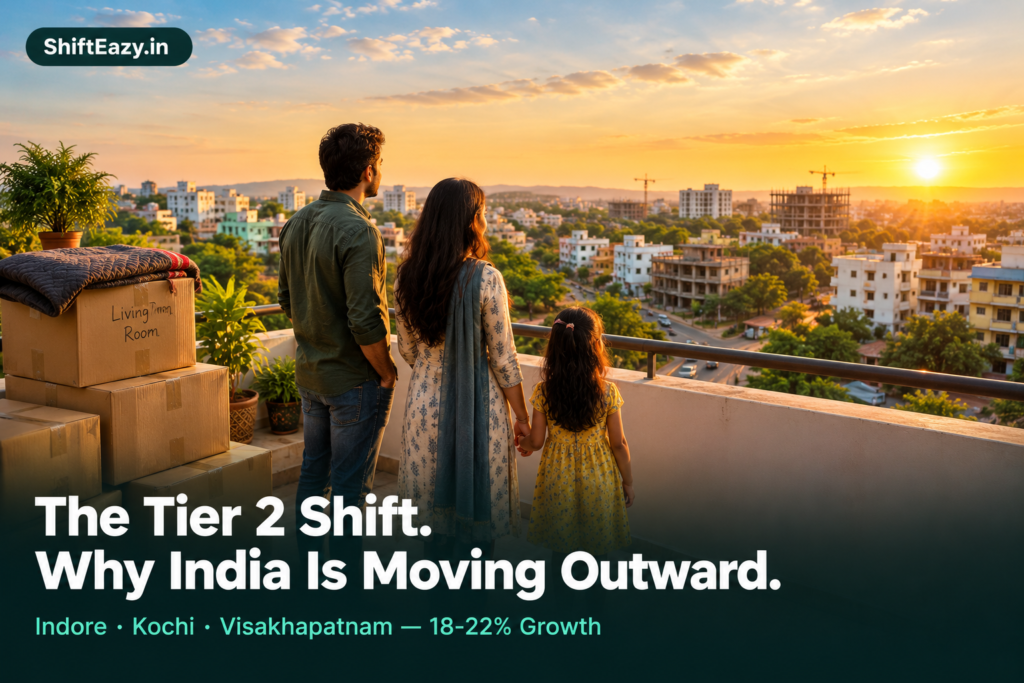
India added roughly 42 million urban residents in 2024–25. But a meaningful share of that growth did not land in the metros. Tier-2 cities including Indore, Kochi and Visakhapatnam recorded population growth of 18 to 22 percent, outpacing several established metropolitan markets.
Tier 2 city relocation is no longer a fringe pattern. It is a measurable share of national moving volume, and the household shifting industry — which sits exactly where these decisions turn into loaded trucks — is seeing it before anyone else.
The Numbers Behind Tier 2 City Relocation
India’s packers and movers industry reached ₹90,016 crore in FY 2025–26, up 14.2 percent from ₹78,850 crore the previous year, according to industry research published by ShiftingApp. The sector handled approximately 8.2 million relocations — 6.1 million household moves and 2.1 million commercial or office shifts.
Eight million moves in a single year is not a niche service industry. It is a measurable index of how a country reorganises itself.
What makes the smaller-city numbers notable is that they are not simply reflecting overall growth. These cities are expanding faster than the national urban average and faster than several metros. That is a directional change in migration, not a rising tide.
Three Forces Driving Tier 2 City Relocation
Hybrid work removed the location requirement
The most obvious driver, and the most frequently overstated. Hybrid work has not emptied the metros. What it has done is decouple a specific category of worker — mid-career professionals in technology, finance, consulting and design — from a mandatory daily commute.
For that group, the arithmetic changed. A 2BHK in Bangalore’s Whitefield or Mumbai’s Andheri costs substantially more than a comparable home in Indore or Visakhapatnam. When the office requirement drops from five days a week to four days a month, the metro premium becomes difficult to justify.
Corporate mobility surveys reflect this. A growing share of tier 2 city relocation is now employee-initiated rather than employer-mandated, reversing the historical pattern where companies moved people and employees complied.
Corporate infrastructure followed, then led
Global Capability Centres expanded sharply, with 487 new centres opening and GCC setups rising 31 percent. India now hosts more than 1,900 GCCs employing over 1.9 million professionals.
The headline expansion sits in Bangalore, Hyderabad and Pune. But the second-order effect is what matters here. As metro talent markets tighten and salary costs climb, companies have begun establishing satellite operations and support functions in cities with lower cost bases and untapped graduate populations.
Visakhapatnam illustrates this well. Its growth is not purely lifestyle migration. It combines a long-standing defence and naval presence, port-linked industry, and a newer wave of IT and services expansion — a mix that produces a very different relocation profile from a purely residential boom.
Metro cost of living reached a breaking point
The least discussed factor, and possibly the most important.
Metro housing costs, particularly rental deposits, have moved beyond what many salaried professionals can absorb. In Mumbai, deposits of three to six months’ rent are standard. On a ₹40,000 monthly rental, that is ₹1.2 lakh to ₹2.4 lakh before a single box is unpacked.
Smaller cities do not carry that structure. Deposits typically run one to three months. Rentals are a fraction of metro equivalents. For a family, the difference over three years can exceed the cost of the move several times over — and the move itself, whether booked through verified packers and movers in Indore or any comparable market, is a one-time cost set against a recurring saving.
What the Move Actually Costs
The economics are visible in real pricing.
Indore. Local household shifting runs ₹3,500 to ₹8,500 for a 1BHK, ₹7,000 to ₹16,000 for a 2BHK, and ₹17,000 to ₹52,000 for long-distance intercity moves. Residential demand concentrates around Vijay Nagar, Scheme 54, Palasia, Nipania and Rajendra Nagar. Comparison platforms report inbound volumes rising on the Delhi, Mumbai and Pune corridors.
Visakhapatnam. Local shifting runs ₹3,000 to ₹8,000, with intercity moves from ₹8,000 to ₹50,000 depending on distance and volume. The city’s relocation profile is unusually mixed — naval and defence transfers alongside IT professionals returning from Bangalore and Hyderabad. Operators there handle both categories, which carry quite different documentation requirements.
Kochi. Kerala’s commercial centre benefits from a distinct dynamic — a large returning diaspora alongside domestic in-migration. Its growth is driven less by corporate expansion and more by returnee settlement, tourism-linked services and sustained infrastructure investment.
What unites all three: moving costs are materially lower than metro equivalents, and the cost of living once settled is lower again.
The Corridors That Are Actually Moving
Aggregate growth figures obscure something useful. This migration is not evenly distributed. It runs along specific corridors, and they are traceable.
Bangalore to Indore and Bhopal. Predominantly IT professionals in their thirties, frequently with young children, moving where family support networks already exist. The clearest example of cost-plus-family migration rather than career migration.
Bangalore and Hyderabad to Visakhapatnam. A two-part flow — returning Andhra professionals who left for metro careers and are now moving back with remote roles intact, plus a smaller stream tied to port and industrial expansion. Verified packers and movers in Visakhapatnam report both categories growing in parallel.
Mumbai and Pune to Indore and Nagpur. Cost-driven almost entirely. Mumbai’s deposit structure is the single most cited push factor, and Central India offers the sharpest contrast.
Gulf to Kochi. Distinct from the domestic pattern. Returning NRI households, often with substantial goods volumes and different requirements — long-term storage, vehicle imports, and timelines governed by visa expiry rather than joining dates.
Delhi NCR to Jaipur and Chandigarh. The shortest and most reversible of these flows. Proximity lets people maintain metro professional ties while living elsewhere, which makes this corridor the most likely to show two-way traffic.
Each corridor has a specific logic — family proximity, returning diaspora, cost arbitrage, or commutable distance. Migration that follows logic tends to persist. Migration driven purely by a temporary condition tends not to.
The Honest Trade-offs of Tier 2 City Relocation
An accurate account has to include what makes this difficult.
Moving service infrastructure is thinner. Metro relocation markets are dense with operators, which produces competition and price transparency. Smaller markets have fewer verified providers. Fewer options means less comparison leverage and a higher proportion of unregistered operators.
This matters practically. The most reliable protection a consumer has is comparing multiple written quotes. In a market with three available movers instead of thirty, that protection weakens considerably.
Return-leg pricing is uneven. Intercity moving economics depend on whether a truck can find a paying load for the return journey. On dense corridors like Delhi–Mumbai, that is straightforward. On Bangalore–Visakhapatnam or Mumbai–Indore, return loads are less certain and the cost passes to the customer. This is why some smaller-city intercity moves price higher than distance alone would suggest.
Career networks are shallower. Many professionals making this move hold roles that depend on remote arrangements. If those arrangements change — and hybrid policy has proven unstable across the industry — local alternative employment may be limited.
Schooling and healthcare vary considerably. These are the factors that most often reverse a move. Families report satisfaction with cost and space, and dissatisfaction with specialist healthcare access and school options, more often than any other pair of variables.
What This Means for the Moving Industry
The industry has historically organised itself around metro-to-metro corridors. Delhi–Mumbai, Bangalore–Hyderabad and Mumbai–Pune are dense, well-served and competitively priced.
Growth outside those corridors stresses that structure in three ways.
Coverage depth. A national platform is only as useful as its thinnest market. Verified operator networks built for metros need genuine depth in cities like Indore, Kochi and Visakhapatnam, not nominal listings.
Price transparency. Digital booking platforms captured 23 percent market share in 2026, up from 11 percent in 2023 — a substantial shift toward comparison-based purchasing. That transparency has arrived unevenly. Metro consumers can compare readily. Smaller-city consumers often cannot, which is precisely where opacity does the most damage.
Documentation standards. Corporate reimbursement requires GST-compliant invoicing. As employee-initiated moves grow, so does demand for operators who can issue compliant paperwork — a capability far more common in metro markets. Platforms listing verified packers and movers across India face the challenge every aggregator faces when a market broadens faster than supply: verification depth is harder to maintain outside dense markets, and it matters more there.
Is Tier 2 City Relocation Structural or Cyclical?
Too early to know with confidence.
Arguments for structural change: hybrid work is now embedded in corporate policy rather than treated as temporary. Metro housing costs show little sign of correcting. Infrastructure investment in secondary cities has multi-year momentum. Corporate expansion into these markets is capital-committed, not experimental.
Arguments for cyclical: a portion of this movement reflects pandemic-era decisions still working through. Return-to-office pressure has increased across sectors. And a share of movers do come back — the reverse flow exists, though it is less documented because it is less interesting to report.
What can be said with reasonable confidence: this migration is now large enough to register in national moving volumes, it has persisted across several consecutive years, and it rests on cost differentials unlikely to narrow soon.
That combination usually indicates a durable trend, even if the current growth rate moderates.
Practical Advice Before You Move
Three points, based on what consistently separates a successful move from a regretted one.
Visit during monsoon, not in a good month. Infrastructure quality across tier 2 city relocation destinations varies most under stress. A city that functions well in February may not in July.
Verify your mover more carefully, not less. Thinner markets carry a higher proportion of unregistered operators. Check GST registration at gst.gov.in, insist on a written itemised quote, and get at least three comparisons even if it takes longer than it would in a metro.
Budget for the possibility of returning. Not pessimism, planning. Roughly a fifth of these relocations reverse within three years, most commonly for schooling or healthcare. Retaining flexibility on property purchase in year one is prudent.
The Larger Picture
India’s moving industry grew 14.2 percent in a single year and handled 8.2 million household and commercial relocations. Those numbers describe a country in motion.
What the smaller-city data adds is direction. For the first time in a generation, a meaningful number of Indians are choosing these cities not because they have to, but because the arithmetic of metro life stopped working for them.
Whether tier 2 city relocation becomes the defining migration story of the decade or a notable chapter within a larger metro trend remains genuinely open. But it is already large enough that any serious account of how India lives and works has to reckon with it.