
Most homeowners don’t think much about the structure supporting their house until it gives them a reason to – like a door that suddenly won’t close right, or a crack that looks like it’s getting bigger, or a floor that’s a little springy in one spot. Homeowners need to decide which of those signals to ignore and which ones demand a call to a Structural Engineer in Burlington and that can mean the difference between a minor repair and a much larger one later on.
Diagonal cracks from the corner of a window or door frame require more attention than the tiny vertical hairline cracks that develop in virtually every home as it settles over the years. Diagonal cracking—especially if it continues to spread or if doors and windows are starting to stick—often signifies differential settlement, or one part of the foundation is moving more than another.
Sloping or bouncy floors are worth watching too, especially in older Burlington homes built before modern floor joist standards were common. An overall slight slope in a whole room may just be the house settling evenly over decades, but a localized dip or a floor that visibly bounces when walked on usually indicates a particular structural weakness that’s worth getting a direct assessment on.
Bowing basement walls are common in this region as the clay-heavy soil common across much of southern Ontario expands when wet, exerting lateral pressure on basement walls over time. A wall that bows in more than an inch or so, or has horizontal cracks along the bow, has typically moved enough to require professional assessment rather than a quick patch-and-paint job.
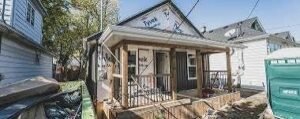
Roof sagging is difficult to detect from the ground, but it’s obvious from a good vantage point, whether it’s across the street or from the upper story of a nearby property. If you can see a ridge line or roof deck sagging visibly, it may be due to undersized rafters, water damage weakening the structure or, over time, the structure has been subjected to loads it was not originally designed to carry, such as heavy snow.
Doors and windows sticking throughout a house, rather than just one or two, often get shrugged off as normal wear when it’s actually a structural symptom. If you start to notice several doors on the same floor sticking at roughly the same time, and new cracking nearby, this is a pattern that suggests the house’s frame is shifting rather than the doors swelling from humidity.
Recent renovation history is another factor worth weighing when deciding whether to call in an engineer. Homes that have had a wall removed, an addition built or a deck attached without permits or engineering review carry more uncertainty than homes with a documented, permitted renovation history. When a structural engineer looks at an undocumented older modification he can tell that it was done safely, or mark it as something that needs to be corrected.
Anyone looking into options for a Burlington Structural Engineer should ask what the assessment includes, before booking. Some inspections might be a visual walkthrough with a written summary, and some might include measurements, photo documentation and specific repair recommendations that a contractor can use directly. Being aware of the level of detail included prevents you from paying for a report that doesn’t actually answer the question that prompted the call.
The earlier you act on these signs, the lesser they tend to cost. A foundation crack that is detected and monitored early on may only require some periodic observation, while that same crack left unattended for several years can lead to a repair that requires underpinning or wall reconstruction — a difference that can often run into tens of thousands of dollars depending on the extent of the damage.
Conclusion
Recognizing these warnings is usually straightforward once a homeowner knows what to look for, but whether something is cosmetic or serious usually requires a trained eye, not a guess. It’s cheaper and less stressful to get a professional opinion early, before a minor crack turns into a structural repair that can’t be ignored.