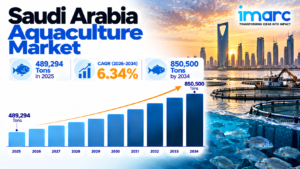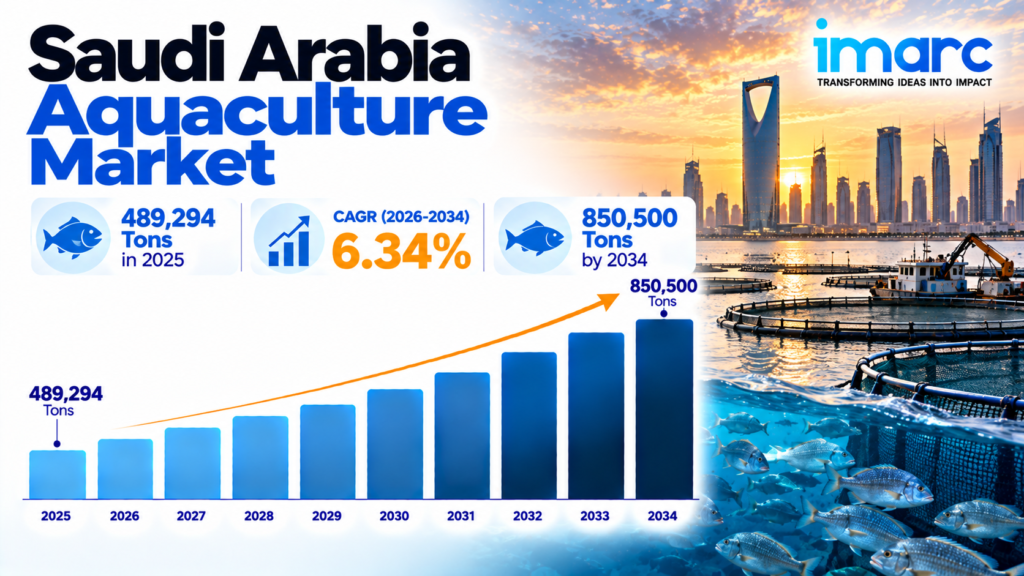
IMARC Group, a leading global market research and management consulting firm, has published its latest market intelligence report on the Saudi Arabia aquaculture market. The Saudi Arabia aquaculture market size increased from 489,294 Tons in 2025 to 520,315 Tons in 2026 and is projected to reach 850,500 Tons by 2034, exhibiting a CAGR of 6.34% during 2026-2034, driven by Vision 2030’s food security and economic diversification objectives, government-backed infrastructure investment, and rising consumer demand for protein-rich seafood.
The market is riding sustained structural momentum as the Kingdom transforms its aquaculture landscape from seafood-import dependency into export-oriented self-sufficiency. Government investment, public-private partnerships, and advanced technology adoption, including recirculating aquaculture systems (RAS) and biofloc technology, are widening the addressable market across coastal and desert-based inland production zones. Consumption dominates the fish type mix, Fresh Water leads the farming environment, and Traditional Retail anchors distribution, while the Kingdom’s 2,600-kilometer coastline along the Red Sea and Arabian Gulf, together with inland RAS facilities in Riyadh, Tabuk, and Jazan, create an aquaculture base built for scale rather than a single mega-project cycle.
Saudi Arabia Aquaculture Market at a Glance:
- Market Size (2025): 489,294 Tons
- Forecast Market Size (2034): 850,500 Tons
- CAGR (2026-2034): 6.34%
- Leading Fish Type (2025): Consumption, 46.27% share
- Leading Environment (2025): Fresh Water, 46.25% share
- Leading Distribution Channel (2025): Traditional Retail, 32.09% share
How AI is Reshaping the Future of the Saudi Arabia Aquaculture Market
- AI-Driven Farm Management and Predictive Water Quality Monitoring: IoT sensors and AI-based platforms track water temperature, dissolved oxygen, pH, and ammonia levels alongside fish behavior patterns, enabling early disease detection and optimized feeding schedules, as demonstrated by the King Abdulaziz City for Science and Technology and King Abdulaziz University trout farming initiative at KACST’s Al-Muzahmiyya research facility.
- Smart Recirculating Aquaculture Systems and Automated Water Treatment: RAS and biofloc technology combine automated biological and mechanical filtration with waste-to-resource conversion, underpinning King Abdullah University of Science and Technology’s partnership with the Ministry of Environment, Water, and Agriculture to raise domestic production from 280,000 tons in 2024 to 530,000 tons annually by 2030.
- Data-Driven Hatchery and Genetic Selection Technologies: Advanced genetic selection programs and precision feeding are enabling disease-resistant, high-yield strains, reflected in the NEOM-Tabuk Fisheries Topian Aquaculture joint venture building the MENA region’s largest hatchery, with a planned capacity of 42 million fingerlings.
Grab a sample PDF of this report: https://www.imarcgroup.com/saudi-arabia-aquaculture-market/requestsample
Saudi Arabia Aquaculture Market Trends and Drivers:
Consumer demand patterns are the single biggest structural shift in the market, with Consumption commanding 46.27% of the fish type mix in 2025 as pelagic fish, freshwater and diadromous species, crustaceans, and demersal fish serve distinct niches across residential and food service channels. Traditional Retail remains the dominant distribution channel at 32.09% share, reflecting consumer preference for fresh, locally sourced seafood from neighborhood markets and souqs, even as supermarkets, hypermarkets, and app-based delivery platforms offering two-hour delivery windows are accelerating modern retail’s share of the mix.
Saudi Arabia’s geography and climate are a structural, not incidental, challenge the industry is engineering around. The Kingdom’s 2,600-kilometer coastline along the Red Sea and Arabian Gulf anchors marine production, while Fresh Water leads the environment segment at 46.25% share as operators in Riyadh, Qassim, and Hail deploy RAS and biofloc technology to convert water-scarce desert locations into productive, year-round farming zones. Riyadh’s inland RAS cluster, paired with integrated multi-trophic aquaponics systems that combine finfish production with vegetable cultivation, is emerging as the clearest proof point of the Kingdom’s bid to geographically diversify production away from coastal disease and jurisdiction risk.
Government-backed capital is the accelerant behind both trends. Vision 2030 has elevated aquaculture to a food security priority, targeting 600,000 tons of annual seafood production by 2030, with the Saudi Agricultural Development Fund financing up to 70% of project costs through subsidized loans and extended repayment terms. Layered on top, the 2025 Saudi-Chinese Business Forum produced 57 agreements and memoranda of understanding worth SAR 14 Billion (approximately USD 3.7 Billion) spanning agriculture, food security, and industrial supply chains, while the Saudi Food and Drug Authority’s 2025 approval of Uniprotein single-cell protein for aquafeed is pulling domestic feed manufacturing and cost competitiveness into mainstream operator planning.
Government Schemes and Vision 2030 Initiatives Driving Demand:
- National Seafood Production Target: Vision 2030 targets 600,000 tons of annual seafood production, formally positioning aquaculture as a core pillar of food security and non-oil economic diversification alongside tourism and manufacturing.
- Saudi Agricultural Development Fund Financing: Subsidized financing covering up to 70% of project costs, paired with favorable interest rates, extended repayment terms, and streamlined licensing, is lowering the capital barrier to new hatchery and grow-out facility development.
- Topian Aquaculture Joint Venture (NEOM and Tabuk Fisheries): Approved by the Ministry of Environment, Water, and Agriculture in 2024, the venture is constructing the MENA region’s largest hatchery, with a planned capacity of 42 million fingerlings and marine-pen finfish production targeting 20,000 metric tons annually by 2030.
- National Salmon Production Center: Launched in December 2024, the Kingdom’s first land-based salmon operation targets 10,000 metric tons of salmon annually, with hatcheries sized for 5 million juveniles alongside an integrated aquaponics system.
- Saudi-Chinese Business Forum Agreements: Held in Beijing in 2025 and chaired by Minister of Environment, Water and Agriculture Abdulrahman AlFadley, the forum produced 57 agreements and MoUs worth SAR 14 Billion (approximately USD 3.7 Billion) spanning agriculture, food security, and supply chains.
Saudi Arabia Aquaculture Industry Segmentation:
The report has segmented the market into the following categories:
Breakup By Fish Type:
- Production
- Consumption
Consumption commands the largest fish type share at 46.27% in 2025, driven by robust domestic demand for pelagic fish, freshwater and diadromous species, crustaceans, and demersal fish across residential and commercial food service channels, with crustaceans commanding premium positioning among health-conscious consumers and export markets.
Breakup By Environment:
- Marine Water
- Fresh Water
- Brackish Water
Fresh Water leads the environment segment at 46.25% share in 2025, supported by inland farming operations across Riyadh, Qassim, and Hail that pair groundwater resources and recirculating aquaculture systems with tilapia and other freshwater species well suited to desert operating conditions.
Breakup By Distribution Channel:
- Traditional Retail
- Supermarkets and Hypermarkets
- Convenience Stores
- Online Channel
- Others
Traditional Retail dominates the distribution channel segment with a 32.09% share in 2025, anchored by neighborhood fish markets and souqs offering daily turnover, competitive pricing, and expert vendor guidance, while modern supermarket chains and app-based online delivery platforms are the fastest-growing channels as cold-chain infrastructure expands.
Competitive Landscape:
The report provides a comprehensive analysis of the competitive landscape in the Saudi Arabia aquaculture market with detailed profiles of all major companies, including:
- National Aquaculture Group (NAQUA)
- Saudi Fisheries Company (SFC)
- Arabian Shrimp Company
- Asmak Holdings
- Jazan Energy, and Development Company (Jazadco)
- Tabuk Fisheries Company
Market Concentration Analysis:
- Vertical Integration: Key players are pursuing vertical integration spanning hatcheries, grow-out facilities, feed production, and processing to strengthen margins and supply reliability
- Consolidation Trend: Strategic joint ventures and partnerships, exemplified by the NEOM-Tabuk Fisheries Topian Aquaculture venture, are accelerating scale-building across hatchery and grow-out capacity
- Capital Inflows: Government-backed financing and international partnerships, including the Saudi-Chinese Business Forum agreements, are reshaping competitive dynamics and funding expansion across the sector
What Does The Full Report Cover?
If you are tracking the Saudi Arabia aquaculture market for investment decisions, market entry planning, competitive benchmarking, or strategic advisory, IMARC Group’s report gives you everything in one place:
- Complete market sizing in volume terms with forecasts covering the full 2026-2034 projection period
- Quantified growth driver analysis with impact scoring across fish type, environment, and distribution channel
- Sub-segment breakdowns for Production and Consumption fish types, all three farming environments, and five distribution channels, each with individual share data
- Competitive profiles of leading national aquaculture operators with strategic landscape assessment
- Value chain analysis, market concentration assessment, and investment and growth opportunity mapping
- Latest technology trends covering recirculating aquaculture systems, AI-driven smart farming, premium species diversification, and Vision 2030-driven food security opportunities shaping market competition across the Kingdom
Recent News and Developments in Saudi Arabia Aquaculture Market
- 2025: The Saudi Food and Drug Authority approved Unibio’s Uniprotein single-cell protein for use in fish, shrimp, and crustacean feed, following an evaluation that began in April 2023, opening a new domestic feed input to the Saudi aquafeed market.
- December 2024: Saudi Arabia launched a national salmon production center targeting 10,000 metric tons of salmon annually, establishing the first land-based salmon operation in the region with hatcheries sized for 5 million juveniles and an integrated aquaponics system.
- 2024: NEOM and Tabuk Fisheries established Topian Aquaculture, a joint venture approved by the Ministry of Environment, Water, and Agriculture to build the MENA region’s largest hatchery, with marine-pen finfish production targeting 20,000 metric tons annually by 2030.
Note: If you require specific details, data, or insights that are not currently included in the scope of this report, we are happy to accommodate your request. As part of our customization service, we will gather and provide the additional information you need, tailored to your specific requirements. Please let us know your exact needs, and we will ensure the report is updated accordingly to meet your expectations.
Key Questions This Report Answers
- What is the current Saudi Arabia aquaculture market size and what is its projected value?
- Which fish type holds the largest share in the Saudi Arabia aquaculture market?
- What are the key drivers of Saudi Arabia aquaculture market growth?
- Which environment segment dominates the Saudi Arabia aquaculture market and why?
- How is Vision 2030, government financing, and rising seafood consumption reshaping production and competitive strategy in the Saudi Arabia aquaculture industry?
- Who are the top companies in the Saudi Arabia aquaculture market and what are their competitive strategies?
- What are the investment and market entry opportunities across recirculating aquaculture systems, premium species production, and aquafeed manufacturing in Saudi Arabia?
About Us
IMARC Group is a global management consulting firm that helps the world’s most ambitious changemakers to create a lasting impact. The company provides a comprehensive suite of market entry and expansion services. IMARC offerings include thorough market assessment, feasibility studies, company incorporation assistance, factory setup support, regulatory approvals and licensing navigation, branding, marketing and sales strategies, competitive landscape and benchmarking analyses, pricing and cost research, and procurement research.
Media and Sales Contact
IMARC Group
Email: sales@imarcgroup.com
United States: +1-201-971-6302
India: +91-120-433-0800
United Kingdom: +44-753-714-6104